Ute N. Gries, Zixuan Guan, Joe Kler, William C. Chueh, Roger A. De Souza
{"title":"Oxygen Surface Exchange on Stepped (100) Surfaces of Strontium Titanate","authors":"Ute N. Gries, Zixuan Guan, Joe Kler, William C. Chueh, Roger A. De Souza","doi":"10.1021/acs.jpcc.5c01338","DOIUrl":null,"url":null,"abstract":"The influence of surface steps on the rate of oxygen surface exchange was investigated for a perovskite-type oxide by means of <sup>18</sup>O<sub>2</sub>/<sup>16</sup>O<sub>2</sub> exchange. Seven vicinal (100)-oriented single-crystal samples of acceptor-doped SrTiO<sub>3</sub> with TiO<sub>2</sub>-terminated surfaces and miscut angles between 0 and 3° were used, giving a variation in step density (ρ<sub>st</sub>) of a factor of approximately 7. All samples were subjected together to a single high-temperature isotope exchange anneal (at <i>T</i> = 1023 K in <i>p</i>O<sub>2</sub> = 0.1 bar, with <i>p</i>H<sub>2</sub>O < 10<sup>–7</sup> bar) and were then analyzed by time-of-flight secondary ion mass spectrometry (ToF-SIMS). Numerical descriptions of the isotope diffusion profiles yielded the oxygen tracer diffusion coefficient for the bulk (<i>D</i>*), the oxygen isotope exchange coefficient for the surface (<i>k</i>*), and the space-charge potential at the surface (Φ<sub>0</sub>). Surprisingly, the <i>k</i>* data exhibited no increase with increasing ρ<sub>st</sub>, suggesting that surface steps do not strongly promote oxygen surface exchange in this system under these conditions. The behavior of Φ<sub>0</sub> as a function of ρ<sub>st</sub> is consistent with preferential formation of oxygen vacancies both at under-coordinated oxide-ion sites of terraces and at under-coordinated oxide-ion sites of step edges and terraces.","PeriodicalId":61,"journal":{"name":"The Journal of Physical Chemistry C","volume":"38 1","pages":""},"PeriodicalIF":3.2000,"publicationDate":"2025-04-16","publicationTypes":"Journal Article","fieldsOfStudy":null,"isOpenAccess":false,"openAccessPdf":"","citationCount":"0","resultStr":null,"platform":"Semanticscholar","paperid":null,"PeriodicalName":"The Journal of Physical Chemistry C","FirstCategoryId":"1","ListUrlMain":"https://doi.org/10.1021/acs.jpcc.5c01338","RegionNum":3,"RegionCategory":"化学","ArticlePicture":[],"TitleCN":null,"AbstractTextCN":null,"PMCID":null,"EPubDate":"","PubModel":"","JCR":"Q2","JCRName":"CHEMISTRY, PHYSICAL","Score":null,"Total":0}
引用次数: 0
Abstract
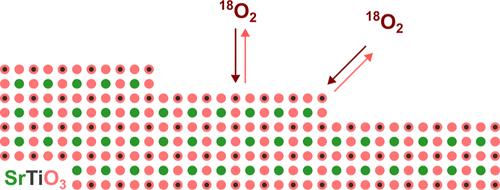
The influence of surface steps on the rate of oxygen surface exchange was investigated for a perovskite-type oxide by means of 18O2/16O2 exchange. Seven vicinal (100)-oriented single-crystal samples of acceptor-doped SrTiO3 with TiO2-terminated surfaces and miscut angles between 0 and 3° were used, giving a variation in step density (ρst) of a factor of approximately 7. All samples were subjected together to a single high-temperature isotope exchange anneal (at T = 1023 K in pO2 = 0.1 bar, with pH2O < 10–7 bar) and were then analyzed by time-of-flight secondary ion mass spectrometry (ToF-SIMS). Numerical descriptions of the isotope diffusion profiles yielded the oxygen tracer diffusion coefficient for the bulk (D*), the oxygen isotope exchange coefficient for the surface (k*), and the space-charge potential at the surface (Φ0). Surprisingly, the k* data exhibited no increase with increasing ρst, suggesting that surface steps do not strongly promote oxygen surface exchange in this system under these conditions. The behavior of Φ0 as a function of ρst is consistent with preferential formation of oxygen vacancies both at under-coordinated oxide-ion sites of terraces and at under-coordinated oxide-ion sites of step edges and terraces.
期刊介绍:
The Journal of Physical Chemistry A/B/C is devoted to reporting new and original experimental and theoretical basic research of interest to physical chemists, biophysical chemists, and chemical physicists.



 京公网安备 11010802042870号
京ICP备2023020795号-1
京公网安备 11010802042870号
京ICP备2023020795号-1

 分享
分享
 求助内容:
求助内容: 应助结果提醒方式:
 扫码关注我们
