Anastasiya A. Yazikova, Aleksandr S. Tomilov, Nikita A. Afimchenko, Igor L. Zilberberg, Anatoly R. Melnikov, Kristina A. Smirnova, Artem S. Poryvaev, Matvey V. Fedin
{"title":"Paramagnetic Gas Adsorbed in Metal–Organic Framework: A Promising Platform for Spin Qubits Design","authors":"Anastasiya A. Yazikova, Aleksandr S. Tomilov, Nikita A. Afimchenko, Igor L. Zilberberg, Anatoly R. Melnikov, Kristina A. Smirnova, Artem S. Poryvaev, Matvey V. Fedin","doi":"10.1021/acs.jpcc.5c01670","DOIUrl":null,"url":null,"abstract":"Development of viable quantum bits (qubits) is currently among the main challenges in quantum technologies. One approach to this problem that utilizes the potential of synthetic chemistry is the creation of molecular spin qubits (MSQs). Metal–organic frameworks (MOFs) are promising materials for scaling up MSQ systems while also exhibiting useful sorption properties. We report the adsorption of paramagnetic nitric oxide (NO) in MOF-808 and its modifications and for the first time propose an adsorbed “gas@MOF” concept to design MSQs. Continuous-wave electron paramagnetic resonance (CW EPR) allowed monitoring of the NO adsorption process that occurs at temperatures below 150 K and leads to immobilization of NO molecules within the MOF-808 matrix. Electron decoherence times <i>T</i><sub>m</sub> acquired by pulse EPR were found sufficiently long to perform simple spin manipulations (∼1.5 μs), which was demonstrated by a Rabi-oscillation experiment. Thus, gas molecules adsorbed in MOFs, “gas@MOF”, can act as potential spin qubits, as was exemplified by NO@MOF-808 as a proof of principle, and can be further extended to other paramagnetic gases and various MOFs.","PeriodicalId":61,"journal":{"name":"The Journal of Physical Chemistry C","volume":"58 1","pages":""},"PeriodicalIF":3.2000,"publicationDate":"2025-04-16","publicationTypes":"Journal Article","fieldsOfStudy":null,"isOpenAccess":false,"openAccessPdf":"","citationCount":"0","resultStr":null,"platform":"Semanticscholar","paperid":null,"PeriodicalName":"The Journal of Physical Chemistry C","FirstCategoryId":"1","ListUrlMain":"https://doi.org/10.1021/acs.jpcc.5c01670","RegionNum":3,"RegionCategory":"化学","ArticlePicture":[],"TitleCN":null,"AbstractTextCN":null,"PMCID":null,"EPubDate":"","PubModel":"","JCR":"Q2","JCRName":"CHEMISTRY, PHYSICAL","Score":null,"Total":0}
引用次数: 0
Abstract
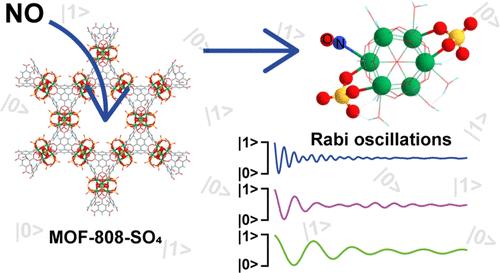
Development of viable quantum bits (qubits) is currently among the main challenges in quantum technologies. One approach to this problem that utilizes the potential of synthetic chemistry is the creation of molecular spin qubits (MSQs). Metal–organic frameworks (MOFs) are promising materials for scaling up MSQ systems while also exhibiting useful sorption properties. We report the adsorption of paramagnetic nitric oxide (NO) in MOF-808 and its modifications and for the first time propose an adsorbed “gas@MOF” concept to design MSQs. Continuous-wave electron paramagnetic resonance (CW EPR) allowed monitoring of the NO adsorption process that occurs at temperatures below 150 K and leads to immobilization of NO molecules within the MOF-808 matrix. Electron decoherence times Tm acquired by pulse EPR were found sufficiently long to perform simple spin manipulations (∼1.5 μs), which was demonstrated by a Rabi-oscillation experiment. Thus, gas molecules adsorbed in MOFs, “gas@MOF”, can act as potential spin qubits, as was exemplified by NO@MOF-808 as a proof of principle, and can be further extended to other paramagnetic gases and various MOFs.
期刊介绍:
The Journal of Physical Chemistry A/B/C is devoted to reporting new and original experimental and theoretical basic research of interest to physical chemists, biophysical chemists, and chemical physicists.




 京公网安备 11010802042870号
京ICP备2023020795号-1
京公网安备 11010802042870号
京ICP备2023020795号-1

 分享
分享
 求助内容:
求助内容: 应助结果提醒方式:
 扫码关注我们
