{"title":"A theoretical study on synergistic tuning of graphene phonons via heteroatom modifications†","authors":"Shuang Li, Lifeng Zhang, Langli Luo and Xing Chen","doi":"10.1039/D5CP00791G","DOIUrl":null,"url":null,"abstract":"<p >This study systematically investigates the effects of nitrogen doping, gold atom cluster loading, and their synergistic influence on the phonon dispersion relations and electronic structure of graphene, based on density-functional theory calculations. Gold atom loading induces significant changes in the low-frequency phonon modes of graphene, and affects the electronic density of states near the Fermi level, indicating strong interactions between gold d-orbitals and graphene's π-orbitals. Nitrogen doping increases the complexity of the phonon spectrum by introducing high-frequency phonon modes and modifying the electronic structure. The synergistic effect of nitrogen doping and gold atom loading results in even more intricate modifications, characterized by the emergence of low-energy phonon modes, reflecting a profound impact on both the electronic and vibrational properties of graphene. Additionally, we compare the experimental electron energy loss spectrum of single Au atom loading on graphene with the simulated spectrum, revealing a good match between them. These findings provide a theoretical basis for designing graphene-based materials with tailored properties for applications in electronic devices and catalysis, suggesting that precise regulation of these properties can be achieved through controlled doping and metal atom loading.</p>","PeriodicalId":99,"journal":{"name":"Physical Chemistry Chemical Physics","volume":" 20","pages":" 10540-10547"},"PeriodicalIF":2.9000,"publicationDate":"2025-04-17","publicationTypes":"Journal Article","fieldsOfStudy":null,"isOpenAccess":false,"openAccessPdf":"","citationCount":"0","resultStr":null,"platform":"Semanticscholar","paperid":null,"PeriodicalName":"Physical Chemistry Chemical Physics","FirstCategoryId":"92","ListUrlMain":"https://pubs.rsc.org/en/content/articlelanding/2025/cp/d5cp00791g","RegionNum":3,"RegionCategory":"化学","ArticlePicture":[],"TitleCN":null,"AbstractTextCN":null,"PMCID":null,"EPubDate":"","PubModel":"","JCR":"Q3","JCRName":"CHEMISTRY, PHYSICAL","Score":null,"Total":0}
引用次数: 0
Abstract
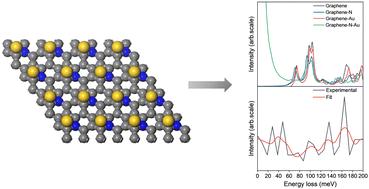
This study systematically investigates the effects of nitrogen doping, gold atom cluster loading, and their synergistic influence on the phonon dispersion relations and electronic structure of graphene, based on density-functional theory calculations. Gold atom loading induces significant changes in the low-frequency phonon modes of graphene, and affects the electronic density of states near the Fermi level, indicating strong interactions between gold d-orbitals and graphene's π-orbitals. Nitrogen doping increases the complexity of the phonon spectrum by introducing high-frequency phonon modes and modifying the electronic structure. The synergistic effect of nitrogen doping and gold atom loading results in even more intricate modifications, characterized by the emergence of low-energy phonon modes, reflecting a profound impact on both the electronic and vibrational properties of graphene. Additionally, we compare the experimental electron energy loss spectrum of single Au atom loading on graphene with the simulated spectrum, revealing a good match between them. These findings provide a theoretical basis for designing graphene-based materials with tailored properties for applications in electronic devices and catalysis, suggesting that precise regulation of these properties can be achieved through controlled doping and metal atom loading.
期刊介绍:
Physical Chemistry Chemical Physics (PCCP) is an international journal co-owned by 19 physical chemistry and physics societies from around the world. This journal publishes original, cutting-edge research in physical chemistry, chemical physics and biophysical chemistry. To be suitable for publication in PCCP, articles must include significant innovation and/or insight into physical chemistry; this is the most important criterion that reviewers and Editors will judge against when evaluating submissions.
The journal has a broad scope and welcomes contributions spanning experiment, theory, computation and data science. Topical coverage includes spectroscopy, dynamics, kinetics, statistical mechanics, thermodynamics, electrochemistry, catalysis, surface science, quantum mechanics, quantum computing and machine learning. Interdisciplinary research areas such as polymers and soft matter, materials, nanoscience, energy, surfaces/interfaces, and biophysical chemistry are welcomed if they demonstrate significant innovation and/or insight into physical chemistry. Joined experimental/theoretical studies are particularly appreciated when complementary and based on up-to-date approaches.




 京公网安备 11010802042870号
京ICP备2023020795号-1
京公网安备 11010802042870号
京ICP备2023020795号-1

 分享
分享
 求助内容:
求助内容: 应助结果提醒方式:
 扫码关注我们
