Guillaume Benas, Sofia De Sousa Coutinho, Brigitte Leridon and Fabio Finocchi
{"title":"Clean and hydrated low-index Rb2Ti2O5 surfaces†","authors":"Guillaume Benas, Sofia De Sousa Coutinho, Brigitte Leridon and Fabio Finocchi","doi":"10.1039/D4CP04441J","DOIUrl":null,"url":null,"abstract":"<p >Despite the remarkable dielectric properties of Rb<small><sub>2</sub></small>Ti<small><sub>2</sub></small>O<small><sub>5</sub></small> upon exposure to a humid atmosphere, its surfaces are still poorly known, to date. Here we study the atomic-scale structure of the clean (100), (010) and (001) surfaces, and the onset of water adsorption <em>via</em> density functional theory. Among them, the clean (001) surface has a very low surface energy, much smaller than most terminations of other perovskites or titania. Rb<small><sub>2</sub></small>Ti<small><sub>2</sub></small>O<small><sub>5</sub></small> (001) is also very reactive towards water, which adsorbs as a molecule, forming regular water arrays on the surface. From the calculations, we conclude that Rb<small><sub>2</sub></small>Ti<small><sub>2</sub></small>O<small><sub>5</sub></small> could very easily cleave under ambient conditions, forming (001) planes with ordered adsorbed water and almost null surface stress. Although Rb<small><sub>2</sub></small>Ti<small><sub>2</sub></small>O<small><sub>5</sub></small> is a three-dimensional crystal, it behaves in this respect as a two-dimensional compound, such as graphite or layered perovskites.</p>","PeriodicalId":99,"journal":{"name":"Physical Chemistry Chemical Physics","volume":" 18","pages":" 9537-9548"},"PeriodicalIF":2.9000,"publicationDate":"2025-04-17","publicationTypes":"Journal Article","fieldsOfStudy":null,"isOpenAccess":false,"openAccessPdf":"","citationCount":"0","resultStr":null,"platform":"Semanticscholar","paperid":null,"PeriodicalName":"Physical Chemistry Chemical Physics","FirstCategoryId":"92","ListUrlMain":"https://pubs.rsc.org/en/content/articlelanding/2025/cp/d4cp04441j","RegionNum":3,"RegionCategory":"化学","ArticlePicture":[],"TitleCN":null,"AbstractTextCN":null,"PMCID":null,"EPubDate":"","PubModel":"","JCR":"Q3","JCRName":"CHEMISTRY, PHYSICAL","Score":null,"Total":0}
引用次数: 0
Abstract
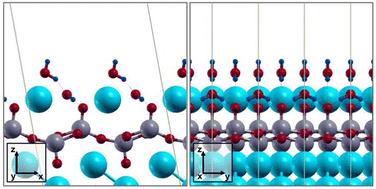
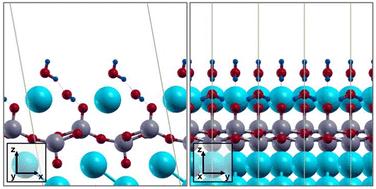
Despite the remarkable dielectric properties of Rb2Ti2O5 upon exposure to a humid atmosphere, its surfaces are still poorly known, to date. Here we study the atomic-scale structure of the clean (100), (010) and (001) surfaces, and the onset of water adsorption via density functional theory. Among them, the clean (001) surface has a very low surface energy, much smaller than most terminations of other perovskites or titania. Rb2Ti2O5 (001) is also very reactive towards water, which adsorbs as a molecule, forming regular water arrays on the surface. From the calculations, we conclude that Rb2Ti2O5 could very easily cleave under ambient conditions, forming (001) planes with ordered adsorbed water and almost null surface stress. Although Rb2Ti2O5 is a three-dimensional crystal, it behaves in this respect as a two-dimensional compound, such as graphite or layered perovskites.
期刊介绍:
Physical Chemistry Chemical Physics (PCCP) is an international journal co-owned by 19 physical chemistry and physics societies from around the world. This journal publishes original, cutting-edge research in physical chemistry, chemical physics and biophysical chemistry. To be suitable for publication in PCCP, articles must include significant innovation and/or insight into physical chemistry; this is the most important criterion that reviewers and Editors will judge against when evaluating submissions.
The journal has a broad scope and welcomes contributions spanning experiment, theory, computation and data science. Topical coverage includes spectroscopy, dynamics, kinetics, statistical mechanics, thermodynamics, electrochemistry, catalysis, surface science, quantum mechanics, quantum computing and machine learning. Interdisciplinary research areas such as polymers and soft matter, materials, nanoscience, energy, surfaces/interfaces, and biophysical chemistry are welcomed if they demonstrate significant innovation and/or insight into physical chemistry. Joined experimental/theoretical studies are particularly appreciated when complementary and based on up-to-date approaches.




 京公网安备 11010802042870号
京ICP备2023020795号-1
京公网安备 11010802042870号
京ICP备2023020795号-1

 分享
分享
 求助内容:
求助内容: 应助结果提醒方式:
 扫码关注我们
