Enhancing Near-Infrared Absorption by Modulation the Intermediate Band of Cu–Fe–S Semiconductors for Boosting Photocatalytic Hydrogenation of Nitroarenes
{"title":"Enhancing Near-Infrared Absorption by Modulation the Intermediate Band of Cu–Fe–S Semiconductors for Boosting Photocatalytic Hydrogenation of Nitroarenes","authors":"Feifan Chen, Haixia Liu, Qun Ji, Lijun Hu, Ming-Gang Ju, Fang Cheng, Xue-Jun Wu","doi":"10.1021/acs.chemmater.4c03131","DOIUrl":null,"url":null,"abstract":"The trade-off between maximizing light harvesting efficiency and maintaining high photoredox potentials is still a persistent and fundamental challenge in the field of photocatalysis. Intermediate band semiconductors (IBSCs) offer a promising approach to address the challenge by introducing an additional energy level within the bandgap, enabling simultaneous absorption of low- and high-energy photons while preserving strong redox capabilities. Herein, three kinds of Cu–Fe–S IBSC nanocrystals, i.e., Cu<sub>5</sub>FeS<sub>4</sub> nanodisks (NDs), CuFeS<sub>2</sub> NDs, and CuFeS<sub>2</sub> octahedrons (Octas), have been controllably synthesized and they exhibit full spectral absorption capability, especially in the near-infrared (NIR) region extending to a wavelength of over 2500 nm. Notably, the Fe content-dependent NIR absorption enhancement has been revealed, originating from the modulation of the IB position within the band, as confirmed by theoretical calculation. These IBSCs can achieve NIR and full-spectrum photocatalytic transformation of 3-nitrostyrene to 3-vinylaniline with excellent conversion and selectivity and also possess broad applicability for various nitrobenzene derivatives. Under full-spectrum irradiation, CuFeS<sub>2</sub> Octas exhibit a turnover frequency of up to 13.0 h<sup>–1</sup>, surpassing most reported nonprecious metal-based photo- and thermocatalysts. This study provides insights into the design of the IBSCs with optimal absorption capability and photoredox potentials, further enhancing the performance of the IBSC-based photocatalysts.","PeriodicalId":33,"journal":{"name":"Chemistry of Materials","volume":"23 1","pages":""},"PeriodicalIF":7.0000,"publicationDate":"2025-04-17","publicationTypes":"Journal Article","fieldsOfStudy":null,"isOpenAccess":false,"openAccessPdf":"","citationCount":"0","resultStr":null,"platform":"Semanticscholar","paperid":null,"PeriodicalName":"Chemistry of Materials","FirstCategoryId":"88","ListUrlMain":"https://doi.org/10.1021/acs.chemmater.4c03131","RegionNum":2,"RegionCategory":"材料科学","ArticlePicture":[],"TitleCN":null,"AbstractTextCN":null,"PMCID":null,"EPubDate":"","PubModel":"","JCR":"Q2","JCRName":"CHEMISTRY, PHYSICAL","Score":null,"Total":0}
引用次数: 0
Abstract
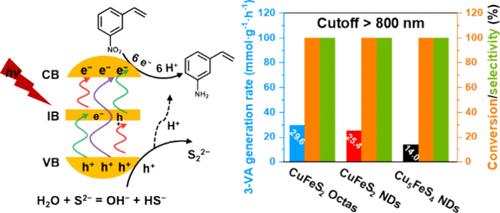
The trade-off between maximizing light harvesting efficiency and maintaining high photoredox potentials is still a persistent and fundamental challenge in the field of photocatalysis. Intermediate band semiconductors (IBSCs) offer a promising approach to address the challenge by introducing an additional energy level within the bandgap, enabling simultaneous absorption of low- and high-energy photons while preserving strong redox capabilities. Herein, three kinds of Cu–Fe–S IBSC nanocrystals, i.e., Cu5FeS4 nanodisks (NDs), CuFeS2 NDs, and CuFeS2 octahedrons (Octas), have been controllably synthesized and they exhibit full spectral absorption capability, especially in the near-infrared (NIR) region extending to a wavelength of over 2500 nm. Notably, the Fe content-dependent NIR absorption enhancement has been revealed, originating from the modulation of the IB position within the band, as confirmed by theoretical calculation. These IBSCs can achieve NIR and full-spectrum photocatalytic transformation of 3-nitrostyrene to 3-vinylaniline with excellent conversion and selectivity and also possess broad applicability for various nitrobenzene derivatives. Under full-spectrum irradiation, CuFeS2 Octas exhibit a turnover frequency of up to 13.0 h–1, surpassing most reported nonprecious metal-based photo- and thermocatalysts. This study provides insights into the design of the IBSCs with optimal absorption capability and photoredox potentials, further enhancing the performance of the IBSC-based photocatalysts.
期刊介绍:
The journal Chemistry of Materials focuses on publishing original research at the intersection of materials science and chemistry. The studies published in the journal involve chemistry as a prominent component and explore topics such as the design, synthesis, characterization, processing, understanding, and application of functional or potentially functional materials. The journal covers various areas of interest, including inorganic and organic solid-state chemistry, nanomaterials, biomaterials, thin films and polymers, and composite/hybrid materials. The journal particularly seeks papers that highlight the creation or development of innovative materials with novel optical, electrical, magnetic, catalytic, or mechanical properties. It is essential that manuscripts on these topics have a primary focus on the chemistry of materials and represent a significant advancement compared to prior research. Before external reviews are sought, submitted manuscripts undergo a review process by a minimum of two editors to ensure their appropriateness for the journal and the presence of sufficient evidence of a significant advance that will be of broad interest to the materials chemistry community.



 京公网安备 11010802042870号
京ICP备2023020795号-1
京公网安备 11010802042870号
京ICP备2023020795号-1

 分享
分享
 求助内容:
求助内容: 应助结果提醒方式:
 扫码关注我们
