Juan Yu, Ming Li, Xuan Kong, Tian Wang, Hao Zhang, Xiaojie Zhu, Junkai Zhao, Zhiyuan Ma and Hongying Yang
{"title":"Polyanion hydrogel electrolyte with a high Zn2+ transference number for dendrite-free aqueous zinc-ion batteries†","authors":"Juan Yu, Ming Li, Xuan Kong, Tian Wang, Hao Zhang, Xiaojie Zhu, Junkai Zhao, Zhiyuan Ma and Hongying Yang","doi":"10.1039/D5TA00819K","DOIUrl":null,"url":null,"abstract":"<p >Aqueous zinc-ion batteries have attracted great attention due to their advantages in energy storage. However, the existence of dendrites and a series of side reactions during the charge and discharge process hinder their further development. In this paper, a polyanionic hydrogel electrolyte (PMZA) based on 2-acrylamide-2-methylpropanesulfonic acid and polyvinyl alcohol (PVA) was designed and synthesized by free radical polymerization and the Hofmeister effect. It has excellent tensile properties (0.14 MPa). It also exhibits an excellent ionic conductivity of 71.17 mS cm<small><sup>−1</sup></small> and an ultra-high ion transference number of 0.912. The Zn//Zn symmetric cell achieves stable cycling for 2100 h while suppressing dendrites and side reactions. The assembled Zn//NVO has a high specific capacity of 164 mA h g<small><sup>−1</sup></small> at a load of 5 A g<small><sup>−1</sup></small> and a cycle life of over 7000 cycles with a capacity retention rate of 100%. This is due to the synergistic interaction between the large number of –SO<small><sub>3</sub></small><small><sup>−</sup></small>, –CONH–, and –OH functional groups contained in PMZA, which constructs a fast cation channel, inhibits the diffusion of SO<small><sub>4</sub></small><small><sup>2−</sup></small> to the anode side, realizes abundant zinc–philic bonding sites, fast Zn<small><sup>2+</sup></small> transport kinetics and efficient desolvation, and effectively curbs dendrites and other side reactions. This work provides a new solution for the development of high-performance gel electrolytes.</p>","PeriodicalId":82,"journal":{"name":"Journal of Materials Chemistry A","volume":" 21","pages":" 16182-16192"},"PeriodicalIF":9.5000,"publicationDate":"2025-04-17","publicationTypes":"Journal Article","fieldsOfStudy":null,"isOpenAccess":false,"openAccessPdf":"","citationCount":"0","resultStr":null,"platform":"Semanticscholar","paperid":null,"PeriodicalName":"Journal of Materials Chemistry A","FirstCategoryId":"88","ListUrlMain":"https://pubs.rsc.org/en/content/articlelanding/2025/ta/d5ta00819k","RegionNum":2,"RegionCategory":"材料科学","ArticlePicture":[],"TitleCN":null,"AbstractTextCN":null,"PMCID":null,"EPubDate":"","PubModel":"","JCR":"Q1","JCRName":"CHEMISTRY, PHYSICAL","Score":null,"Total":0}
引用次数: 0
Abstract
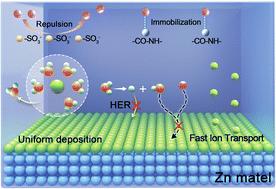
Aqueous zinc-ion batteries have attracted great attention due to their advantages in energy storage. However, the existence of dendrites and a series of side reactions during the charge and discharge process hinder their further development. In this paper, a polyanionic hydrogel electrolyte (PMZA) based on 2-acrylamide-2-methylpropanesulfonic acid and polyvinyl alcohol (PVA) was designed and synthesized by free radical polymerization and the Hofmeister effect. It has excellent tensile properties (0.14 MPa). It also exhibits an excellent ionic conductivity of 71.17 mS cm−1 and an ultra-high ion transference number of 0.912. The Zn//Zn symmetric cell achieves stable cycling for 2100 h while suppressing dendrites and side reactions. The assembled Zn//NVO has a high specific capacity of 164 mA h g−1 at a load of 5 A g−1 and a cycle life of over 7000 cycles with a capacity retention rate of 100%. This is due to the synergistic interaction between the large number of –SO3−, –CONH–, and –OH functional groups contained in PMZA, which constructs a fast cation channel, inhibits the diffusion of SO42− to the anode side, realizes abundant zinc–philic bonding sites, fast Zn2+ transport kinetics and efficient desolvation, and effectively curbs dendrites and other side reactions. This work provides a new solution for the development of high-performance gel electrolytes.
锌离子水电池因其储能方面的优势而备受关注。然而,在充放电过程中枝晶的存在和一系列副反应阻碍了它们的进一步发展。采用自由基聚合和Hofmeister效应,设计并合成了以2-丙烯酰胺-2-甲基丙磺酸和聚乙烯醇为原料的聚阴离子水凝胶电解质(PMZA)。具有优异的拉伸性能(0.14 MPa)。离子电导率为71.17 mS cm-1,离子转移数为0.912。在抑制树突和副反应的同时,锌/锌对称电池实现了2100 h的稳定循环。组装后的Zn//NVO在5 a g-1负载下具有164 mAh g-1的高比容量,循环寿命超过7000次,容量保持率为100%。这是由于PMZA中含有大量的- so3 -、- co - nh3 -和- oh官能团之间的协同作用,构建了快速阳离子通道,抑制了SO42-向阳极侧的扩散,实现了丰富的亲锌键位、快速的Zn2+输运动力学和高效的脱溶,有效地抑制了枝晶等副反应。这项工作为高性能凝胶电解质的开发提供了新的解决方案。
期刊介绍:
The Journal of Materials Chemistry A, B & C covers a wide range of high-quality studies in the field of materials chemistry, with each section focusing on specific applications of the materials studied. Journal of Materials Chemistry A emphasizes applications in energy and sustainability, including topics such as artificial photosynthesis, batteries, and fuel cells. Journal of Materials Chemistry B focuses on applications in biology and medicine, while Journal of Materials Chemistry C covers applications in optical, magnetic, and electronic devices. Example topic areas within the scope of Journal of Materials Chemistry A include catalysis, green/sustainable materials, sensors, and water treatment, among others.



 京公网安备 11010802042870号
京ICP备2023020795号-1
京公网安备 11010802042870号
京ICP备2023020795号-1

 分享
分享
 求助内容:
求助内容: 应助结果提醒方式:
 扫码关注我们
