Jesus Guillen Campos, Minwook Park, Yuhang Wu, Sara Sandlass, Egor M. Novikov, Sophia J. Bailey, Michael Gordon, Tatiana V. Timofeeva and Javier Read de Alaniz
{"title":"Synthesis of photoresponsive liquid crystal elastomers: a general chemical approach†","authors":"Jesus Guillen Campos, Minwook Park, Yuhang Wu, Sara Sandlass, Egor M. Novikov, Sophia J. Bailey, Michael Gordon, Tatiana V. Timofeeva and Javier Read de Alaniz","doi":"10.1039/D5TA01043H","DOIUrl":null,"url":null,"abstract":"<p >Liquid crystal elastomers represent a versatile class of polymer materials with potential applications in soft robotics, adhesives, and smart materials. The integration of photoresponsive molecules into LCEs enables spatiotemporal control, wavelength-selective actuation and remote operations, expanding their application space. However, the incorporation of sensitive photoresponsive molecules is often hindered by the chemical methods and processing conditions required for the LCE fabrication. In this work, we introduce a general strategy for covalent incorporation of photoresponsive moieties into LCEs through Diels–Alder chemistry utilizing late-stage functionalization. This approach facilitates the retention of material alignment and thermomechanical properties, while enabling the functionalization of thick, aligned polysiloxane elastomers. A wide range of photoresponsive molecules, including azobenzenes, spiropyrans, cyanine dyes, and donor–acceptor Stenhouse adducts, were successfully integrated, demonstrating this method's versatility. Furthermore, we leverage the reversible nature of Diels–Alder conjugation to achieve on-demand editing and exchange of photoresponsive moieties within a single LCE, allowing for dynamic tuning of material properties. This platform offers a scalable and efficient route for developing multifunctional LCEs, providing new opportunities for advanced stimuli-responsive materials and broadening the scope of applications across various fields.</p>","PeriodicalId":82,"journal":{"name":"Journal of Materials Chemistry A","volume":" 21","pages":" 15773-15781"},"PeriodicalIF":9.5000,"publicationDate":"2025-04-17","publicationTypes":"Journal Article","fieldsOfStudy":null,"isOpenAccess":false,"openAccessPdf":"","citationCount":"0","resultStr":null,"platform":"Semanticscholar","paperid":null,"PeriodicalName":"Journal of Materials Chemistry A","FirstCategoryId":"88","ListUrlMain":"https://pubs.rsc.org/en/content/articlelanding/2025/ta/d5ta01043h","RegionNum":2,"RegionCategory":"材料科学","ArticlePicture":[],"TitleCN":null,"AbstractTextCN":null,"PMCID":null,"EPubDate":"","PubModel":"","JCR":"Q1","JCRName":"CHEMISTRY, PHYSICAL","Score":null,"Total":0}
引用次数: 0
Abstract
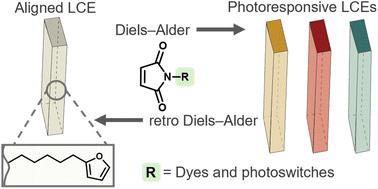
Liquid crystal elastomers represent a versatile class of polymer materials with potential applications in soft robotics, adhesives, and smart materials. The integration of photoresponsive molecules into LCEs enables spatiotemporal control, wavelength-selective actuation and remote operations, expanding their application space. However, the incorporation of sensitive photoresponsive molecules is often hindered by the chemical methods and processing conditions required for the LCE fabrication. In this work, we introduce a general strategy for covalent incorporation of photoresponsive moieties into LCEs through Diels–Alder chemistry utilizing late-stage functionalization. This approach facilitates the retention of material alignment and thermomechanical properties, while enabling the functionalization of thick, aligned polysiloxane elastomers. A wide range of photoresponsive molecules, including azobenzenes, spiropyrans, cyanine dyes, and donor–acceptor Stenhouse adducts, were successfully integrated, demonstrating this method's versatility. Furthermore, we leverage the reversible nature of Diels–Alder conjugation to achieve on-demand editing and exchange of photoresponsive moieties within a single LCE, allowing for dynamic tuning of material properties. This platform offers a scalable and efficient route for developing multifunctional LCEs, providing new opportunities for advanced stimuli-responsive materials and broadening the scope of applications across various fields.
期刊介绍:
The Journal of Materials Chemistry A, B & C covers a wide range of high-quality studies in the field of materials chemistry, with each section focusing on specific applications of the materials studied. Journal of Materials Chemistry A emphasizes applications in energy and sustainability, including topics such as artificial photosynthesis, batteries, and fuel cells. Journal of Materials Chemistry B focuses on applications in biology and medicine, while Journal of Materials Chemistry C covers applications in optical, magnetic, and electronic devices. Example topic areas within the scope of Journal of Materials Chemistry A include catalysis, green/sustainable materials, sensors, and water treatment, among others.



 京公网安备 11010802042870号
京ICP备2023020795号-1
京公网安备 11010802042870号
京ICP备2023020795号-1

 分享
分享
 求助内容:
求助内容: 应助结果提醒方式:
 扫码关注我们
