Leonardo F. Saraiva, Airton G. Bispo-Jr., André L. Costa, Fernando A. Sigoli, Sergio A. M. Lima, Ana M. Pires
{"title":"Dimensionality Reduction Expands the Frontiers of Lanthanide Luminescence Thermometry Beyond Single-Parametric Thermal Sensing","authors":"Leonardo F. Saraiva, Airton G. Bispo-Jr., André L. Costa, Fernando A. Sigoli, Sergio A. M. Lima, Ana M. Pires","doi":"10.1021/acs.chemmater.4c03173","DOIUrl":null,"url":null,"abstract":"Luminescent thermometers (LThs) are particularly suitable for monitoring submicron-scale thermal changes, spurring substantial advances in the field. Compared with the efforts to maximize the performance of LThs by designing novel materials, few advances have been made at the methodological level to exploit classical thermometric essays. Such a viewpoint motivated this study, which sought to combine data analysis algorithms with multiple thermometric parameters to introduce an advanced perspective on postprocessing data methodologies. Specifically, three distinct dimensionality reduction (DR) algorithms were employed: multiple linear regression (MLR), non-negative matrix factorization (NMF), and kernel principal component analysis (k-PCA). These methods were applied to the proof-of-concept SrY<sub>2</sub>O<sub>4</sub>:Tb<sup>III/IV</sup>,Eu<sup>III</sup> phosphor using the thermal dependence of the thermally coupled levels of Eu<sup>III</sup> (Δ) and the <sup>5</sup>D<sub>0</sub> lifetime (τ). Compared to traditional fitting and integration analyses, the DR approach provided enhanced thermometric performance, achieving a sensitivity increase from 0.897% K<sup>–1</sup> (using Δ) to 3.68% K<sup>–1</sup> (using k-PCA) and reducing temperature uncertainty below 0.03 K (k-PCA). By moving beyond single parametric thermal sensing with DR, these outcomes enable us to push the limits of luminescence thermometry toward unexplored pathways.","PeriodicalId":33,"journal":{"name":"Chemistry of Materials","volume":"38 1","pages":""},"PeriodicalIF":7.0000,"publicationDate":"2025-04-16","publicationTypes":"Journal Article","fieldsOfStudy":null,"isOpenAccess":false,"openAccessPdf":"","citationCount":"0","resultStr":null,"platform":"Semanticscholar","paperid":null,"PeriodicalName":"Chemistry of Materials","FirstCategoryId":"88","ListUrlMain":"https://doi.org/10.1021/acs.chemmater.4c03173","RegionNum":2,"RegionCategory":"材料科学","ArticlePicture":[],"TitleCN":null,"AbstractTextCN":null,"PMCID":null,"EPubDate":"","PubModel":"","JCR":"Q2","JCRName":"CHEMISTRY, PHYSICAL","Score":null,"Total":0}
引用次数: 0
Abstract
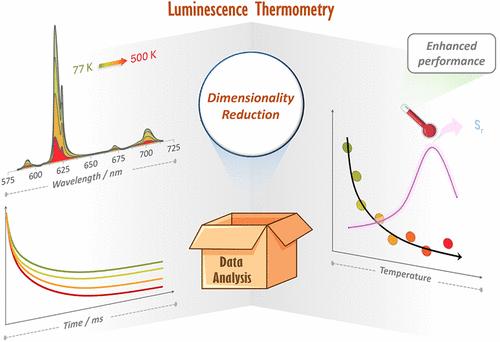
Luminescent thermometers (LThs) are particularly suitable for monitoring submicron-scale thermal changes, spurring substantial advances in the field. Compared with the efforts to maximize the performance of LThs by designing novel materials, few advances have been made at the methodological level to exploit classical thermometric essays. Such a viewpoint motivated this study, which sought to combine data analysis algorithms with multiple thermometric parameters to introduce an advanced perspective on postprocessing data methodologies. Specifically, three distinct dimensionality reduction (DR) algorithms were employed: multiple linear regression (MLR), non-negative matrix factorization (NMF), and kernel principal component analysis (k-PCA). These methods were applied to the proof-of-concept SrY2O4:TbIII/IV,EuIII phosphor using the thermal dependence of the thermally coupled levels of EuIII (Δ) and the 5D0 lifetime (τ). Compared to traditional fitting and integration analyses, the DR approach provided enhanced thermometric performance, achieving a sensitivity increase from 0.897% K–1 (using Δ) to 3.68% K–1 (using k-PCA) and reducing temperature uncertainty below 0.03 K (k-PCA). By moving beyond single parametric thermal sensing with DR, these outcomes enable us to push the limits of luminescence thermometry toward unexplored pathways.
发光温度计(LThs)特别适用于监测亚微米尺度的热变化,促进了该领域的实质性进展。与通过设计新材料来最大化LThs性能的努力相比,在方法层面上利用经典的温度测量论文取得的进展很少。这样的观点激发了本研究,该研究试图将数据分析算法与多个温度参数相结合,以引入对后处理数据方法的先进观点。具体而言,采用了三种不同的降维算法:多元线性回归(MLR)、非负矩阵分解(NMF)和核主成分分析(k-PCA)。利用EuIII的热耦合水平(Δ)和5D0寿命(τ)的热依赖性,将这些方法应用于概念验证SrY2O4:TbIII/IV,EuIII荧光粉。与传统的拟合和积分分析相比,DR方法提供了更强的测温性能,将灵敏度从0.87% K - 1(使用Δ)提高到3.68% K - 1(使用K - pca),并将温度不确定性降低到0.03 K (K - pca)以下。通过超越DR的单参数热传感,这些结果使我们能够将发光测温的极限推向未探索的途径。
期刊介绍:
The journal Chemistry of Materials focuses on publishing original research at the intersection of materials science and chemistry. The studies published in the journal involve chemistry as a prominent component and explore topics such as the design, synthesis, characterization, processing, understanding, and application of functional or potentially functional materials. The journal covers various areas of interest, including inorganic and organic solid-state chemistry, nanomaterials, biomaterials, thin films and polymers, and composite/hybrid materials. The journal particularly seeks papers that highlight the creation or development of innovative materials with novel optical, electrical, magnetic, catalytic, or mechanical properties. It is essential that manuscripts on these topics have a primary focus on the chemistry of materials and represent a significant advancement compared to prior research. Before external reviews are sought, submitted manuscripts undergo a review process by a minimum of two editors to ensure their appropriateness for the journal and the presence of sufficient evidence of a significant advance that will be of broad interest to the materials chemistry community.



 京公网安备 11010802042870号
京ICP备2023020795号-1
京公网安备 11010802042870号
京ICP备2023020795号-1

 分享
分享
 求助内容:
求助内容: 应助结果提醒方式:
 扫码关注我们
