{"title":"Impact of charging in constant potential electrochemistry modelling","authors":"Henrik H. Kristoffersen","doi":"10.1016/j.jcat.2025.116148","DOIUrl":null,"url":null,"abstract":"<div><div>A huge issue in computational electrochemistry is that different modelling approaches, used to study electron transfer reactions, give different results that cannot easily be reconciled with each other. Modeling approaches differ in their handling of interface charging and employed electrolyte model. I study charging of electrolyte-Cu(111) interfaces with electrons and cations (or positive continuum charge) and observe that charging energies (i.e. the energy stabilization from charging the interface with one extra electron and thereby going from one potential to another) depend strongly on the electrolyte model. When the electrolyte is a film containing water molecules, there is a significant stabilization of the energy with more negative potential. This is in contrast to the charging of an interface with implicit solvent, where charge repulsion result in low stabilization of the energy with more negative potential. Therefore, modelling with implicit solvent gives the impression that changing has small effect on constant potential reaction energies and, consequently, that charging can be ignored. This is likely erroneous. I further consider constant potential CO<sub>2</sub> adsorption to highlight the importance of charging and using an electrolyte model with water molecules, and show that other modelling approaches gives significantly different CO<sub>2</sub> adsorption energies.</div></div>","PeriodicalId":346,"journal":{"name":"Journal of Catalysis","volume":"447 ","pages":"Article 116148"},"PeriodicalIF":6.5000,"publicationDate":"2025-07-01","publicationTypes":"Journal Article","fieldsOfStudy":null,"isOpenAccess":false,"openAccessPdf":"","citationCount":"0","resultStr":null,"platform":"Semanticscholar","paperid":null,"PeriodicalName":"Journal of Catalysis","FirstCategoryId":"92","ListUrlMain":"https://www.sciencedirect.com/science/article/pii/S0021951725002131","RegionNum":1,"RegionCategory":"化学","ArticlePicture":[],"TitleCN":null,"AbstractTextCN":null,"PMCID":null,"EPubDate":"2025/4/16 0:00:00","PubModel":"Epub","JCR":"Q2","JCRName":"CHEMISTRY, PHYSICAL","Score":null,"Total":0}
引用次数: 0
Abstract
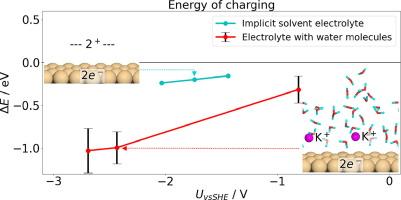
A huge issue in computational electrochemistry is that different modelling approaches, used to study electron transfer reactions, give different results that cannot easily be reconciled with each other. Modeling approaches differ in their handling of interface charging and employed electrolyte model. I study charging of electrolyte-Cu(111) interfaces with electrons and cations (or positive continuum charge) and observe that charging energies (i.e. the energy stabilization from charging the interface with one extra electron and thereby going from one potential to another) depend strongly on the electrolyte model. When the electrolyte is a film containing water molecules, there is a significant stabilization of the energy with more negative potential. This is in contrast to the charging of an interface with implicit solvent, where charge repulsion result in low stabilization of the energy with more negative potential. Therefore, modelling with implicit solvent gives the impression that changing has small effect on constant potential reaction energies and, consequently, that charging can be ignored. This is likely erroneous. I further consider constant potential CO2 adsorption to highlight the importance of charging and using an electrolyte model with water molecules, and show that other modelling approaches gives significantly different CO2 adsorption energies.
期刊介绍:
The Journal of Catalysis publishes scholarly articles on both heterogeneous and homogeneous catalysis, covering a wide range of chemical transformations. These include various types of catalysis, such as those mediated by photons, plasmons, and electrons. The focus of the studies is to understand the relationship between catalytic function and the underlying chemical properties of surfaces and metal complexes.
The articles in the journal offer innovative concepts and explore the synthesis and kinetics of inorganic solids and homogeneous complexes. Furthermore, they discuss spectroscopic techniques for characterizing catalysts, investigate the interaction of probes and reacting species with catalysts, and employ theoretical methods.
The research presented in the journal should have direct relevance to the field of catalytic processes, addressing either fundamental aspects or applications of catalysis.




 京公网安备 11010802042870号
京ICP备2023020795号-1
京公网安备 11010802042870号
京ICP备2023020795号-1

 分享
分享
 求助内容:
求助内容: 应助结果提醒方式:
 扫码关注我们
