Nae-Un Kang, Eun Chae Kim, Sang-Gi Yu, Hye Jin U, You Min Kim, Gwan Yong Baek, Young-Sam Cho and Hyung Woo Kim
{"title":"Evaluation of pre-osteoblastic cell line behaviors under low shear stress conditions†","authors":"Nae-Un Kang, Eun Chae Kim, Sang-Gi Yu, Hye Jin U, You Min Kim, Gwan Yong Baek, Young-Sam Cho and Hyung Woo Kim","doi":"10.1039/D4LC00917G","DOIUrl":null,"url":null,"abstract":"<p >The bone is a dynamic tissue that undergoes continuous remodeling through the activities of osteoclasts, osteoblasts, and osteocytes, influenced by mechanical stimuli <em>via</em> mechano-transduction. While relatively high shear stress levels (>1 Pa) have been extensively studied for their positive effects on pre-osteoblast and osteoblast cells' function, the influence of relatively low shear stress (<1 Pa) remains largely unexplored. This study investigates the effects of low shear stress (0.01 Pa and 0.1 Pa) on the pre-osteoblastic cell line's behaviors using a specially designed shear stress generating microchannel system. First of all, numerical analysis was conducted to optimize microchannel parameters for generating the desired shear stress levels, leading to the design of a microchannel that ensures sufficient internal volume for cell viability. The results from CCK-8 and ALP activity assays demonstrated that low shear stresses significantly enhanced pre-osteoblast proliferation while inhibiting differentiation to osteoblasts over time. Furthermore, immunofluorescence and SEM imaging revealed that pre-osteoblastic cell lines exposed to low shear stress exhibited a contracted morphology and increased alignment, suggesting that shear stress promotes proliferation by facilitating mitotic rounding. These findings underscore the importance of low shear stress in pre-osteoblast behavior, providing valuable insights for bone tissue engineering and regenerative medicine strategies aimed at mimicking physiological interstitial fluid flow.</p>","PeriodicalId":85,"journal":{"name":"Lab on a Chip","volume":" 10","pages":" 2401-2409"},"PeriodicalIF":5.4000,"publicationDate":"2025-04-16","publicationTypes":"Journal Article","fieldsOfStudy":null,"isOpenAccess":false,"openAccessPdf":"","citationCount":"0","resultStr":null,"platform":"Semanticscholar","paperid":null,"PeriodicalName":"Lab on a Chip","FirstCategoryId":"5","ListUrlMain":"https://pubs.rsc.org/en/content/articlelanding/2025/lc/d4lc00917g","RegionNum":2,"RegionCategory":"工程技术","ArticlePicture":[],"TitleCN":null,"AbstractTextCN":null,"PMCID":null,"EPubDate":"","PubModel":"","JCR":"Q1","JCRName":"BIOCHEMICAL RESEARCH METHODS","Score":null,"Total":0}
引用次数: 0
Abstract
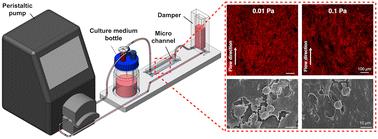
The bone is a dynamic tissue that undergoes continuous remodeling through the activities of osteoclasts, osteoblasts, and osteocytes, influenced by mechanical stimuli via mechano-transduction. While relatively high shear stress levels (>1 Pa) have been extensively studied for their positive effects on pre-osteoblast and osteoblast cells' function, the influence of relatively low shear stress (<1 Pa) remains largely unexplored. This study investigates the effects of low shear stress (0.01 Pa and 0.1 Pa) on the pre-osteoblastic cell line's behaviors using a specially designed shear stress generating microchannel system. First of all, numerical analysis was conducted to optimize microchannel parameters for generating the desired shear stress levels, leading to the design of a microchannel that ensures sufficient internal volume for cell viability. The results from CCK-8 and ALP activity assays demonstrated that low shear stresses significantly enhanced pre-osteoblast proliferation while inhibiting differentiation to osteoblasts over time. Furthermore, immunofluorescence and SEM imaging revealed that pre-osteoblastic cell lines exposed to low shear stress exhibited a contracted morphology and increased alignment, suggesting that shear stress promotes proliferation by facilitating mitotic rounding. These findings underscore the importance of low shear stress in pre-osteoblast behavior, providing valuable insights for bone tissue engineering and regenerative medicine strategies aimed at mimicking physiological interstitial fluid flow.
期刊介绍:
Lab on a Chip is the premiere journal that publishes cutting-edge research in the field of miniaturization. By their very nature, microfluidic/nanofluidic/miniaturized systems are at the intersection of disciplines, spanning fundamental research to high-end application, which is reflected by the broad readership of the journal. Lab on a Chip publishes two types of papers on original research: full-length research papers and communications. Papers should demonstrate innovations, which can come from technical advancements or applications addressing pressing needs in globally important areas. The journal also publishes Comments, Reviews, and Perspectives.




 京公网安备 11010802042870号
京ICP备2023020795号-1
京公网安备 11010802042870号
京ICP备2023020795号-1

 分享
分享
 求助内容:
求助内容: 应助结果提醒方式:
 扫码关注我们
