{"title":"Revealing Irradiation-Induced Dynamic Structural Failure in LiCoO2 Cathodes via Electron-Temperature-Dependent Deep Potential Molecular Dynamics","authors":"Pengfei Liu, Yuanyuan Liu, Xiaoya Zhang, Wei He, Hong Zhang, Qingshui Xie, Jingli Ren, Zi-Zhong Zhu, Dong-Liang Peng","doi":"10.1021/acs.jpclett.5c00486","DOIUrl":null,"url":null,"abstract":"In lithium-ion batteries (LIBs) used for deep-space exploration, LiCoO<sub>2</sub> cathode materials face significant challenges in high-radiation environments, including structural degradation and ion migration. This study investigates the dynamic structural evolution of LiCoO<sub>2</sub> under irradiation using the electron-temperature-dependent deep potential (ETD-DP) model. Compared with traditional ab initio molecular dynamics (AIMD) simulations, the ETD-DP method extends both the spatial and temporal scales by several orders of magnitude. The results reveal that LiCoO<sub>2</sub>’s response to irradiation occurs on the nanosecond time scale, divided into three stages: ion traversal, intense local structural adjustment, and structure relaxation. During the intense adjustment stage, irradiation induces the migration of transition metal ions toward the lithium layers. In the structure relaxation stage, cobalt ions displaced from their equilibrium positions form a dumbbell structure with adjacent Co ions. The simulation results were validated through high-energy electron beam experiments using aberration-corrected electron microscopy. This study provides valuable insights for improving the irradiation tolerance of LIB cathode materials and offers new perspectives on the application of high-energy particle-beam-based fine structural characterization techniques in advanced battery applications.","PeriodicalId":62,"journal":{"name":"The Journal of Physical Chemistry Letters","volume":"136 1","pages":""},"PeriodicalIF":4.6000,"publicationDate":"2025-04-18","publicationTypes":"Journal Article","fieldsOfStudy":null,"isOpenAccess":false,"openAccessPdf":"","citationCount":"0","resultStr":null,"platform":"Semanticscholar","paperid":null,"PeriodicalName":"The Journal of Physical Chemistry Letters","FirstCategoryId":"1","ListUrlMain":"https://doi.org/10.1021/acs.jpclett.5c00486","RegionNum":2,"RegionCategory":"化学","ArticlePicture":[],"TitleCN":null,"AbstractTextCN":null,"PMCID":null,"EPubDate":"","PubModel":"","JCR":"Q2","JCRName":"CHEMISTRY, PHYSICAL","Score":null,"Total":0}
引用次数: 0
Abstract
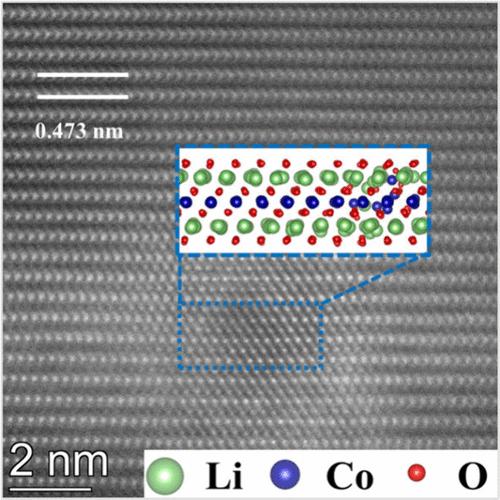
In lithium-ion batteries (LIBs) used for deep-space exploration, LiCoO2 cathode materials face significant challenges in high-radiation environments, including structural degradation and ion migration. This study investigates the dynamic structural evolution of LiCoO2 under irradiation using the electron-temperature-dependent deep potential (ETD-DP) model. Compared with traditional ab initio molecular dynamics (AIMD) simulations, the ETD-DP method extends both the spatial and temporal scales by several orders of magnitude. The results reveal that LiCoO2’s response to irradiation occurs on the nanosecond time scale, divided into three stages: ion traversal, intense local structural adjustment, and structure relaxation. During the intense adjustment stage, irradiation induces the migration of transition metal ions toward the lithium layers. In the structure relaxation stage, cobalt ions displaced from their equilibrium positions form a dumbbell structure with adjacent Co ions. The simulation results were validated through high-energy electron beam experiments using aberration-corrected electron microscopy. This study provides valuable insights for improving the irradiation tolerance of LIB cathode materials and offers new perspectives on the application of high-energy particle-beam-based fine structural characterization techniques in advanced battery applications.
期刊介绍:
The Journal of Physical Chemistry (JPC) Letters is devoted to reporting new and original experimental and theoretical basic research of interest to physical chemists, biophysical chemists, chemical physicists, physicists, material scientists, and engineers. An important criterion for acceptance is that the paper reports a significant scientific advance and/or physical insight such that rapid publication is essential. Two issues of JPC Letters are published each month.



 京公网安备 11010802042870号
京ICP备2023020795号-1
京公网安备 11010802042870号
京ICP备2023020795号-1

 分享
分享
 求助内容:
求助内容: 应助结果提醒方式:
 扫码关注我们
