Samuele Pelatti, Stefania Benedetti, Giuseppe Ammirati, Patrick O’Keeffe, Daniele Catone, Stefano Turchini, Xinchao Huang, Yohei Uemura, Frederico Lima, Christopher Jackson Milne, Paola Luches
{"title":"Niobium Oxide Films with Variable Stoichiometry: Structure, Morphology, and Ultrafast Dynamics","authors":"Samuele Pelatti, Stefania Benedetti, Giuseppe Ammirati, Patrick O’Keeffe, Daniele Catone, Stefano Turchini, Xinchao Huang, Yohei Uemura, Frederico Lima, Christopher Jackson Milne, Paola Luches","doi":"10.1021/acs.jpcc.4c08535","DOIUrl":null,"url":null,"abstract":"Niobium oxide can be stabilized in three distinct stoichiometries, each exhibiting unique physicochemical properties relevant to various technological applications. This study presents a novel procedure for fabricating niobium oxide films and tuning their stoichiometry among the three most stable oxide phases. Starting with a magnetron-sputtered film predominantly composed of Nb<sub>2</sub>O<sub>5</sub>, its structure and stoichiometry are optimized through thermal treatment in an O<sub>2</sub>/N<sub>2</sub> flux. A vacuum reduction treatment transforms the as-grown film into the NbO phase, which can then be reoxidized under controlled oxygen partial pressure to achieve the NbO<sub>2</sub> phase. The films are characterized in terms of surface composition using X-ray photoemission spectroscopy, structure through X-ray diffraction, optical properties via UV–vis spectrophotometry, and morphology using scanning electron microscopy. Additionally, we show that X-ray absorption near-edge spectroscopy at the Nb K-edge, performed with X-ray free-electron laser radiation, can provide insights into the electronic structure and subsurface stoichiometry of the films. The ultrafast mechanisms underlying photoinduced processes in NbO<sub>2</sub> are also discussed.","PeriodicalId":61,"journal":{"name":"The Journal of Physical Chemistry C","volume":"17 1","pages":""},"PeriodicalIF":3.2000,"publicationDate":"2025-04-18","publicationTypes":"Journal Article","fieldsOfStudy":null,"isOpenAccess":false,"openAccessPdf":"","citationCount":"0","resultStr":null,"platform":"Semanticscholar","paperid":null,"PeriodicalName":"The Journal of Physical Chemistry C","FirstCategoryId":"1","ListUrlMain":"https://doi.org/10.1021/acs.jpcc.4c08535","RegionNum":3,"RegionCategory":"化学","ArticlePicture":[],"TitleCN":null,"AbstractTextCN":null,"PMCID":null,"EPubDate":"","PubModel":"","JCR":"Q2","JCRName":"CHEMISTRY, PHYSICAL","Score":null,"Total":0}
引用次数: 0
Abstract
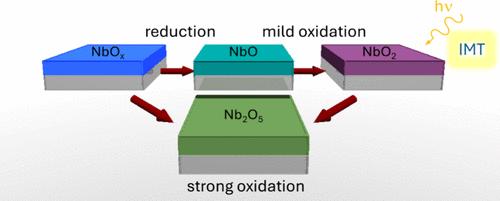
Niobium oxide can be stabilized in three distinct stoichiometries, each exhibiting unique physicochemical properties relevant to various technological applications. This study presents a novel procedure for fabricating niobium oxide films and tuning their stoichiometry among the three most stable oxide phases. Starting with a magnetron-sputtered film predominantly composed of Nb2O5, its structure and stoichiometry are optimized through thermal treatment in an O2/N2 flux. A vacuum reduction treatment transforms the as-grown film into the NbO phase, which can then be reoxidized under controlled oxygen partial pressure to achieve the NbO2 phase. The films are characterized in terms of surface composition using X-ray photoemission spectroscopy, structure through X-ray diffraction, optical properties via UV–vis spectrophotometry, and morphology using scanning electron microscopy. Additionally, we show that X-ray absorption near-edge spectroscopy at the Nb K-edge, performed with X-ray free-electron laser radiation, can provide insights into the electronic structure and subsurface stoichiometry of the films. The ultrafast mechanisms underlying photoinduced processes in NbO2 are also discussed.
期刊介绍:
The Journal of Physical Chemistry A/B/C is devoted to reporting new and original experimental and theoretical basic research of interest to physical chemists, biophysical chemists, and chemical physicists.



 京公网安备 11010802042870号
京ICP备2023020795号-1
京公网安备 11010802042870号
京ICP备2023020795号-1

 分享
分享
 求助内容:
求助内容: 应助结果提醒方式:
 扫码关注我们
