Shyam Deo, Thomas Ludwig, Melinda L. Jue, Nathan C. Ellebracht, Mathew J. Rasmussen, James M. Crawford, Matthew M. Yung, Sneha A. Akhade, Simon H. Pang
{"title":"Theoretical and Experimental Insights into CO2 Capture and Methanation over Amine-Grafted Ru-Based Catalysts","authors":"Shyam Deo, Thomas Ludwig, Melinda L. Jue, Nathan C. Ellebracht, Mathew J. Rasmussen, James M. Crawford, Matthew M. Yung, Sneha A. Akhade, Simon H. Pang","doi":"10.1021/acs.jpcc.4c08009","DOIUrl":null,"url":null,"abstract":"Carbon capture and storage (CCS) technologies, along with CO<sub>2</sub> capture and conversion methods, have emerged as crucial research areas to address rising CO<sub>2</sub> emissions. In this study, we seek to understand the mechanistic role of amines in enabling lower-energy pathways for CO<sub>2</sub> conversion. Our research focuses on the development and analysis of dual-functional materials (DFMs) engineered for the reactive capture and conversion (RCC) of CO<sub>2</sub> into methane, utilizing Ru catalysts grafted with amine groups. We employ Density Functional Theory (DFT) calculations using methylamine as a model amine to investigate the impact of amine groups on CO<sub>2</sub> methanation on a Ru(0001) surface, both in the presence and absence of amine groups. The amine ligand alters the carbon coordination environment, promoting direct C–O dissociation and potentially destabilizing the CO* adsorbate, thereby reducing the risk of CO poisoning. Additionally, we observe a preference for hydrogenation, although it becomes more energetically uphill in the amine-bound scenario. Our experiments, however, report similar CO<sub>2</sub> conversion and CH<sub>4</sub> production rates over the synthesized catalysts “Ru/TiO<sub>2</sub>” and the amine (<i>N</i>-(2-aminoethyl)-3-aminoproplytrimethoxysilane (“diaminosilane”)) deposited catalyst “Diamine−Ru/TiO<sub>2</sub>”. By constructing comparative reaction-free energy diagrams and performing microkinetic modeling (MKM) simulations, we link our theoretical findings with experimentally observed CO<sub>2</sub> uptake, conversion, and methane production rates. A microkinetic model was employed to investigate the anomaly, showing reduced amine–carbon complex coverage and increased CO<sub>2</sub> coverage at all temperatures. The MKM simulations consistently confirmed these trends. This comprehensive approach offers key insights into the role of the amine-CO<sub>2</sub> bond in methanation, highlighting a pathway toward lower-energy, more efficient CO<sub>2</sub> capture and conversion processes.","PeriodicalId":61,"journal":{"name":"The Journal of Physical Chemistry C","volume":"24 1","pages":""},"PeriodicalIF":3.2000,"publicationDate":"2025-04-18","publicationTypes":"Journal Article","fieldsOfStudy":null,"isOpenAccess":false,"openAccessPdf":"","citationCount":"0","resultStr":null,"platform":"Semanticscholar","paperid":null,"PeriodicalName":"The Journal of Physical Chemistry C","FirstCategoryId":"1","ListUrlMain":"https://doi.org/10.1021/acs.jpcc.4c08009","RegionNum":3,"RegionCategory":"化学","ArticlePicture":[],"TitleCN":null,"AbstractTextCN":null,"PMCID":null,"EPubDate":"","PubModel":"","JCR":"Q2","JCRName":"CHEMISTRY, PHYSICAL","Score":null,"Total":0}
引用次数: 0
Abstract
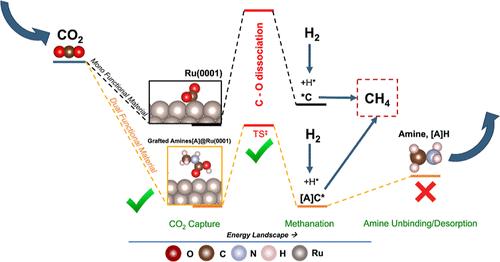
Carbon capture and storage (CCS) technologies, along with CO2 capture and conversion methods, have emerged as crucial research areas to address rising CO2 emissions. In this study, we seek to understand the mechanistic role of amines in enabling lower-energy pathways for CO2 conversion. Our research focuses on the development and analysis of dual-functional materials (DFMs) engineered for the reactive capture and conversion (RCC) of CO2 into methane, utilizing Ru catalysts grafted with amine groups. We employ Density Functional Theory (DFT) calculations using methylamine as a model amine to investigate the impact of amine groups on CO2 methanation on a Ru(0001) surface, both in the presence and absence of amine groups. The amine ligand alters the carbon coordination environment, promoting direct C–O dissociation and potentially destabilizing the CO* adsorbate, thereby reducing the risk of CO poisoning. Additionally, we observe a preference for hydrogenation, although it becomes more energetically uphill in the amine-bound scenario. Our experiments, however, report similar CO2 conversion and CH4 production rates over the synthesized catalysts “Ru/TiO2” and the amine (N-(2-aminoethyl)-3-aminoproplytrimethoxysilane (“diaminosilane”)) deposited catalyst “Diamine−Ru/TiO2”. By constructing comparative reaction-free energy diagrams and performing microkinetic modeling (MKM) simulations, we link our theoretical findings with experimentally observed CO2 uptake, conversion, and methane production rates. A microkinetic model was employed to investigate the anomaly, showing reduced amine–carbon complex coverage and increased CO2 coverage at all temperatures. The MKM simulations consistently confirmed these trends. This comprehensive approach offers key insights into the role of the amine-CO2 bond in methanation, highlighting a pathway toward lower-energy, more efficient CO2 capture and conversion processes.
期刊介绍:
The Journal of Physical Chemistry A/B/C is devoted to reporting new and original experimental and theoretical basic research of interest to physical chemists, biophysical chemists, and chemical physicists.



 京公网安备 11010802042870号
京ICP备2023020795号-1
京公网安备 11010802042870号
京ICP备2023020795号-1

 分享
分享
 求助内容:
求助内容: 应助结果提醒方式:
 扫码关注我们
