Søren S. Sørensen, Daniel Boysen, Esben R. Lindbjerg, Helle N. Mortensen, Kaja T. Lippert, Sisse M. Diget, Zuzanna Konieczna, Matthieu Micoulaut and Morten M. Smedskjaer
{"title":"Balancing fracture toughness and ionic conductivity in lithium thiosilicate glassy electrolytes†","authors":"Søren S. Sørensen, Daniel Boysen, Esben R. Lindbjerg, Helle N. Mortensen, Kaja T. Lippert, Sisse M. Diget, Zuzanna Konieczna, Matthieu Micoulaut and Morten M. Smedskjaer","doi":"10.1039/D5CP00285K","DOIUrl":null,"url":null,"abstract":"<p >The use of solid instead of liquid electrolytes can lead to increased battery capacity and safety. However, solid-state electrolytes bring a number of challenges, especially the lower ionic conductivity and the risk of material cracking, ultimately causing battery failure. This work addresses these challenges by probing the archetypical electrolyte family of lithium thiosilicate glasses (<em>x</em>Li<small><sub>2</sub></small>S–(100−<em>x</em>)SiS<small><sub>2</sub></small>) to study the influence of lithium sulfide content on the mechanical and ionic transport properties. Interestingly, we find a decreasing fracture toughness and increasing ionic conductivity with increasing Li<small><sub>2</sub></small>S content. We ascribe this to the depolymerization of the glassy network with increasing Li<small><sub>2</sub></small>S content and a decoupled activation mechanism of thermal diffusion and movement under mechanical strain. Ultimately, the investigated glasses offer insights into battery operation where the electrolyte is continuously cycled through high- and low-lithium content states. In turn, this highlights the need to consider the material properties across a wide range of compositions when engineering future solid-state electrolytes.</p>","PeriodicalId":99,"journal":{"name":"Physical Chemistry Chemical Physics","volume":" 19","pages":" 10331-10341"},"PeriodicalIF":2.9000,"publicationDate":"2025-04-18","publicationTypes":"Journal Article","fieldsOfStudy":null,"isOpenAccess":false,"openAccessPdf":"","citationCount":"0","resultStr":null,"platform":"Semanticscholar","paperid":null,"PeriodicalName":"Physical Chemistry Chemical Physics","FirstCategoryId":"92","ListUrlMain":"https://pubs.rsc.org/en/content/articlelanding/2025/cp/d5cp00285k","RegionNum":3,"RegionCategory":"化学","ArticlePicture":[],"TitleCN":null,"AbstractTextCN":null,"PMCID":null,"EPubDate":"","PubModel":"","JCR":"Q3","JCRName":"CHEMISTRY, PHYSICAL","Score":null,"Total":0}
引用次数: 0
Abstract
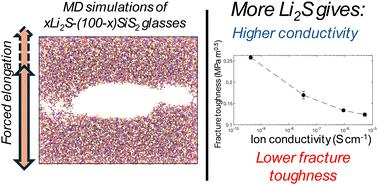
The use of solid instead of liquid electrolytes can lead to increased battery capacity and safety. However, solid-state electrolytes bring a number of challenges, especially the lower ionic conductivity and the risk of material cracking, ultimately causing battery failure. This work addresses these challenges by probing the archetypical electrolyte family of lithium thiosilicate glasses (xLi2S–(100−x)SiS2) to study the influence of lithium sulfide content on the mechanical and ionic transport properties. Interestingly, we find a decreasing fracture toughness and increasing ionic conductivity with increasing Li2S content. We ascribe this to the depolymerization of the glassy network with increasing Li2S content and a decoupled activation mechanism of thermal diffusion and movement under mechanical strain. Ultimately, the investigated glasses offer insights into battery operation where the electrolyte is continuously cycled through high- and low-lithium content states. In turn, this highlights the need to consider the material properties across a wide range of compositions when engineering future solid-state electrolytes.
期刊介绍:
Physical Chemistry Chemical Physics (PCCP) is an international journal co-owned by 19 physical chemistry and physics societies from around the world. This journal publishes original, cutting-edge research in physical chemistry, chemical physics and biophysical chemistry. To be suitable for publication in PCCP, articles must include significant innovation and/or insight into physical chemistry; this is the most important criterion that reviewers and Editors will judge against when evaluating submissions.
The journal has a broad scope and welcomes contributions spanning experiment, theory, computation and data science. Topical coverage includes spectroscopy, dynamics, kinetics, statistical mechanics, thermodynamics, electrochemistry, catalysis, surface science, quantum mechanics, quantum computing and machine learning. Interdisciplinary research areas such as polymers and soft matter, materials, nanoscience, energy, surfaces/interfaces, and biophysical chemistry are welcomed if they demonstrate significant innovation and/or insight into physical chemistry. Joined experimental/theoretical studies are particularly appreciated when complementary and based on up-to-date approaches.




 京公网安备 11010802042870号
京ICP备2023020795号-1
京公网安备 11010802042870号
京ICP备2023020795号-1

 分享
分享
 求助内容:
求助内容: 应助结果提醒方式:
 扫码关注我们
