{"title":"Chirality-Promoted Chemical Ligation and Reverse Transcription of Acyclic Threoninol Nucleic Acid","authors":"Hikari Okita, Keiji Murayama, Hiroyuki Asanuma","doi":"10.1021/jacs.5c03128","DOIUrl":null,"url":null,"abstract":"The building blocks of current life on Earth are chiral compounds, such as 2’-deoxy-<span>D</span>-ribose of DNA and <span>L</span>-amino acids with homochirality, which play an important role in various biological reactions. We investigated the effect of chirality on the template-directed chemical synthesis of nucleic acids as a model for primitive replication of genetic materials in the absence of enzymes. The efficiency of the template-directed chemical ligation of two <i>acyclic</i> nucleic acids, achiral serinol nucleic acid (SNA) and chiral <i>acyclic</i> <span>l</span>-threoninol nucleic acid (<span>L</span>-<i>a</i>TNA), induced by <i>N</i>-cyanoimidazole and a divalent metal cation, was evaluated. The chemical ligation of SNA fragments on an SNA template was much slower than the ligation of <span>L</span>-<i>a</i>TNA fragments on an <span>L</span>-<i>a</i>TNA template. Examination of <span>L</span>-<i>a</i>TNA and SNA heteroligation and the effects of chimeric template strands revealed the crucial importance of <span>L</span>-<i>a</i>TNA chirality, which induces helical propagation and fixes the local conformation of the reactive phosphate group for effective chemical ligation. DNA and RNA templates also enhanced the ligation of SNA and <span>L</span>-<i>a</i>TNA fragments. “Reverse transcription” from template RNA to <span>L</span>-<i>a</i>TNA was also demonstrated. Our findings show that scaffold chirality is crucial for chemical replication and reverse transcription in XNA-based systems. Furthermore, the reverse transcription from RNA to <span>L</span>-<i>a</i>TNA will find applications in XNA-based in vitro selection, the creation of artificial life, and nanotechnologies.","PeriodicalId":49,"journal":{"name":"Journal of the American Chemical Society","volume":"30 1","pages":""},"PeriodicalIF":15.6000,"publicationDate":"2025-04-17","publicationTypes":"Journal Article","fieldsOfStudy":null,"isOpenAccess":false,"openAccessPdf":"","citationCount":"0","resultStr":null,"platform":"Semanticscholar","paperid":null,"PeriodicalName":"Journal of the American Chemical Society","FirstCategoryId":"92","ListUrlMain":"https://doi.org/10.1021/jacs.5c03128","RegionNum":1,"RegionCategory":"化学","ArticlePicture":[],"TitleCN":null,"AbstractTextCN":null,"PMCID":null,"EPubDate":"","PubModel":"","JCR":"Q1","JCRName":"CHEMISTRY, MULTIDISCIPLINARY","Score":null,"Total":0}
引用次数: 0
Abstract
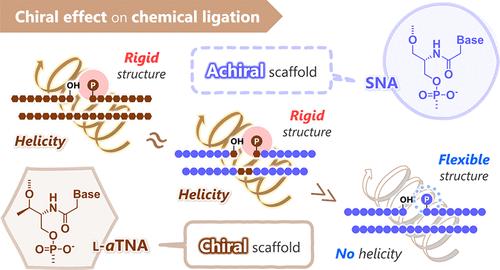
The building blocks of current life on Earth are chiral compounds, such as 2’-deoxy-D-ribose of DNA and L-amino acids with homochirality, which play an important role in various biological reactions. We investigated the effect of chirality on the template-directed chemical synthesis of nucleic acids as a model for primitive replication of genetic materials in the absence of enzymes. The efficiency of the template-directed chemical ligation of two acyclic nucleic acids, achiral serinol nucleic acid (SNA) and chiral acyclicl-threoninol nucleic acid (L-aTNA), induced by N-cyanoimidazole and a divalent metal cation, was evaluated. The chemical ligation of SNA fragments on an SNA template was much slower than the ligation of L-aTNA fragments on an L-aTNA template. Examination of L-aTNA and SNA heteroligation and the effects of chimeric template strands revealed the crucial importance of L-aTNA chirality, which induces helical propagation and fixes the local conformation of the reactive phosphate group for effective chemical ligation. DNA and RNA templates also enhanced the ligation of SNA and L-aTNA fragments. “Reverse transcription” from template RNA to L-aTNA was also demonstrated. Our findings show that scaffold chirality is crucial for chemical replication and reverse transcription in XNA-based systems. Furthermore, the reverse transcription from RNA to L-aTNA will find applications in XNA-based in vitro selection, the creation of artificial life, and nanotechnologies.
期刊介绍:
The flagship journal of the American Chemical Society, known as the Journal of the American Chemical Society (JACS), has been a prestigious publication since its establishment in 1879. It holds a preeminent position in the field of chemistry and related interdisciplinary sciences. JACS is committed to disseminating cutting-edge research papers, covering a wide range of topics, and encompasses approximately 19,000 pages of Articles, Communications, and Perspectives annually. With a weekly publication frequency, JACS plays a vital role in advancing the field of chemistry by providing essential research.



 京公网安备 11010802042870号
京ICP备2023020795号-1
京公网安备 11010802042870号
京ICP备2023020795号-1

 分享
分享
 求助内容:
求助内容: 应助结果提醒方式:
 扫码关注我们
