{"title":"3D kinematics of cavitation bubbles and the relationship with cavitation intensity in straight-tube ultrasonic microreactors","authors":"Zehong Fang , Xiaojing Zhu , Jingjing Li , Rui Yin , Yonghuai Lu , Zhuotao Zheng , Jingfu Jia , Zhengya Dong , Zhilin Wu","doi":"10.1016/j.ces.2025.121700","DOIUrl":null,"url":null,"abstract":"<div><div>Straight-tube ultrasonic microreactor has notable advantages in nanomaterial preparation. The 3D kinematics of cavitation bubbles impacts its mixing efficiency, which is critical for understanding and optimizing the reactor. High-speed photography, image processing, sonochemical luminescence, degradation of chlorinated hydrocarbons, fatty emulsification, etc., were used to study the 3D motion of cavitation bubbles and intensity. In the channel with a 1–2 mm inner diameter, a few macrobubbles moved along the glass channel, and cavitation bubble clouds were almost unobserved, resulting in lower cavitation intensity and poor emulsification efficiency. At 3–5 mm, bubble clouds were divided into 2–4 segments with a radial-circulation motion. Consequently, both cavitation intensity and emulsification were significantly improved. Moreover, macrobubbles escaped radial circulation, and moved rapidly near walls, but were confined in segments. At 6 mm, the bubble clouds adhered to one side wall, and overall cavitation intensity was similar to 4–5 mm channels.</div></div>","PeriodicalId":271,"journal":{"name":"Chemical Engineering Science","volume":"312 ","pages":"Article 121700"},"PeriodicalIF":4.3000,"publicationDate":"2025-06-15","publicationTypes":"Journal Article","fieldsOfStudy":null,"isOpenAccess":false,"openAccessPdf":"","citationCount":"0","resultStr":null,"platform":"Semanticscholar","paperid":null,"PeriodicalName":"Chemical Engineering Science","FirstCategoryId":"5","ListUrlMain":"https://www.sciencedirect.com/science/article/pii/S0009250925005238","RegionNum":2,"RegionCategory":"工程技术","ArticlePicture":[],"TitleCN":null,"AbstractTextCN":null,"PMCID":null,"EPubDate":"2025/4/18 0:00:00","PubModel":"Epub","JCR":"Q2","JCRName":"ENGINEERING, CHEMICAL","Score":null,"Total":0}
引用次数: 0
Abstract
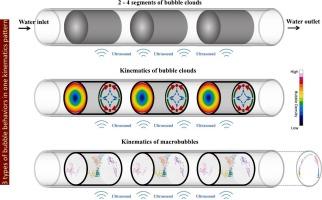
Straight-tube ultrasonic microreactor has notable advantages in nanomaterial preparation. The 3D kinematics of cavitation bubbles impacts its mixing efficiency, which is critical for understanding and optimizing the reactor. High-speed photography, image processing, sonochemical luminescence, degradation of chlorinated hydrocarbons, fatty emulsification, etc., were used to study the 3D motion of cavitation bubbles and intensity. In the channel with a 1–2 mm inner diameter, a few macrobubbles moved along the glass channel, and cavitation bubble clouds were almost unobserved, resulting in lower cavitation intensity and poor emulsification efficiency. At 3–5 mm, bubble clouds were divided into 2–4 segments with a radial-circulation motion. Consequently, both cavitation intensity and emulsification were significantly improved. Moreover, macrobubbles escaped radial circulation, and moved rapidly near walls, but were confined in segments. At 6 mm, the bubble clouds adhered to one side wall, and overall cavitation intensity was similar to 4–5 mm channels.
期刊介绍:
Chemical engineering enables the transformation of natural resources and energy into useful products for society. It draws on and applies natural sciences, mathematics and economics, and has developed fundamental engineering science that underpins the discipline.
Chemical Engineering Science (CES) has been publishing papers on the fundamentals of chemical engineering since 1951. CES is the platform where the most significant advances in the discipline have ever since been published. Chemical Engineering Science has accompanied and sustained chemical engineering through its development into the vibrant and broad scientific discipline it is today.




 京公网安备 11010802042870号
京ICP备2023020795号-1
京公网安备 11010802042870号
京ICP备2023020795号-1

 分享
分享
 求助内容:
求助内容: 应助结果提醒方式:
 扫码关注我们
