Huimin Zhou , Xueqian Liu , Changqing He , Lin He , Hong Sui
{"title":"Reconfiguration of intermolecular hydrogen bond for viscosity reduction of heavy oil","authors":"Huimin Zhou , Xueqian Liu , Changqing He , Lin He , Hong Sui","doi":"10.1016/j.ces.2025.121696","DOIUrl":null,"url":null,"abstract":"<div><div>Reduction of heavy oil viscosity could significantly enhance the heavy oil recovery, separate oily sludgy, improve the heavy oil transportation and storage. Herein, with careful characterization and simulation, we found that the intermolecular hydrogen bond at the edge of asphaltenes plays an important role in forming asphaltene aggregates in oil phase, which increases the oil viscosity sharply. To efficiently reduce the viscosity, we synthesized a novel nonionic material with multiple hydrogen bond sites for breaking the asphaltene aggregates. This oil-soluble viscosity reducer (VR-1) was synthesized by the reaction of oleic acid and tetraethylenepentamine, successfully introducing the N and O heteroatoms into the molecules. It is found that, after optimization, the VR-1 could reduce the Tahe heavy oil viscosity (high content of asphaltenes and resins (>41 %)) by over 80.5 % (from 16,772 mPa·s to 3268 mPa·s) at the addition of 3 wt%. The mechanistic study by experimental characterizations and molecular dynamics (MD) simulations shows that VR-1 could reduce the particle size of asphaltene aggregates significantly. It is observed that hydrogen bond sites in VR-1 play the key roles in weakening and reconstructing the intermolecular non-covalent interactions between asphaltene molecules, which facilitates the dispersion of asphaltene aggregates. These reconfigurations at the surface of asphaltene molecules by VR-1 finally reduce the oil viscosity. This work provides new insights in developing new materials and strategies for changing oil viscosity in a low carbon way, especially those with high content of asphaltenes and resins.</div></div>","PeriodicalId":271,"journal":{"name":"Chemical Engineering Science","volume":"313 ","pages":"Article 121696"},"PeriodicalIF":4.3000,"publicationDate":"2025-07-01","publicationTypes":"Journal Article","fieldsOfStudy":null,"isOpenAccess":false,"openAccessPdf":"","citationCount":"0","resultStr":null,"platform":"Semanticscholar","paperid":null,"PeriodicalName":"Chemical Engineering Science","FirstCategoryId":"5","ListUrlMain":"https://www.sciencedirect.com/science/article/pii/S0009250925005196","RegionNum":2,"RegionCategory":"工程技术","ArticlePicture":[],"TitleCN":null,"AbstractTextCN":null,"PMCID":null,"EPubDate":"2025/4/18 0:00:00","PubModel":"Epub","JCR":"Q2","JCRName":"ENGINEERING, CHEMICAL","Score":null,"Total":0}
引用次数: 0
Abstract
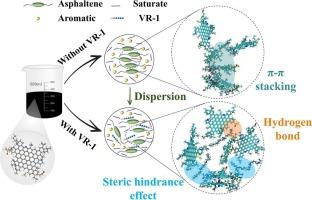
Reduction of heavy oil viscosity could significantly enhance the heavy oil recovery, separate oily sludgy, improve the heavy oil transportation and storage. Herein, with careful characterization and simulation, we found that the intermolecular hydrogen bond at the edge of asphaltenes plays an important role in forming asphaltene aggregates in oil phase, which increases the oil viscosity sharply. To efficiently reduce the viscosity, we synthesized a novel nonionic material with multiple hydrogen bond sites for breaking the asphaltene aggregates. This oil-soluble viscosity reducer (VR-1) was synthesized by the reaction of oleic acid and tetraethylenepentamine, successfully introducing the N and O heteroatoms into the molecules. It is found that, after optimization, the VR-1 could reduce the Tahe heavy oil viscosity (high content of asphaltenes and resins (>41 %)) by over 80.5 % (from 16,772 mPa·s to 3268 mPa·s) at the addition of 3 wt%. The mechanistic study by experimental characterizations and molecular dynamics (MD) simulations shows that VR-1 could reduce the particle size of asphaltene aggregates significantly. It is observed that hydrogen bond sites in VR-1 play the key roles in weakening and reconstructing the intermolecular non-covalent interactions between asphaltene molecules, which facilitates the dispersion of asphaltene aggregates. These reconfigurations at the surface of asphaltene molecules by VR-1 finally reduce the oil viscosity. This work provides new insights in developing new materials and strategies for changing oil viscosity in a low carbon way, especially those with high content of asphaltenes and resins.
期刊介绍:
Chemical engineering enables the transformation of natural resources and energy into useful products for society. It draws on and applies natural sciences, mathematics and economics, and has developed fundamental engineering science that underpins the discipline.
Chemical Engineering Science (CES) has been publishing papers on the fundamentals of chemical engineering since 1951. CES is the platform where the most significant advances in the discipline have ever since been published. Chemical Engineering Science has accompanied and sustained chemical engineering through its development into the vibrant and broad scientific discipline it is today.




 京公网安备 11010802042870号
京ICP备2023020795号-1
京公网安备 11010802042870号
京ICP备2023020795号-1

 分享
分享
 求助内容:
求助内容: 应助结果提醒方式:
 扫码关注我们
