A novel quantitative structure–property relationship model for predicting the maximum volumetric heating capacity and the corresponding working temperature of heat pump refrigerants
Na Deng , Yuhang Wu , Baolian Niu , Quan Zuo , Hanchi Xu
{"title":"A novel quantitative structure–property relationship model for predicting the maximum volumetric heating capacity and the corresponding working temperature of heat pump refrigerants","authors":"Na Deng , Yuhang Wu , Baolian Niu , Quan Zuo , Hanchi Xu","doi":"10.1016/j.ces.2025.121703","DOIUrl":null,"url":null,"abstract":"<div><div>This paper presents a structure–property relationship model between the microstructure and macroscopic cyclic characteristics of heat pump working fluids. The model is established based on the molecular surface charge density distribution function “<em>σ</em>-profile” proposed by the COSMO-RS theory to describe the molecular structure information. The <em>σ</em>-profile curves were parameterized by Gaussian function fitting, and new molecular descriptors expressing the type and quantities of molecular groups were proposed. These molecular descriptors were used to characterize the thermophysical properties of the working fluids through stepwise multiple linear regression. Based on the molecular structure, a QSPR model expression is established to predict the maximum volumetric heating capacity and the corresponding temperature. The average absolute relative deviation (AARD) of the predictions was 9.35% and 7.34%, respectively. The proposed model provides a way to design a new type of working fluid with better cyclic characteristics.</div></div>","PeriodicalId":271,"journal":{"name":"Chemical Engineering Science","volume":"312 ","pages":"Article 121703"},"PeriodicalIF":4.3000,"publicationDate":"2025-06-15","publicationTypes":"Journal Article","fieldsOfStudy":null,"isOpenAccess":false,"openAccessPdf":"","citationCount":"0","resultStr":null,"platform":"Semanticscholar","paperid":null,"PeriodicalName":"Chemical Engineering Science","FirstCategoryId":"5","ListUrlMain":"https://www.sciencedirect.com/science/article/pii/S0009250925005263","RegionNum":2,"RegionCategory":"工程技术","ArticlePicture":[],"TitleCN":null,"AbstractTextCN":null,"PMCID":null,"EPubDate":"2025/4/18 0:00:00","PubModel":"Epub","JCR":"Q2","JCRName":"ENGINEERING, CHEMICAL","Score":null,"Total":0}
引用次数: 0
Abstract
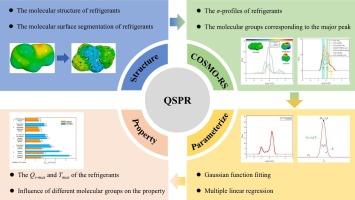
This paper presents a structure–property relationship model between the microstructure and macroscopic cyclic characteristics of heat pump working fluids. The model is established based on the molecular surface charge density distribution function “σ-profile” proposed by the COSMO-RS theory to describe the molecular structure information. The σ-profile curves were parameterized by Gaussian function fitting, and new molecular descriptors expressing the type and quantities of molecular groups were proposed. These molecular descriptors were used to characterize the thermophysical properties of the working fluids through stepwise multiple linear regression. Based on the molecular structure, a QSPR model expression is established to predict the maximum volumetric heating capacity and the corresponding temperature. The average absolute relative deviation (AARD) of the predictions was 9.35% and 7.34%, respectively. The proposed model provides a way to design a new type of working fluid with better cyclic characteristics.
期刊介绍:
Chemical engineering enables the transformation of natural resources and energy into useful products for society. It draws on and applies natural sciences, mathematics and economics, and has developed fundamental engineering science that underpins the discipline.
Chemical Engineering Science (CES) has been publishing papers on the fundamentals of chemical engineering since 1951. CES is the platform where the most significant advances in the discipline have ever since been published. Chemical Engineering Science has accompanied and sustained chemical engineering through its development into the vibrant and broad scientific discipline it is today.





 京公网安备 11010802042870号
京ICP备2023020795号-1
京公网安备 11010802042870号
京ICP备2023020795号-1

 分享
分享
 求助内容:
求助内容: 应助结果提醒方式:
 扫码关注我们
