Yair Shahaf, Thierry K. Slot, Shaked Avidan, Jeffrey E. Dick, David Eisenberg
{"title":"Buffer Effects on Nitrite Reduction Electrocatalysis","authors":"Yair Shahaf, Thierry K. Slot, Shaked Avidan, Jeffrey E. Dick, David Eisenberg","doi":"10.1021/acscatal.4c07765","DOIUrl":null,"url":null,"abstract":"The Haber-Bosch process has provided an energy-intensive way to produce ammonia for over 100 years. However, alternative methods are required to lower pollution and enhance energy efficiency. Unfortunately, key mechanistic insights into the heterogeneous reduction of nitrogen and its intermediates are lacking. The nitrite reduction reaction (NO<sub>2</sub>RR) is an important electrochemical reaction in the nitrogen cycle, playing a significant role in ammonia-based energy storage and wastewater remediation. Although the NO<sub>2</sub>RR involves the transfer of multiple protons competing with the hydrogen evolution reaction (HER), the effect of the proton donor has not been investigated in heterogeneous electrocatalysis. We now present an electrochemical study of nitrite reduction in four buffer systems acting as proton donors: citrate, phosphate, 2-(<i>N</i>-morpholino)ethanesulfonic acid, and borate buffers. The chosen catalyst was a typical iron- and nitrogen-codoped carbon (FeNC) with atomically dispersed FeN<sub>4</sub> sites. All buffers except borate enhanced the NO<sub>2</sub>RR considerably, while the reduction mechanism was independent of buffer identity. The kinetics of the reaction depended more strongly on buffer concentration than on the <i></i><span style=\"color: inherit;\"></span><span data-mathml='<math xmlns=\"http://www.w3.org/1998/Math/MathML\" display=\"inline\"><msubsup><mrow><mi>NO</mi></mrow><mrow><mn>2</mn></mrow><mrow><mo>&#x2212;</mo></mrow></msubsup></math>' role=\"presentation\" style=\"position: relative;\" tabindex=\"0\"><nobr aria-hidden=\"true\"><span style=\"width: 2.219em; display: inline-block;\"><span style=\"display: inline-block; position: relative; width: 1.991em; height: 0px; font-size: 110%;\"><span style=\"position: absolute; clip: rect(1.196em, 1001.99em, 2.616em, -999.997em); top: -2.156em; left: 0em;\"><span><span><span style=\"display: inline-block; position: relative; width: 1.991em; height: 0px;\"><span style=\"position: absolute; clip: rect(3.128em, 1001.42em, 4.151em, -999.997em); top: -3.974em; left: 0em;\"><span><span style=\"font-family: STIXMathJax_Main;\">NO</span></span><span style=\"display: inline-block; width: 0px; height: 3.98em;\"></span></span><span style=\"position: absolute; clip: rect(3.412em, 1000.57em, 4.207em, -999.997em); top: -4.372em; left: 1.423em;\"><span><span style=\"font-size: 70.7%; font-family: STIXMathJax_Main;\">−</span></span><span style=\"display: inline-block; width: 0px; height: 3.98em;\"></span></span><span style=\"position: absolute; clip: rect(3.355em, 1000.46em, 4.151em, -999.997em); top: -3.69em; left: 1.423em;\"><span><span style=\"font-size: 70.7%; font-family: STIXMathJax_Main;\">2</span></span><span style=\"display: inline-block; width: 0px; height: 3.98em;\"></span></span></span></span></span><span style=\"display: inline-block; width: 0px; height: 2.162em;\"></span></span></span><span style=\"display: inline-block; overflow: hidden; vertical-align: -0.372em; border-left: 0px solid; width: 0px; height: 1.316em;\"></span></span></nobr><span role=\"presentation\"><math display=\"inline\" xmlns=\"http://www.w3.org/1998/Math/MathML\"><msubsup><mrow><mi>NO</mi></mrow><mrow><mn>2</mn></mrow><mrow><mo>−</mo></mrow></msubsup></math></span></span><script type=\"math/mml\"><math display=\"inline\"><msubsup><mrow><mi>NO</mi></mrow><mrow><mn>2</mn></mrow><mrow><mo>−</mo></mrow></msubsup></math></script> concentration. Furthermore, we propose a double role for the protonated buffer species: a crucial proton donor during the rate-determining reduction of an NO<sub><i>x</i></sub> intermediate and an efficient pH regulator near the electrode. These key mechanistic insights into heterogeneous nitrite reduction help to understand proton-coupled electrocatalysis and contribute to the development of alternative nitrogen-based fuels.","PeriodicalId":9,"journal":{"name":"ACS Catalysis ","volume":"108 1","pages":""},"PeriodicalIF":13.1000,"publicationDate":"2025-04-18","publicationTypes":"Journal Article","fieldsOfStudy":null,"isOpenAccess":false,"openAccessPdf":"","citationCount":"0","resultStr":null,"platform":"Semanticscholar","paperid":null,"PeriodicalName":"ACS Catalysis ","FirstCategoryId":"92","ListUrlMain":"https://doi.org/10.1021/acscatal.4c07765","RegionNum":1,"RegionCategory":"化学","ArticlePicture":[],"TitleCN":null,"AbstractTextCN":null,"PMCID":null,"EPubDate":"","PubModel":"","JCR":"Q1","JCRName":"CHEMISTRY, PHYSICAL","Score":null,"Total":0}
引用次数: 0
Abstract
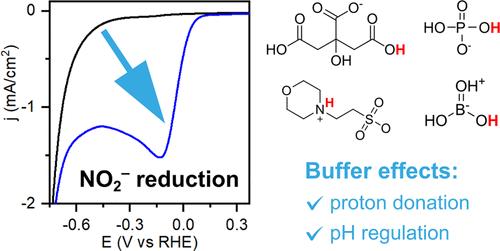
The Haber-Bosch process has provided an energy-intensive way to produce ammonia for over 100 years. However, alternative methods are required to lower pollution and enhance energy efficiency. Unfortunately, key mechanistic insights into the heterogeneous reduction of nitrogen and its intermediates are lacking. The nitrite reduction reaction (NO2RR) is an important electrochemical reaction in the nitrogen cycle, playing a significant role in ammonia-based energy storage and wastewater remediation. Although the NO2RR involves the transfer of multiple protons competing with the hydrogen evolution reaction (HER), the effect of the proton donor has not been investigated in heterogeneous electrocatalysis. We now present an electrochemical study of nitrite reduction in four buffer systems acting as proton donors: citrate, phosphate, 2-(N-morpholino)ethanesulfonic acid, and borate buffers. The chosen catalyst was a typical iron- and nitrogen-codoped carbon (FeNC) with atomically dispersed FeN4 sites. All buffers except borate enhanced the NO2RR considerably, while the reduction mechanism was independent of buffer identity. The kinetics of the reaction depended more strongly on buffer concentration than on the NO−2 concentration. Furthermore, we propose a double role for the protonated buffer species: a crucial proton donor during the rate-determining reduction of an NOx intermediate and an efficient pH regulator near the electrode. These key mechanistic insights into heterogeneous nitrite reduction help to understand proton-coupled electrocatalysis and contribute to the development of alternative nitrogen-based fuels.
期刊介绍:
ACS Catalysis is an esteemed journal that publishes original research in the fields of heterogeneous catalysis, molecular catalysis, and biocatalysis. It offers broad coverage across diverse areas such as life sciences, organometallics and synthesis, photochemistry and electrochemistry, drug discovery and synthesis, materials science, environmental protection, polymer discovery and synthesis, and energy and fuels.
The scope of the journal is to showcase innovative work in various aspects of catalysis. This includes new reactions and novel synthetic approaches utilizing known catalysts, the discovery or modification of new catalysts, elucidation of catalytic mechanisms through cutting-edge investigations, practical enhancements of existing processes, as well as conceptual advances in the field. Contributions to ACS Catalysis can encompass both experimental and theoretical research focused on catalytic molecules, macromolecules, and materials that exhibit catalytic turnover.



 京公网安备 11010802042870号
京ICP备2023020795号-1
京公网安备 11010802042870号
京ICP备2023020795号-1

 分享
分享
 求助内容:
求助内容: 应助结果提醒方式:
 扫码关注我们
