{"title":"Quantitative Elucidation of Catalytic Reaction of Truncated Aldehyde Dehydrogenase Based on Linear Free Energy Relationship","authors":"Konatsu Ichikawa, Taiki Adachi, Yuki Kitazumi, Osamu Shirai, Keisei Sowa","doi":"10.1021/acscatal.4c07978","DOIUrl":null,"url":null,"abstract":"Some oxidoreductases can communicate directly and electrically with electrodes; this process is called direct electron transfer (DET)-type bioelectrocatalysis. Understanding its detailed mechanisms is essential for developing and improving DET-based bioelectrochemical devices. In this study, we investigated the pH dependence of kinetic and thermodynamic characteristics of a variant of an aldehyde dehydrogenase (ALDH) without the cytochrome <i>c</i> subunit (ΔC_ALDH) and compared it with that of a wild-type recombinant ALDH (rALDH). Owing to the pronounced DET activity of ΔC_ALDH at multi-walled carbon nanotubes, the voltammograms were analyzed to obtain the enzymatic parameters. The potential difference between the electrode-active site of the enzyme and electron donor (<i>E</i>°′<sub>E</sub> – <i>E</i>°′<sub>D</sub>) and the limiting catalytic current density (<i>j</i><sub>cat</sub>) exhibited an ideal linear free energy relationship (LFER), suggesting that the catalytic reaction of ΔC_ALDH was controlled by the thermodynamic driving force without any specific interactions. We also measured the ferricyanide reductase activity in solution (<i>k</i><sub>sol</sub>) to investigate the effect of electron acceptors (electrode and ferricyanide) on the enzymatic properties. The <i>k</i><sub>sol</sub> of ΔC_ALDH has a pH dependence similar to that of <i>j</i><sub>cat</sub>; therefore, the experimental data were kinetically analyzed based on the LFER by considering the potential difference between the electron acceptor and electrode-active site of the enzyme (<i>E</i>°′<sub>A</sub> – <i>E</i>°′<sub>E</sub>). By integrating the analytical results obtained from the DET-type acetaldehyde oxidation using an electrode and ferricyanide reduction in solution, the catalytic constant for the DET-type bioelectrocatalysis (<i>k</i><sub>DET</sub>) and the surface concentration of the effective enzyme immobilized on the electrode (Γ<sub>E,eff</sub>) of ΔC_ALDH were calculated to be 5000 ± 2000 s<sup>–1</sup> and 13 ± 7 pmol cm<sup>–2</sup>, respectively. This study achieved a detailed evaluation of the multi-step catalytic reactions of redox enzymes and can help elucidate the reaction mechanisms of DET-type bioelectrocatalysis.","PeriodicalId":9,"journal":{"name":"ACS Catalysis ","volume":"136 1","pages":""},"PeriodicalIF":13.1000,"publicationDate":"2025-04-18","publicationTypes":"Journal Article","fieldsOfStudy":null,"isOpenAccess":false,"openAccessPdf":"","citationCount":"0","resultStr":null,"platform":"Semanticscholar","paperid":null,"PeriodicalName":"ACS Catalysis ","FirstCategoryId":"92","ListUrlMain":"https://doi.org/10.1021/acscatal.4c07978","RegionNum":1,"RegionCategory":"化学","ArticlePicture":[],"TitleCN":null,"AbstractTextCN":null,"PMCID":null,"EPubDate":"","PubModel":"","JCR":"Q1","JCRName":"CHEMISTRY, PHYSICAL","Score":null,"Total":0}
引用次数: 0
Abstract
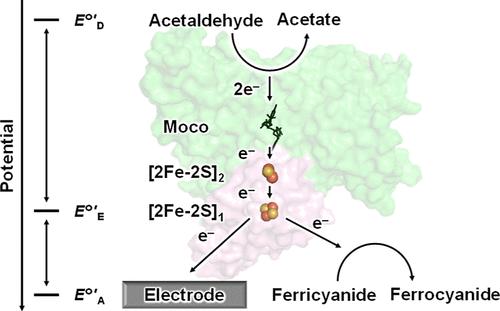
Some oxidoreductases can communicate directly and electrically with electrodes; this process is called direct electron transfer (DET)-type bioelectrocatalysis. Understanding its detailed mechanisms is essential for developing and improving DET-based bioelectrochemical devices. In this study, we investigated the pH dependence of kinetic and thermodynamic characteristics of a variant of an aldehyde dehydrogenase (ALDH) without the cytochrome c subunit (ΔC_ALDH) and compared it with that of a wild-type recombinant ALDH (rALDH). Owing to the pronounced DET activity of ΔC_ALDH at multi-walled carbon nanotubes, the voltammograms were analyzed to obtain the enzymatic parameters. The potential difference between the electrode-active site of the enzyme and electron donor (E°′E – E°′D) and the limiting catalytic current density (jcat) exhibited an ideal linear free energy relationship (LFER), suggesting that the catalytic reaction of ΔC_ALDH was controlled by the thermodynamic driving force without any specific interactions. We also measured the ferricyanide reductase activity in solution (ksol) to investigate the effect of electron acceptors (electrode and ferricyanide) on the enzymatic properties. The ksol of ΔC_ALDH has a pH dependence similar to that of jcat; therefore, the experimental data were kinetically analyzed based on the LFER by considering the potential difference between the electron acceptor and electrode-active site of the enzyme (E°′A – E°′E). By integrating the analytical results obtained from the DET-type acetaldehyde oxidation using an electrode and ferricyanide reduction in solution, the catalytic constant for the DET-type bioelectrocatalysis (kDET) and the surface concentration of the effective enzyme immobilized on the electrode (ΓE,eff) of ΔC_ALDH were calculated to be 5000 ± 2000 s–1 and 13 ± 7 pmol cm–2, respectively. This study achieved a detailed evaluation of the multi-step catalytic reactions of redox enzymes and can help elucidate the reaction mechanisms of DET-type bioelectrocatalysis.
期刊介绍:
ACS Catalysis is an esteemed journal that publishes original research in the fields of heterogeneous catalysis, molecular catalysis, and biocatalysis. It offers broad coverage across diverse areas such as life sciences, organometallics and synthesis, photochemistry and electrochemistry, drug discovery and synthesis, materials science, environmental protection, polymer discovery and synthesis, and energy and fuels.
The scope of the journal is to showcase innovative work in various aspects of catalysis. This includes new reactions and novel synthetic approaches utilizing known catalysts, the discovery or modification of new catalysts, elucidation of catalytic mechanisms through cutting-edge investigations, practical enhancements of existing processes, as well as conceptual advances in the field. Contributions to ACS Catalysis can encompass both experimental and theoretical research focused on catalytic molecules, macromolecules, and materials that exhibit catalytic turnover.



 京公网安备 11010802042870号
京ICP备2023020795号-1
京公网安备 11010802042870号
京ICP备2023020795号-1

 分享
分享
 求助内容:
求助内容: 应助结果提醒方式:
 扫码关注我们
