Josepha J.G. Kromwijk, Job G.A. Vloedgraven, Fleur Neijenhuis, Ward van der Stam, Matteo Monai, Bert M. Weckhuysen
{"title":"Impact of Tungsten Loading on the Activation of Zeolite-Based Catalysts for Methane Dehydroaromatization","authors":"Josepha J.G. Kromwijk, Job G.A. Vloedgraven, Fleur Neijenhuis, Ward van der Stam, Matteo Monai, Bert M. Weckhuysen","doi":"10.1021/acscatal.4c07228","DOIUrl":null,"url":null,"abstract":"To improve the performance of zeolite-based catalysts for the methane dehydroaromatization (MDA) reaction, it is of importance to understand the nature of the catalytically active phase. Although many studies have been devoted to unraveling the structure of the active site, there is still no consensus. Monomeric, dimeric, and/or clusters of molybdenum oxide or tungsten oxide are proposed precatalyst structures. This precatalyst is activated under reaction conditions, to form (oxy)carbidic species which are believed to be the active site. In this study, we investigated the effect of tungsten dispersion on the activation of W/ZSM-5 catalysts. We observed unexpected long activation times that could be shortened by inert or reductive pretreatment. Based on our investigations, we hypothesize that W/ZSM-5 catalysts with low weight loadings (i.e., 2 wt %) cannot be activated due to the presence of monomeric tungsten. For catalysts with medium weight loadings (i.e., 5 and 7 wt %), restructuring of the tungsten is required for the formation of the active site, which can be achieved through performing a thermal pretreatment. For higher weight loadings (i.e., 10 wt %), reduction plays a key role in the activation of the catalyst. We show that the activation of the catalyst is impacted by the precatalyst structure. These insights aid in the development of suitable activation treatments which could save time and energy if the reaction would be performed at an industrial scale.","PeriodicalId":9,"journal":{"name":"ACS Catalysis ","volume":"24 1","pages":""},"PeriodicalIF":13.1000,"publicationDate":"2025-04-18","publicationTypes":"Journal Article","fieldsOfStudy":null,"isOpenAccess":false,"openAccessPdf":"","citationCount":"0","resultStr":null,"platform":"Semanticscholar","paperid":null,"PeriodicalName":"ACS Catalysis ","FirstCategoryId":"92","ListUrlMain":"https://doi.org/10.1021/acscatal.4c07228","RegionNum":1,"RegionCategory":"化学","ArticlePicture":[],"TitleCN":null,"AbstractTextCN":null,"PMCID":null,"EPubDate":"","PubModel":"","JCR":"Q1","JCRName":"CHEMISTRY, PHYSICAL","Score":null,"Total":0}
引用次数: 0
Abstract
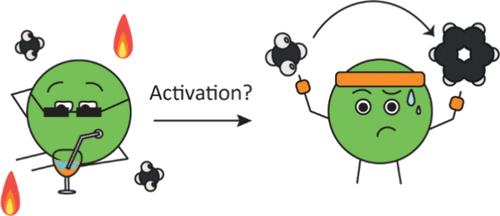
To improve the performance of zeolite-based catalysts for the methane dehydroaromatization (MDA) reaction, it is of importance to understand the nature of the catalytically active phase. Although many studies have been devoted to unraveling the structure of the active site, there is still no consensus. Monomeric, dimeric, and/or clusters of molybdenum oxide or tungsten oxide are proposed precatalyst structures. This precatalyst is activated under reaction conditions, to form (oxy)carbidic species which are believed to be the active site. In this study, we investigated the effect of tungsten dispersion on the activation of W/ZSM-5 catalysts. We observed unexpected long activation times that could be shortened by inert or reductive pretreatment. Based on our investigations, we hypothesize that W/ZSM-5 catalysts with low weight loadings (i.e., 2 wt %) cannot be activated due to the presence of monomeric tungsten. For catalysts with medium weight loadings (i.e., 5 and 7 wt %), restructuring of the tungsten is required for the formation of the active site, which can be achieved through performing a thermal pretreatment. For higher weight loadings (i.e., 10 wt %), reduction plays a key role in the activation of the catalyst. We show that the activation of the catalyst is impacted by the precatalyst structure. These insights aid in the development of suitable activation treatments which could save time and energy if the reaction would be performed at an industrial scale.
期刊介绍:
ACS Catalysis is an esteemed journal that publishes original research in the fields of heterogeneous catalysis, molecular catalysis, and biocatalysis. It offers broad coverage across diverse areas such as life sciences, organometallics and synthesis, photochemistry and electrochemistry, drug discovery and synthesis, materials science, environmental protection, polymer discovery and synthesis, and energy and fuels.
The scope of the journal is to showcase innovative work in various aspects of catalysis. This includes new reactions and novel synthetic approaches utilizing known catalysts, the discovery or modification of new catalysts, elucidation of catalytic mechanisms through cutting-edge investigations, practical enhancements of existing processes, as well as conceptual advances in the field. Contributions to ACS Catalysis can encompass both experimental and theoretical research focused on catalytic molecules, macromolecules, and materials that exhibit catalytic turnover.




 京公网安备 11010802042870号
京ICP备2023020795号-1
京公网安备 11010802042870号
京ICP备2023020795号-1

 分享
分享
 求助内容:
求助内容: 应助结果提醒方式:
 扫码关注我们
