Lorenzo Brivio , Mattia Sponchioni , Paolo Innocenti , Giuseppe Storti , Davide Moscatelli
{"title":"Hybrid process for the depolymerization of polyethylene terephthalate (PET) from post-consumer mixed textile wastes","authors":"Lorenzo Brivio , Mattia Sponchioni , Paolo Innocenti , Giuseppe Storti , Davide Moscatelli","doi":"10.1016/j.ces.2025.121702","DOIUrl":null,"url":null,"abstract":"<div><div>In this study, we developed a new process integrating glycolysis and methanolysis to depolymerize low-quality polyethylene terephthalate (PET) wastes, particularly post-consumer mixed textiles. PET is first depolymerized with ethylene glycol and a catalyst, i.e. Na<sub>2</sub>CO<sub>3</sub>, to produce bis(2-hydroxyethyl) terephthalate (BHET). This is then extracted from the glycolyzed products and a transesterification with methanol is performed, yielding dimethyl terephthalate (DMT). Finally, DMT is recovered from the solution and purified by distillation. The proposed process allows a very low weight ratio between the fibers containing PET and the ethylene glycol used in the glycolysis reaction, thus avoiding a final step of product concentration. Also, BHET dimers and trimers can be recovered together with the monomer, thus increasing the global process yield. Indeed, a global DMT yield up to 77% can be achieved with this hybrid process, which is higher than that of other chemical recycling processes currently applied to textile wastes.</div></div>","PeriodicalId":271,"journal":{"name":"Chemical Engineering Science","volume":"313 ","pages":"Article 121702"},"PeriodicalIF":4.3000,"publicationDate":"2025-07-01","publicationTypes":"Journal Article","fieldsOfStudy":null,"isOpenAccess":false,"openAccessPdf":"","citationCount":"0","resultStr":null,"platform":"Semanticscholar","paperid":null,"PeriodicalName":"Chemical Engineering Science","FirstCategoryId":"5","ListUrlMain":"https://www.sciencedirect.com/science/article/pii/S0009250925005251","RegionNum":2,"RegionCategory":"工程技术","ArticlePicture":[],"TitleCN":null,"AbstractTextCN":null,"PMCID":null,"EPubDate":"2025/4/18 0:00:00","PubModel":"Epub","JCR":"Q2","JCRName":"ENGINEERING, CHEMICAL","Score":null,"Total":0}
引用次数: 0
Abstract
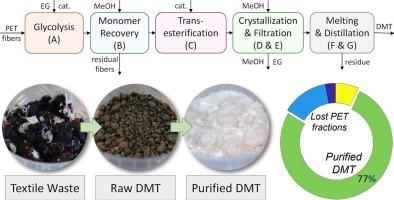
In this study, we developed a new process integrating glycolysis and methanolysis to depolymerize low-quality polyethylene terephthalate (PET) wastes, particularly post-consumer mixed textiles. PET is first depolymerized with ethylene glycol and a catalyst, i.e. Na2CO3, to produce bis(2-hydroxyethyl) terephthalate (BHET). This is then extracted from the glycolyzed products and a transesterification with methanol is performed, yielding dimethyl terephthalate (DMT). Finally, DMT is recovered from the solution and purified by distillation. The proposed process allows a very low weight ratio between the fibers containing PET and the ethylene glycol used in the glycolysis reaction, thus avoiding a final step of product concentration. Also, BHET dimers and trimers can be recovered together with the monomer, thus increasing the global process yield. Indeed, a global DMT yield up to 77% can be achieved with this hybrid process, which is higher than that of other chemical recycling processes currently applied to textile wastes.
期刊介绍:
Chemical engineering enables the transformation of natural resources and energy into useful products for society. It draws on and applies natural sciences, mathematics and economics, and has developed fundamental engineering science that underpins the discipline.
Chemical Engineering Science (CES) has been publishing papers on the fundamentals of chemical engineering since 1951. CES is the platform where the most significant advances in the discipline have ever since been published. Chemical Engineering Science has accompanied and sustained chemical engineering through its development into the vibrant and broad scientific discipline it is today.




 京公网安备 11010802042870号
京ICP备2023020795号-1
京公网安备 11010802042870号
京ICP备2023020795号-1

 分享
分享
 求助内容:
求助内容: 应助结果提醒方式:
 扫码关注我们
