{"title":"A Robust Single-Molecule Diode with High Rectification Ratio and Integrability","authors":"Yilin Guo, Chen Yang, Shuyao Zhou, Kendall N. Houk, Xuefeng Guo","doi":"10.1021/jacs.5c00566","DOIUrl":null,"url":null,"abstract":"Advancements in molecular electronics focus on single molecules as key components to create stable and functional devices that meet the requirements of device miniaturization and molecular function exploration. However, as the pioneering concept of a molecular diode, all single-molecule rectifiers reported previously are limited by their modest rectification ratios, owing to electron transmission in the off-state, highlighting the imperative for performance enhancements. Here, we demonstrate a unique method capable of realizing a stable and reproducible high-performance single-molecule rectifier through the strategic application of an electric-field-catalyzed Fries rearrangement. This flexible reaction enables the exquisite control of reversible conductance switching between a structure with constructive quantum interference and a structure with destructive quantum interference, therefore leading to an exceptional rectification ratio of up to 5000 at a bias of 1.0 V, which ranks the highest among the rectifiers constructed by only one individual molecule. The stable operation of nearly 100 devices at high temperatures demonstrates reproducibility. Moreover, on-chip integration of different single-molecule rectifiers succeeds in achieving half-wave and bridge rectifications, thus facilitating efficient alternating current-to-direct current conversions. This convenient strategy of electric-field-catalyzed quantum interference switching potentially revolutionizes device efficiency and miniaturization in nanotechnology, laying an actual step toward future practical integrated molecular-scale electronic nanocircuits.","PeriodicalId":49,"journal":{"name":"Journal of the American Chemical Society","volume":"75 1","pages":""},"PeriodicalIF":15.6000,"publicationDate":"2025-04-17","publicationTypes":"Journal Article","fieldsOfStudy":null,"isOpenAccess":false,"openAccessPdf":"","citationCount":"0","resultStr":null,"platform":"Semanticscholar","paperid":null,"PeriodicalName":"Journal of the American Chemical Society","FirstCategoryId":"92","ListUrlMain":"https://doi.org/10.1021/jacs.5c00566","RegionNum":1,"RegionCategory":"化学","ArticlePicture":[],"TitleCN":null,"AbstractTextCN":null,"PMCID":null,"EPubDate":"","PubModel":"","JCR":"Q1","JCRName":"CHEMISTRY, MULTIDISCIPLINARY","Score":null,"Total":0}
引用次数: 0
Abstract
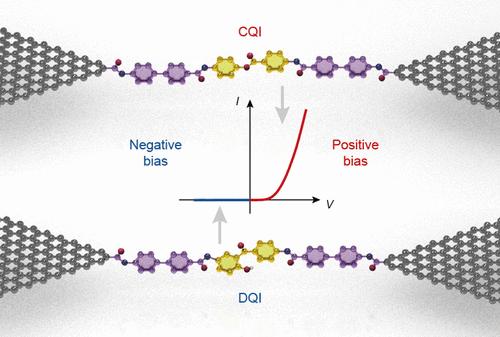
Advancements in molecular electronics focus on single molecules as key components to create stable and functional devices that meet the requirements of device miniaturization and molecular function exploration. However, as the pioneering concept of a molecular diode, all single-molecule rectifiers reported previously are limited by their modest rectification ratios, owing to electron transmission in the off-state, highlighting the imperative for performance enhancements. Here, we demonstrate a unique method capable of realizing a stable and reproducible high-performance single-molecule rectifier through the strategic application of an electric-field-catalyzed Fries rearrangement. This flexible reaction enables the exquisite control of reversible conductance switching between a structure with constructive quantum interference and a structure with destructive quantum interference, therefore leading to an exceptional rectification ratio of up to 5000 at a bias of 1.0 V, which ranks the highest among the rectifiers constructed by only one individual molecule. The stable operation of nearly 100 devices at high temperatures demonstrates reproducibility. Moreover, on-chip integration of different single-molecule rectifiers succeeds in achieving half-wave and bridge rectifications, thus facilitating efficient alternating current-to-direct current conversions. This convenient strategy of electric-field-catalyzed quantum interference switching potentially revolutionizes device efficiency and miniaturization in nanotechnology, laying an actual step toward future practical integrated molecular-scale electronic nanocircuits.
期刊介绍:
The flagship journal of the American Chemical Society, known as the Journal of the American Chemical Society (JACS), has been a prestigious publication since its establishment in 1879. It holds a preeminent position in the field of chemistry and related interdisciplinary sciences. JACS is committed to disseminating cutting-edge research papers, covering a wide range of topics, and encompasses approximately 19,000 pages of Articles, Communications, and Perspectives annually. With a weekly publication frequency, JACS plays a vital role in advancing the field of chemistry by providing essential research.



 京公网安备 11010802042870号
京ICP备2023020795号-1
京公网安备 11010802042870号
京ICP备2023020795号-1

 分享
分享
 求助内容:
求助内容: 应助结果提醒方式:
 扫码关注我们
