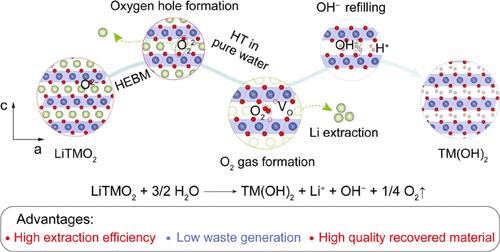
{"title":"Irreversible Oxygen Redox Enables Lithium Extraction from Ternary Lithium-Ion Battery Cathodes in Water","authors":"Chao Wu, Qi Zhang, Haoyan Meng, Bo Wu, Yiming Zhang, Junhua Li, Ying Tang, Anqi Zou, Jiliang Zhu, Caozheng Diao, Feng Gao, Zhi Gen Yu, Junmin Xue, Shibo Xi, Xiaopeng Wang, Jiagang Wu","doi":"10.1021/jacs.5c00452","DOIUrl":null,"url":null,"abstract":"Developing a low-cost and environmentally friendly method for lithium extraction is essential for the efficient recycling of spent lithium-ion battery (LIB) cathodes. Current technologies, such as solvent extraction/precipitation and electrochemical processes, rely on anion- or cation-rich extraction agents and necessitate further purification, leading to high energy consumption and waste pollution. Here, we demonstrate that applying mechanical treatment on ternary LIB cathodes enables water to extract lithium from the cathode materials under mild conditions, achieving Li extraction efficiencies of 99.4% for LiNi<sub>0.8</sub>Mn<sub>0.1</sub>Co<sub>0.1</sub>O<sub>2</sub> (NMC811), 98.9% for LiNi<sub>0.9</sub>Co<sub>0.075</sub>Al<sub>0.025</sub>O<sub>2</sub> (NCA), and 97.1% for LiNi<sub>0.9</sub>Mn<sub>0.05</sub>Co<sub>0.05</sub>O<sub>2</sub> (NMC955) at 150 °C. This process involves an irreversible oxygen redox reaction, resulting in the structural transformation to metal hydroxide species. Further experiments revealed that mechanical treatment leads to the formation of oxygen holes (O<sup>2−δ</sup>), which are subsequently oxidized into O<sub>2</sub> gas through O–O dimerization during the hydrothermal process, creating oxygen vacancies. These vacant sites then act as channels for the release of surrounding Li<sup>+</sup> ions, followed by the OH<sup>–</sup> refilling process. Unlike previous methods, this work avoids the use of additional leaching reagents and produces high-quality end products, such as transition metal hydroxides and analytical-grade Li<sub>2</sub>CO<sub>3</sub>. Moreover, our proposed lithium extraction strategy further enables the recovered materials to be seamlessly reintegrated into the production of fresh cathode materials, providing valuable insights into the sustainable recycling of LIB cathodes.","PeriodicalId":49,"journal":{"name":"Journal of the American Chemical Society","volume":"7 1","pages":""},"PeriodicalIF":15.6000,"publicationDate":"2025-04-17","publicationTypes":"Journal Article","fieldsOfStudy":null,"isOpenAccess":false,"openAccessPdf":"","citationCount":"0","resultStr":null,"platform":"Semanticscholar","paperid":null,"PeriodicalName":"Journal of the American Chemical Society","FirstCategoryId":"92","ListUrlMain":"https://doi.org/10.1021/jacs.5c00452","RegionNum":1,"RegionCategory":"化学","ArticlePicture":[],"TitleCN":null,"AbstractTextCN":null,"PMCID":null,"EPubDate":"","PubModel":"","JCR":"Q1","JCRName":"CHEMISTRY, MULTIDISCIPLINARY","Score":null,"Total":0}
引用次数: 0
Abstract
Developing a low-cost and environmentally friendly method for lithium extraction is essential for the efficient recycling of spent lithium-ion battery (LIB) cathodes. Current technologies, such as solvent extraction/precipitation and electrochemical processes, rely on anion- or cation-rich extraction agents and necessitate further purification, leading to high energy consumption and waste pollution. Here, we demonstrate that applying mechanical treatment on ternary LIB cathodes enables water to extract lithium from the cathode materials under mild conditions, achieving Li extraction efficiencies of 99.4% for LiNi0.8Mn0.1Co0.1O2 (NMC811), 98.9% for LiNi0.9Co0.075Al0.025O2 (NCA), and 97.1% for LiNi0.9Mn0.05Co0.05O2 (NMC955) at 150 °C. This process involves an irreversible oxygen redox reaction, resulting in the structural transformation to metal hydroxide species. Further experiments revealed that mechanical treatment leads to the formation of oxygen holes (O2−δ), which are subsequently oxidized into O2 gas through O–O dimerization during the hydrothermal process, creating oxygen vacancies. These vacant sites then act as channels for the release of surrounding Li+ ions, followed by the OH– refilling process. Unlike previous methods, this work avoids the use of additional leaching reagents and produces high-quality end products, such as transition metal hydroxides and analytical-grade Li2CO3. Moreover, our proposed lithium extraction strategy further enables the recovered materials to be seamlessly reintegrated into the production of fresh cathode materials, providing valuable insights into the sustainable recycling of LIB cathodes.
期刊介绍:
The flagship journal of the American Chemical Society, known as the Journal of the American Chemical Society (JACS), has been a prestigious publication since its establishment in 1879. It holds a preeminent position in the field of chemistry and related interdisciplinary sciences. JACS is committed to disseminating cutting-edge research papers, covering a wide range of topics, and encompasses approximately 19,000 pages of Articles, Communications, and Perspectives annually. With a weekly publication frequency, JACS plays a vital role in advancing the field of chemistry by providing essential research.



 京公网安备 11010802042870号
京ICP备2023020795号-1
京公网安备 11010802042870号
京ICP备2023020795号-1

 分享
分享
 求助内容:
求助内容: 应助结果提醒方式:
 扫码关注我们
