{"title":"Deracemization of C(sp3)–H Arylated Carbonyl Compounds via Asymmetric Ion-Pairing Photoredox Catalysis","authors":"Chenxi Wen, Zhengke Huang, Sheng-Ye Zhang, Zhimin Li, Bolong Chai, Zheng Huang, Qi-Kai Kang","doi":"10.1021/jacs.5c02235","DOIUrl":null,"url":null,"abstract":"Deracemization of C(sp<sup>3</sup>)–H arylated carbonyl compounds faces limitations in terms of substrate scope. Through the photoactivation of the aryl group and the stereocontrol of the generated arene radical cation via asymmetric ion-pairing catalysis, we are able to achieve deracemization of carbonyl compounds arylated at both enolizable and unenolizable stereocenters. A diverse range of α-, β-, and γ-aryl ketones and esters, including natural products and medicinal derivatives, can be effectively converted into their enantiomers with high enantioselectivity. Mechanistic investigations through combined experimental and computational studies suggest that the reaction involves single-electron oxidation of electron-rich aryl groups, followed by a kinetic resolution of the resulting radical cation intermediates by the chiral phosphate anion. Deprotonation is identified as the stereodetermining step, while stereoselective back electron transfer and triplet-state quenching of <sup>3</sup> Mes-Acr<sub>1</sub><sup>+</sup>* may also affect the enantioselectivity at the photostationary state.","PeriodicalId":49,"journal":{"name":"Journal of the American Chemical Society","volume":"16 1","pages":""},"PeriodicalIF":15.6000,"publicationDate":"2025-04-17","publicationTypes":"Journal Article","fieldsOfStudy":null,"isOpenAccess":false,"openAccessPdf":"","citationCount":"0","resultStr":null,"platform":"Semanticscholar","paperid":null,"PeriodicalName":"Journal of the American Chemical Society","FirstCategoryId":"92","ListUrlMain":"https://doi.org/10.1021/jacs.5c02235","RegionNum":1,"RegionCategory":"化学","ArticlePicture":[],"TitleCN":null,"AbstractTextCN":null,"PMCID":null,"EPubDate":"","PubModel":"","JCR":"Q1","JCRName":"CHEMISTRY, MULTIDISCIPLINARY","Score":null,"Total":0}
引用次数: 0
Abstract
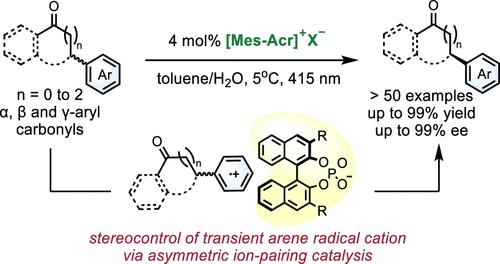
Deracemization of C(sp3)–H arylated carbonyl compounds faces limitations in terms of substrate scope. Through the photoactivation of the aryl group and the stereocontrol of the generated arene radical cation via asymmetric ion-pairing catalysis, we are able to achieve deracemization of carbonyl compounds arylated at both enolizable and unenolizable stereocenters. A diverse range of α-, β-, and γ-aryl ketones and esters, including natural products and medicinal derivatives, can be effectively converted into their enantiomers with high enantioselectivity. Mechanistic investigations through combined experimental and computational studies suggest that the reaction involves single-electron oxidation of electron-rich aryl groups, followed by a kinetic resolution of the resulting radical cation intermediates by the chiral phosphate anion. Deprotonation is identified as the stereodetermining step, while stereoselective back electron transfer and triplet-state quenching of 3 Mes-Acr1+* may also affect the enantioselectivity at the photostationary state.
期刊介绍:
The flagship journal of the American Chemical Society, known as the Journal of the American Chemical Society (JACS), has been a prestigious publication since its establishment in 1879. It holds a preeminent position in the field of chemistry and related interdisciplinary sciences. JACS is committed to disseminating cutting-edge research papers, covering a wide range of topics, and encompasses approximately 19,000 pages of Articles, Communications, and Perspectives annually. With a weekly publication frequency, JACS plays a vital role in advancing the field of chemistry by providing essential research.



 京公网安备 11010802042870号
京ICP备2023020795号-1
京公网安备 11010802042870号
京ICP备2023020795号-1

 分享
分享
 求助内容:
求助内容: 应助结果提醒方式:
 扫码关注我们
