Stephanie Federico , Christian Renn , Petra Brehova , Zlatko Janeba , Susanne Moschütz , Katharina Sylvester , Rasha Abu Shamleh , Helay Baburi , Herbert Zimmermann , Ali El-Tayeb , Norbert Sträter , Christa E. Müller
{"title":"Acyclic purine and pyrimidine nucleotide analogs as ecto-5′-nucleotidase (CD73) inhibitors","authors":"Stephanie Federico , Christian Renn , Petra Brehova , Zlatko Janeba , Susanne Moschütz , Katharina Sylvester , Rasha Abu Shamleh , Helay Baburi , Herbert Zimmermann , Ali El-Tayeb , Norbert Sträter , Christa E. Müller","doi":"10.1016/j.ejmech.2025.117653","DOIUrl":null,"url":null,"abstract":"<div><div>Ecto-5′-nucleotidase (CD73) is a novel target in cancer (immuno)therapy. Its blockade prevents the formation of immunosuppressive and cancer-promoting adenosine from AMP. Here, we report on the development of a series of small molecules that mimic adenine nucleotides, in which the ribose moiety was replaced by an alkyl chain. Its length was found to be crucial for potency. A crystal structure of the <em>N</em><sup>6</sup>-disubstituted acyclic ADP analog <strong>26</strong> (<em>N</em><sup><em>6</em></sup>-benzyl,<em>N</em><sup>6</sup>-methyladenine-9-yl)pentyloxydiphosphonate) in complex with human CD73 revealed that the flexible pentyl linker adopts to interdomain rotation angles differing by up to 18.5°. The most potent CD73 inhibitor of the present series was analog <strong>27</strong> (<em>N</em><sup><em>6</em></sup>-benzyl,<em>N</em><sup>6</sup>-methyladenine-9-yl)hexyloxydiphosphonate, PSB-24000) which exhibited submicromolar potency at human CD73 (K<sub>i</sub> 563 nM at soluble CD73; K<sub>i</sub> 481 nM at membrane-bound CD73 of triple-negative breast cancer cells). Acyclic nucleotide analogs may be advantageous compared to the previously reported nucleotidic CD73 inhibitors due to their high chemical stability, and because less off-target effects are to be expected. The structure-activity relationships discovered in this study provide valuable insights which will be useful for the development of CD73 inhibitors as immunotherapeutic drugs.</div></div>","PeriodicalId":314,"journal":{"name":"European Journal of Medicinal Chemistry","volume":"294 ","pages":"Article 117653"},"PeriodicalIF":5.9000,"publicationDate":"2025-09-15","publicationTypes":"Journal Article","fieldsOfStudy":null,"isOpenAccess":false,"openAccessPdf":"","citationCount":"0","resultStr":null,"platform":"Semanticscholar","paperid":null,"PeriodicalName":"European Journal of Medicinal Chemistry","FirstCategoryId":"3","ListUrlMain":"https://www.sciencedirect.com/science/article/pii/S0223523425004180","RegionNum":2,"RegionCategory":"医学","ArticlePicture":[],"TitleCN":null,"AbstractTextCN":null,"PMCID":null,"EPubDate":"2025/4/17 0:00:00","PubModel":"Epub","JCR":"Q1","JCRName":"CHEMISTRY, MEDICINAL","Score":null,"Total":0}
引用次数: 0
Abstract
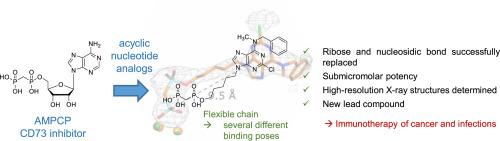
Ecto-5′-nucleotidase (CD73) is a novel target in cancer (immuno)therapy. Its blockade prevents the formation of immunosuppressive and cancer-promoting adenosine from AMP. Here, we report on the development of a series of small molecules that mimic adenine nucleotides, in which the ribose moiety was replaced by an alkyl chain. Its length was found to be crucial for potency. A crystal structure of the N6-disubstituted acyclic ADP analog 26 (N6-benzyl,N6-methyladenine-9-yl)pentyloxydiphosphonate) in complex with human CD73 revealed that the flexible pentyl linker adopts to interdomain rotation angles differing by up to 18.5°. The most potent CD73 inhibitor of the present series was analog 27 (N6-benzyl,N6-methyladenine-9-yl)hexyloxydiphosphonate, PSB-24000) which exhibited submicromolar potency at human CD73 (Ki 563 nM at soluble CD73; Ki 481 nM at membrane-bound CD73 of triple-negative breast cancer cells). Acyclic nucleotide analogs may be advantageous compared to the previously reported nucleotidic CD73 inhibitors due to their high chemical stability, and because less off-target effects are to be expected. The structure-activity relationships discovered in this study provide valuable insights which will be useful for the development of CD73 inhibitors as immunotherapeutic drugs.
期刊介绍:
The European Journal of Medicinal Chemistry is a global journal that publishes studies on all aspects of medicinal chemistry. It provides a medium for publication of original papers and also welcomes critical review papers.
A typical paper would report on the organic synthesis, characterization and pharmacological evaluation of compounds. Other topics of interest are drug design, QSAR, molecular modeling, drug-receptor interactions, molecular aspects of drug metabolism, prodrug synthesis and drug targeting. The journal expects manuscripts to present the rational for a study, provide insight into the design of compounds or understanding of mechanism, or clarify the targets.




 京公网安备 11010802042870号
京ICP备2023020795号-1
京公网安备 11010802042870号
京ICP备2023020795号-1

 分享
分享
 求助内容:
求助内容: 应助结果提醒方式:
 扫码关注我们
