Shiyue Xing, Zhongliang Liu, Yingfang Jiang, Pinghui Tang, Jian Zhang, Jiatang Chen, Huihui Li and Chunzhong Li
{"title":"Platinum–copper nanowire networks with enhanced CO tolerance toward methanol oxidation electrocatalysis†","authors":"Shiyue Xing, Zhongliang Liu, Yingfang Jiang, Pinghui Tang, Jian Zhang, Jiatang Chen, Huihui Li and Chunzhong Li","doi":"10.1039/D5SC00656B","DOIUrl":null,"url":null,"abstract":"<p >Developing platinum-based electrocatalysts with high CO tolerance for the methanol oxidation reaction (MOR) is crucial for the practical application of direct methanol fuel cells (DMFCs). Herein, we employed a straightforward one-step method to synthesize Pt<small><sub><em>x</em></sub></small>Cu<small><sub><em>y</em></sub></small> network nanowires (NWNs), which exhibit the advantages of structural stability and bimetallic ensembles. The synergistic effect of compressive strain and the ligand effect, induced by Cu incorporation, can effectively lower the d-band center of Pt, thereby weakening the adsorption strength of CO on the catalyst surface. The optimized Pt<small><sub>42</sub></small>Cu<small><sub>58</sub></small> NWNs deliver a peak mass activity of 1.33 A mg<small><sub>Pt</sub></small><small><sup>−1</sup></small> and a specific activity of 4.43 mA cm<small><sup>−2</sup></small> for the MOR, which are 3.03 and 4.03 times higher than those of commercial Pt/C, respectively. The CO stripping and <em>in situ</em> Fourier transform infrared spectroscopy results indicate their high anti-CO poisoning ability and methanol activation capacity. Moreover, the Pt<small><sub>42</sub></small>Cu<small><sub>58</sub></small> NWNs also exhibit an excellent stability with high current densities observed after 3600 s of operation due to the enhanced CO tolerance and the stable three-dimensional (3D) network structure. This work provides a feasible strategy to suppress CO poisoning during the MOR and obtain highly efficient anode catalysts with enhanced durability in the DMFC field.</p>","PeriodicalId":9909,"journal":{"name":"Chemical Science","volume":" 21","pages":" 9311-9319"},"PeriodicalIF":7.4000,"publicationDate":"2025-04-18","publicationTypes":"Journal Article","fieldsOfStudy":null,"isOpenAccess":false,"openAccessPdf":"https://pubs.rsc.org/en/content/articlepdf/2025/sc/d5sc00656b?page=search","citationCount":"0","resultStr":null,"platform":"Semanticscholar","paperid":null,"PeriodicalName":"Chemical Science","FirstCategoryId":"92","ListUrlMain":"https://pubs.rsc.org/en/content/articlelanding/2025/sc/d5sc00656b","RegionNum":1,"RegionCategory":"化学","ArticlePicture":[],"TitleCN":null,"AbstractTextCN":null,"PMCID":null,"EPubDate":"","PubModel":"","JCR":"Q1","JCRName":"CHEMISTRY, MULTIDISCIPLINARY","Score":null,"Total":0}
引用次数: 0
Abstract
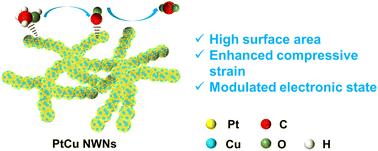
Developing platinum-based electrocatalysts with high CO tolerance for the methanol oxidation reaction (MOR) is crucial for the practical application of direct methanol fuel cells (DMFCs). Herein, we employed a straightforward one-step method to synthesize PtxCuy network nanowires (NWNs), which exhibit the advantages of structural stability and bimetallic ensembles. The synergistic effect of compressive strain and the ligand effect, induced by Cu incorporation, can effectively lower the d-band center of Pt, thereby weakening the adsorption strength of CO on the catalyst surface. The optimized Pt42Cu58 NWNs deliver a peak mass activity of 1.33 A mgPt−1 and a specific activity of 4.43 mA cm−2 for the MOR, which are 3.03 and 4.03 times higher than those of commercial Pt/C, respectively. The CO stripping and in situ Fourier transform infrared spectroscopy results indicate their high anti-CO poisoning ability and methanol activation capacity. Moreover, the Pt42Cu58 NWNs also exhibit an excellent stability with high current densities observed after 3600 s of operation due to the enhanced CO tolerance and the stable three-dimensional (3D) network structure. This work provides a feasible strategy to suppress CO poisoning during the MOR and obtain highly efficient anode catalysts with enhanced durability in the DMFC field.
开发对甲醇氧化反应(MOR)具有高二氧化碳耐受性的铂基电催化剂对于直接甲醇燃料电池(DMFC)的实际应用至关重要。在此,我们采用简单的一步法合成了 PtxCuy 网络纳米线(NWNs),它具有结构稳定和双金属组合的优点。掺入 Cu 所产生的压缩应变和配体效应的协同作用可有效降低铂的 d 带中心,从而削弱 CO 在催化剂表面的吸附强度。优化后的 Pt42Cu58 NWNs 对 MOR 的峰值质量活性为 1.33 A mgPt-1,比活性为 4.43 mA cm-2,分别是商用 Pt/C 的 3.03 倍和 4.03 倍。CO 剥离和原位傅立叶变换红外光谱结果表明,其具有很强的抗 CO 中毒能力和甲醇活化能力。此外,由于 Pt42Cu58 NWNs 对 CO 的耐受性增强,且具有稳定的三维(3D)网络结构,因此在运行 3600 秒后仍能观察到较高的电流密度,表现出极佳的稳定性。这项研究为抑制 MOR 过程中的 CO 中毒和获得高效阳极催化剂提供了可行的策略,并提高了 DMFC 领域的耐用性。
期刊介绍:
Chemical Science is a journal that encompasses various disciplines within the chemical sciences. Its scope includes publishing ground-breaking research with significant implications for its respective field, as well as appealing to a wider audience in related areas. To be considered for publication, articles must showcase innovative and original advances in their field of study and be presented in a manner that is understandable to scientists from diverse backgrounds. However, the journal generally does not publish highly specialized research.




 京公网安备 11010802042870号
京ICP备2023020795号-1
京公网安备 11010802042870号
京ICP备2023020795号-1

 分享
分享
 求助内容:
求助内容: 应助结果提醒方式:
 扫码关注我们
