Kenneth S. Kendler, Henrik Ohlsson, Jan Sundquist, Kristina Sundquist
{"title":"The moderation of genetic risk for ten major psychiatric and substance use disorders by the genetic aptitude for educational attainment","authors":"Kenneth S. Kendler, Henrik Ohlsson, Jan Sundquist, Kristina Sundquist","doi":"10.1038/s41380-025-03022-z","DOIUrl":null,"url":null,"abstract":"We seek to clarify the impact of the Genetic Aptitude for Educational Attainment (GAEA) on risk for 10 psychiatric disorders divided into 4 groups: Internalizing, Externalizing, Eating/Compulsive and Psychotic. Educational attainment and psychiatric and substance use disorder information were obtained from national Swedish registries. GAEA and disorder-specific family genetic risk score (FGRS) were calculated from extended pedigrees. In males, information on IQ and resilience was obtained from the Swedish conscript registry. Affected individuals were born in Sweden from 1973–1995 to Swedish born parents. Controlling for disorder specific FGRS, GAEA were negatively and substantially associated with risk for externalizing and internalizing disorders, minimally associated with psychotic disorder risk and positively and modestly associated with risk for eating/compulsive disorders. While the majority of GAEA effect on risk for externalizing disorders was mediated through impact on IQ, for internalizing disorders, mediation was largely through resilience. For externalizing and internalizing disorders, interactions between GAEA and disorder specific FGRS were robust and negative – the slope of disorder risk with increasing genetic liability was steepest in those with low GAEA. For eating disorders, interactions were modest and positive –the slope of risk with increasing genetic liability being steepest in individuals with high GAEA. We found that the impact of GAEA on risk for psychiatric and substance can be substantial and varies widely across disorders in magnitude, direction, and mediation. GAEA also often interacts, sometimes robustly, with disorder specific genetic risk factors. Comprehensive risk models for psychiatric disorders should consider the inclusion of GAEA.","PeriodicalId":19008,"journal":{"name":"Molecular Psychiatry","volume":"30 7","pages":"3160-3167"},"PeriodicalIF":10.1000,"publicationDate":"2025-04-17","publicationTypes":"Journal Article","fieldsOfStudy":null,"isOpenAccess":false,"openAccessPdf":"https://www.nature.comhttps://www.nature.com/articles/s41380-025-03022-z.pdf","citationCount":"0","resultStr":null,"platform":"Semanticscholar","paperid":null,"PeriodicalName":"Molecular Psychiatry","FirstCategoryId":"3","ListUrlMain":"https://www.nature.com/articles/s41380-025-03022-z","RegionNum":1,"RegionCategory":"医学","ArticlePicture":[],"TitleCN":null,"AbstractTextCN":null,"PMCID":null,"EPubDate":"","PubModel":"","JCR":"Q1","JCRName":"BIOCHEMISTRY & MOLECULAR BIOLOGY","Score":null,"Total":0}
引用次数: 0
Abstract
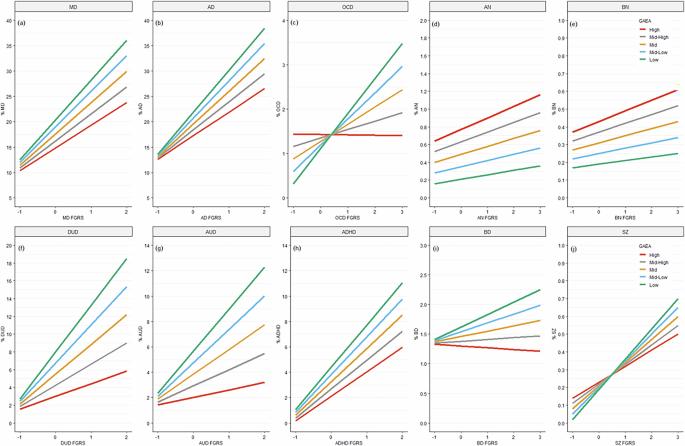
We seek to clarify the impact of the Genetic Aptitude for Educational Attainment (GAEA) on risk for 10 psychiatric disorders divided into 4 groups: Internalizing, Externalizing, Eating/Compulsive and Psychotic. Educational attainment and psychiatric and substance use disorder information were obtained from national Swedish registries. GAEA and disorder-specific family genetic risk score (FGRS) were calculated from extended pedigrees. In males, information on IQ and resilience was obtained from the Swedish conscript registry. Affected individuals were born in Sweden from 1973–1995 to Swedish born parents. Controlling for disorder specific FGRS, GAEA were negatively and substantially associated with risk for externalizing and internalizing disorders, minimally associated with psychotic disorder risk and positively and modestly associated with risk for eating/compulsive disorders. While the majority of GAEA effect on risk for externalizing disorders was mediated through impact on IQ, for internalizing disorders, mediation was largely through resilience. For externalizing and internalizing disorders, interactions between GAEA and disorder specific FGRS were robust and negative – the slope of disorder risk with increasing genetic liability was steepest in those with low GAEA. For eating disorders, interactions were modest and positive –the slope of risk with increasing genetic liability being steepest in individuals with high GAEA. We found that the impact of GAEA on risk for psychiatric and substance can be substantial and varies widely across disorders in magnitude, direction, and mediation. GAEA also often interacts, sometimes robustly, with disorder specific genetic risk factors. Comprehensive risk models for psychiatric disorders should consider the inclusion of GAEA.
期刊介绍:
Molecular Psychiatry focuses on publishing research that aims to uncover the biological mechanisms behind psychiatric disorders and their treatment. The journal emphasizes studies that bridge pre-clinical and clinical research, covering cellular, molecular, integrative, clinical, imaging, and psychopharmacology levels.




 京公网安备 11010802042870号
京ICP备2023020795号-1
京公网安备 11010802042870号
京ICP备2023020795号-1

 分享
分享
 求助内容:
求助内容: 应助结果提醒方式:
 扫码关注我们
