Fabrication of the Fe3O4/Cu-BTC Metal–Organic Framework Composite: A Magnetically Retrievable Efficient Catalytic Material for Hydration of Nitriles to Amides in Water
{"title":"Fabrication of the Fe3O4/Cu-BTC Metal–Organic Framework Composite: A Magnetically Retrievable Efficient Catalytic Material for Hydration of Nitriles to Amides in Water","authors":"Mayuri Dutta, Jyotismita Bora, Gunjan Hazarika, Nikita Debgupta and Bolin Chetia*, ","doi":"10.1021/acs.chemmater.5c00449","DOIUrl":null,"url":null,"abstract":"<p >Metal–organic frameworks (MOFs) have become a rising star in the field of materials chemistry and engineering owing to their fascinating physico-chemical properties. The amalgamation of magnetic nanostructures with MOFs allows researchers to design promising hybrid materials with enhanced catalytic activity for desired organic transformations compared to their individual counterparts, facile separability, and reusability. In this contribution, the present work successfully reports the fabrication of a hybrid magnetic metal–organic framework (MMOF) material named Fe<sub>3</sub>O<sub>4</sub>/Cu-BTC via a facile hydrothermal approach with ferromagnetic properties and a large specific surface area of about 189.891 m<sup>2</sup> g<sup>–1</sup>. The physico-chemical properties of as-synthesized materials were established via various spectroscopic, microscopic, and physical techniques. The catalytic activity of Fe<sub>3</sub>O<sub>4</sub>/Cu-BTC was evaluated for the hydration of nitriles to primary amides, and the catalyst was found to be efficient with up to 99% isolated yield. The catalyst was magnetically recoverable within a time span of 60 s and reusable up to the six catalytic cycles without any significant loss of catalytic activity. Large specific surface area, excellent magnetic retrievability, superior recyclability, and wider functional group tolerance are the outstanding features of this protocol.</p>","PeriodicalId":33,"journal":{"name":"Chemistry of Materials","volume":"37 12","pages":"4402–4415"},"PeriodicalIF":7.0000,"publicationDate":"2025-04-18","publicationTypes":"Journal Article","fieldsOfStudy":null,"isOpenAccess":false,"openAccessPdf":"","citationCount":"0","resultStr":null,"platform":"Semanticscholar","paperid":null,"PeriodicalName":"Chemistry of Materials","FirstCategoryId":"88","ListUrlMain":"https://pubs.acs.org/doi/10.1021/acs.chemmater.5c00449","RegionNum":2,"RegionCategory":"材料科学","ArticlePicture":[],"TitleCN":null,"AbstractTextCN":null,"PMCID":null,"EPubDate":"","PubModel":"","JCR":"Q2","JCRName":"CHEMISTRY, PHYSICAL","Score":null,"Total":0}
引用次数: 0
Abstract
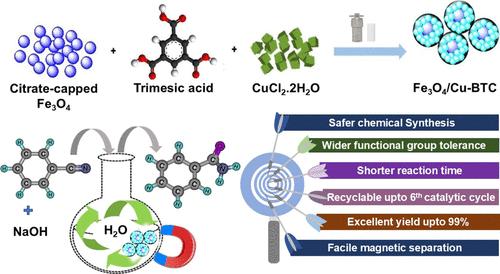
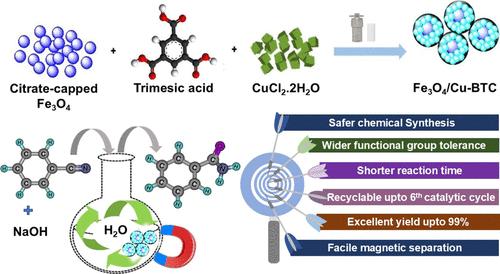
Metal–organic frameworks (MOFs) have become a rising star in the field of materials chemistry and engineering owing to their fascinating physico-chemical properties. The amalgamation of magnetic nanostructures with MOFs allows researchers to design promising hybrid materials with enhanced catalytic activity for desired organic transformations compared to their individual counterparts, facile separability, and reusability. In this contribution, the present work successfully reports the fabrication of a hybrid magnetic metal–organic framework (MMOF) material named Fe3O4/Cu-BTC via a facile hydrothermal approach with ferromagnetic properties and a large specific surface area of about 189.891 m2 g–1. The physico-chemical properties of as-synthesized materials were established via various spectroscopic, microscopic, and physical techniques. The catalytic activity of Fe3O4/Cu-BTC was evaluated for the hydration of nitriles to primary amides, and the catalyst was found to be efficient with up to 99% isolated yield. The catalyst was magnetically recoverable within a time span of 60 s and reusable up to the six catalytic cycles without any significant loss of catalytic activity. Large specific surface area, excellent magnetic retrievability, superior recyclability, and wider functional group tolerance are the outstanding features of this protocol.
期刊介绍:
The journal Chemistry of Materials focuses on publishing original research at the intersection of materials science and chemistry. The studies published in the journal involve chemistry as a prominent component and explore topics such as the design, synthesis, characterization, processing, understanding, and application of functional or potentially functional materials. The journal covers various areas of interest, including inorganic and organic solid-state chemistry, nanomaterials, biomaterials, thin films and polymers, and composite/hybrid materials. The journal particularly seeks papers that highlight the creation or development of innovative materials with novel optical, electrical, magnetic, catalytic, or mechanical properties. It is essential that manuscripts on these topics have a primary focus on the chemistry of materials and represent a significant advancement compared to prior research. Before external reviews are sought, submitted manuscripts undergo a review process by a minimum of two editors to ensure their appropriateness for the journal and the presence of sufficient evidence of a significant advance that will be of broad interest to the materials chemistry community.



 京公网安备 11010802042870号
京ICP备2023020795号-1
京公网安备 11010802042870号
京ICP备2023020795号-1

 分享
分享
 求助内容:
求助内容: 应助结果提醒方式:
 扫码关注我们
