Daping Xia , Hang Lv , Zhenhong Chen , Hao Chen , Pengfei Su
{"title":"Bioconversion of coal to Biogas: Insights into the microbial degradation mechanisms and molecular structure transformations","authors":"Daping Xia , Hang Lv , Zhenhong Chen , Hao Chen , Pengfei Su","doi":"10.1016/j.ces.2025.121706","DOIUrl":null,"url":null,"abstract":"<div><div>This study explores the microbial degradation mechanisms and molecular structural transitions of coal during the bioconversion process. We built macromolecular structure models of coal samples at various stages of anaerobic fermentation by analyzing its elemental makeup, carbon framework, surface groups, and pore changes, and using molecular simulation. Experimental results indicate that: the pore size of the coal sample increased from 3.04 nm to 5.0 nm, accompanied by a slight increase in the interlayer spacing d<sub>002</sub> of the aromatic layers, with a decrease in both the microcrystalline extension L<sub>a</sub> and the stacking height L<sub>c</sub>, suggesting the disruption of the coal sample’s microcrystalline structure. During the biogas production process, the molecular structural transformations are primarily focused on the side chains, specifically characterized by a reduction in − CH<sub>2</sub> − groups within the aliphatic chains, consumption of − OH groups, and the formation of − COOH groups. Notably, the cleavage of benzene rings occurs at the initial stage of biogas production, while the degradation of naphthalene rings takes place during the biogas production peak, indicating that the aromatic structures significantly influence the biogas production process in lignite. GC–MS analysis of the fermentation liquid revealed that benzene compounds are the main constituents, suggesting that the degradation of naphthalene rings occurs through an open-ring mechanism rather than a direct degradation pathway. During microbial fermentation, the model’s total potential energy drops significantly, making it more stable. This change increases non-six-membered rings and lattice defects, affecting the coal’s pore structure and reducing its surface fractal dimension.</div></div>","PeriodicalId":271,"journal":{"name":"Chemical Engineering Science","volume":"312 ","pages":"Article 121706"},"PeriodicalIF":4.3000,"publicationDate":"2025-06-15","publicationTypes":"Journal Article","fieldsOfStudy":null,"isOpenAccess":false,"openAccessPdf":"","citationCount":"0","resultStr":null,"platform":"Semanticscholar","paperid":null,"PeriodicalName":"Chemical Engineering Science","FirstCategoryId":"5","ListUrlMain":"https://www.sciencedirect.com/science/article/pii/S0009250925005299","RegionNum":2,"RegionCategory":"工程技术","ArticlePicture":[],"TitleCN":null,"AbstractTextCN":null,"PMCID":null,"EPubDate":"2025/4/19 0:00:00","PubModel":"Epub","JCR":"Q2","JCRName":"ENGINEERING, CHEMICAL","Score":null,"Total":0}
引用次数: 0
Abstract
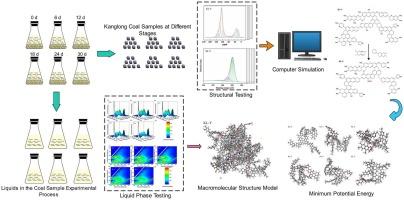
This study explores the microbial degradation mechanisms and molecular structural transitions of coal during the bioconversion process. We built macromolecular structure models of coal samples at various stages of anaerobic fermentation by analyzing its elemental makeup, carbon framework, surface groups, and pore changes, and using molecular simulation. Experimental results indicate that: the pore size of the coal sample increased from 3.04 nm to 5.0 nm, accompanied by a slight increase in the interlayer spacing d002 of the aromatic layers, with a decrease in both the microcrystalline extension La and the stacking height Lc, suggesting the disruption of the coal sample’s microcrystalline structure. During the biogas production process, the molecular structural transformations are primarily focused on the side chains, specifically characterized by a reduction in − CH2 − groups within the aliphatic chains, consumption of − OH groups, and the formation of − COOH groups. Notably, the cleavage of benzene rings occurs at the initial stage of biogas production, while the degradation of naphthalene rings takes place during the biogas production peak, indicating that the aromatic structures significantly influence the biogas production process in lignite. GC–MS analysis of the fermentation liquid revealed that benzene compounds are the main constituents, suggesting that the degradation of naphthalene rings occurs through an open-ring mechanism rather than a direct degradation pathway. During microbial fermentation, the model’s total potential energy drops significantly, making it more stable. This change increases non-six-membered rings and lattice defects, affecting the coal’s pore structure and reducing its surface fractal dimension.
期刊介绍:
Chemical engineering enables the transformation of natural resources and energy into useful products for society. It draws on and applies natural sciences, mathematics and economics, and has developed fundamental engineering science that underpins the discipline.
Chemical Engineering Science (CES) has been publishing papers on the fundamentals of chemical engineering since 1951. CES is the platform where the most significant advances in the discipline have ever since been published. Chemical Engineering Science has accompanied and sustained chemical engineering through its development into the vibrant and broad scientific discipline it is today.




 京公网安备 11010802042870号
京ICP备2023020795号-1
京公网安备 11010802042870号
京ICP备2023020795号-1

 分享
分享
 求助内容:
求助内容: 应助结果提醒方式:
 扫码关注我们
