{"title":"Scaling Laws for Charge Transport in Isotropic Bulks and Solutions of Conjugated Polymers","authors":"Jiayi Huang, Artem M. Rumyantsev","doi":"10.1021/acs.macromol.5c00344","DOIUrl":null,"url":null,"abstract":"Conjugated polymers comprise alternating single and double bonds along the backbones, which ensures their electrical conductivity. Herein, charge transport in them is modeled as a diffusion process, with two types of mechanisms involved: intra- and interchain hopping characterized by τ<sub>1</sub> and τ<sub>2</sub> times, respectively. Charge carriers’ diffusivity in isotropic melts and semidilute solutions of conjugated polymers under a weak electric field is calculated. By extending de Gennes’ approach [<i>Phys. A: Stat. Mech. Appl.</i> <b>1986</b>, <i>138</i>, 206–219], we identify three universal regimes of charge transport. In the free regime, charges rapidly hop between different chains so that the charge carrier diffusivity is <i>D</i><sub>F</sub> ∼ τ<sub>1</sub><sup>–1</sup><i>N</i><sup>0</sup>. In the semifree regime, interchain hopping is slow compared to intrachain hopping, which makes diffusivity dependent on both characteristic times, <i>D</i><sub>SF</sub> ∼ (τ<sub>1</sub>τ<sub>2</sub>)<sup>−1/2</sup><i>N</i><sup>0</sup>. Finally, in the captive regime, interchain hopping is strongly hindered, causing the charge carriers to traverse the entire chain before hopping to another. For flexible polymers, this leads to diffusivity increasing linearly with the chain length <i>N</i>, <i>D</i><sub>C</sub> ∼ τ<sub>2</sub><sup>–1</sup><i>N</i><sup>1</sup>. These laws also hold for semiflexible polymers and/or semidilute solutions, where the pairwise contact probability depends on the polymer volume fraction. Weakly and strongly fluctuating solutions are considered within the mean-field and scaling approaches, respectively. In addition to the diffusion (charge hopping) model, the conductivity of polymer systems is quantitatively described by considering them as finite resistor ladders. The charge carrier’s diffusivity and the resulting conductivity in alternating current (AC) are predicted as a function of its frequency. We believe that our findings will facilitate the rational design of polymer-based flexible and stretchable electronic devices.","PeriodicalId":51,"journal":{"name":"Macromolecules","volume":"29 1","pages":""},"PeriodicalIF":5.2000,"publicationDate":"2025-04-19","publicationTypes":"Journal Article","fieldsOfStudy":null,"isOpenAccess":false,"openAccessPdf":"","citationCount":"0","resultStr":null,"platform":"Semanticscholar","paperid":null,"PeriodicalName":"Macromolecules","FirstCategoryId":"92","ListUrlMain":"https://doi.org/10.1021/acs.macromol.5c00344","RegionNum":1,"RegionCategory":"化学","ArticlePicture":[],"TitleCN":null,"AbstractTextCN":null,"PMCID":null,"EPubDate":"","PubModel":"","JCR":"Q1","JCRName":"POLYMER SCIENCE","Score":null,"Total":0}
引用次数: 0
Abstract
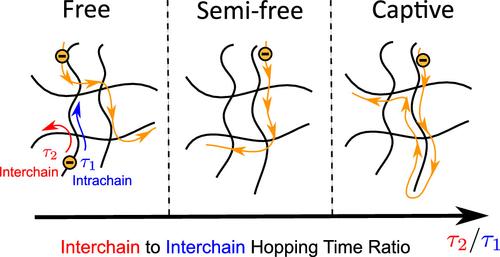
Conjugated polymers comprise alternating single and double bonds along the backbones, which ensures their electrical conductivity. Herein, charge transport in them is modeled as a diffusion process, with two types of mechanisms involved: intra- and interchain hopping characterized by τ1 and τ2 times, respectively. Charge carriers’ diffusivity in isotropic melts and semidilute solutions of conjugated polymers under a weak electric field is calculated. By extending de Gennes’ approach [Phys. A: Stat. Mech. Appl.1986, 138, 206–219], we identify three universal regimes of charge transport. In the free regime, charges rapidly hop between different chains so that the charge carrier diffusivity is DF ∼ τ1–1N0. In the semifree regime, interchain hopping is slow compared to intrachain hopping, which makes diffusivity dependent on both characteristic times, DSF ∼ (τ1τ2)−1/2N0. Finally, in the captive regime, interchain hopping is strongly hindered, causing the charge carriers to traverse the entire chain before hopping to another. For flexible polymers, this leads to diffusivity increasing linearly with the chain length N, DC ∼ τ2–1N1. These laws also hold for semiflexible polymers and/or semidilute solutions, where the pairwise contact probability depends on the polymer volume fraction. Weakly and strongly fluctuating solutions are considered within the mean-field and scaling approaches, respectively. In addition to the diffusion (charge hopping) model, the conductivity of polymer systems is quantitatively described by considering them as finite resistor ladders. The charge carrier’s diffusivity and the resulting conductivity in alternating current (AC) are predicted as a function of its frequency. We believe that our findings will facilitate the rational design of polymer-based flexible and stretchable electronic devices.
期刊介绍:
Macromolecules publishes original, fundamental, and impactful research on all aspects of polymer science. Topics of interest include synthesis (e.g., controlled polymerizations, polymerization catalysis, post polymerization modification, new monomer structures and polymer architectures, and polymerization mechanisms/kinetics analysis); phase behavior, thermodynamics, dynamic, and ordering/disordering phenomena (e.g., self-assembly, gelation, crystallization, solution/melt/solid-state characteristics); structure and properties (e.g., mechanical and rheological properties, surface/interfacial characteristics, electronic and transport properties); new state of the art characterization (e.g., spectroscopy, scattering, microscopy, rheology), simulation (e.g., Monte Carlo, molecular dynamics, multi-scale/coarse-grained modeling), and theoretical methods. Renewable/sustainable polymers, polymer networks, responsive polymers, electro-, magneto- and opto-active macromolecules, inorganic polymers, charge-transporting polymers (ion-containing, semiconducting, and conducting), nanostructured polymers, and polymer composites are also of interest. Typical papers published in Macromolecules showcase important and innovative concepts, experimental methods/observations, and theoretical/computational approaches that demonstrate a fundamental advance in the understanding of polymers.



 京公网安备 11010802042870号
京ICP备2023020795号-1
京公网安备 11010802042870号
京ICP备2023020795号-1

 分享
分享
 求助内容:
求助内容: 应助结果提醒方式:
 扫码关注我们
