Ke Wang, Xiaofang Liu, Ziyan Li, Fan Zhao, Guiyan Liu, Yongfei Zeng
{"title":"New Family of Multistimuli-Responsive Acrylamide-Based Homopolymers: Synthesis, Responsive Behavior, and Application in Controlled Release","authors":"Ke Wang, Xiaofang Liu, Ziyan Li, Fan Zhao, Guiyan Liu, Yongfei Zeng","doi":"10.1021/acs.macromol.5c00573","DOIUrl":null,"url":null,"abstract":"A new family of multistimuli-responsive acrylamide-based homopolymers with different end pendant substituents were prepared by reversible addition–fragmentation chain transfer (RAFT) polymerization. They include three types of multistimuli-response: temperature/pH/CO<sub>2</sub>-response, temperature/pH/redox-response, and temperature/pH/light-response. When the terminal substituent was ethyl and tetrahydropyran, P(Et-N-AM) and P(THP-N-AM) exhibited lower critical solution temperature (LCST) behavior in water, which can be adjusted by degree of polymerization (DP) and concentration of polymer, additives, pH, and the injection of CO<sub>2</sub>/N<sub>2</sub> to the solution. When the terminal substituents were phenyl, ferrocene, and azobenzene, P(Ph-N-AM), P(Fc-N-AM), and P(Azo-N-AM) were insoluble in water due to the increase of hydrophobicity, but the upper critical solution temperature (UCST) was exhibited in the mixed solution of <sup><i>n</i></sup>BuOH/water and can be adjusted by the addition of acid or base. P(Fc-N-AM) was also redox-responsive, and its UV/vis absorption peaks changed with the addition of FeCl<sub>3</sub>/VC. P(Azo-N-AM) was also light-responsive, and under UV/blue light radiation, the characteristic peaks of its UV/vis absorption spectrum changed reversibly. In addition, the three homopolymers were amphiphilic, which can self-assemble in solution, and the obtained micelles were also responsive. Finally, nile red (NR) was used as a hydrophobic drug model, and the controlled release behavior of NR-loaded micelles of P(Fc-N-AM) and P(Azo-N-AM) under different stimuli was investigated. This work has greatly enriched the family of multistimuli-responsive poly(<i>N</i>-substituted acrylamide)s, and the synthetic steps of homopolymers were simple; the responsive behavior was sensitive, and the species were rich. It provides a reference for the design of novel stimuli-responsive polymers and has a good application prospect in self-assembly, drug release, and other fields.","PeriodicalId":51,"journal":{"name":"Macromolecules","volume":"28 1","pages":""},"PeriodicalIF":5.2000,"publicationDate":"2025-04-19","publicationTypes":"Journal Article","fieldsOfStudy":null,"isOpenAccess":false,"openAccessPdf":"","citationCount":"0","resultStr":null,"platform":"Semanticscholar","paperid":null,"PeriodicalName":"Macromolecules","FirstCategoryId":"92","ListUrlMain":"https://doi.org/10.1021/acs.macromol.5c00573","RegionNum":1,"RegionCategory":"化学","ArticlePicture":[],"TitleCN":null,"AbstractTextCN":null,"PMCID":null,"EPubDate":"","PubModel":"","JCR":"Q1","JCRName":"POLYMER SCIENCE","Score":null,"Total":0}
引用次数: 0
Abstract
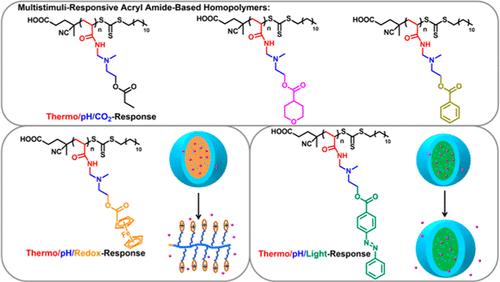
A new family of multistimuli-responsive acrylamide-based homopolymers with different end pendant substituents were prepared by reversible addition–fragmentation chain transfer (RAFT) polymerization. They include three types of multistimuli-response: temperature/pH/CO2-response, temperature/pH/redox-response, and temperature/pH/light-response. When the terminal substituent was ethyl and tetrahydropyran, P(Et-N-AM) and P(THP-N-AM) exhibited lower critical solution temperature (LCST) behavior in water, which can be adjusted by degree of polymerization (DP) and concentration of polymer, additives, pH, and the injection of CO2/N2 to the solution. When the terminal substituents were phenyl, ferrocene, and azobenzene, P(Ph-N-AM), P(Fc-N-AM), and P(Azo-N-AM) were insoluble in water due to the increase of hydrophobicity, but the upper critical solution temperature (UCST) was exhibited in the mixed solution of nBuOH/water and can be adjusted by the addition of acid or base. P(Fc-N-AM) was also redox-responsive, and its UV/vis absorption peaks changed with the addition of FeCl3/VC. P(Azo-N-AM) was also light-responsive, and under UV/blue light radiation, the characteristic peaks of its UV/vis absorption spectrum changed reversibly. In addition, the three homopolymers were amphiphilic, which can self-assemble in solution, and the obtained micelles were also responsive. Finally, nile red (NR) was used as a hydrophobic drug model, and the controlled release behavior of NR-loaded micelles of P(Fc-N-AM) and P(Azo-N-AM) under different stimuli was investigated. This work has greatly enriched the family of multistimuli-responsive poly(N-substituted acrylamide)s, and the synthetic steps of homopolymers were simple; the responsive behavior was sensitive, and the species were rich. It provides a reference for the design of novel stimuli-responsive polymers and has a good application prospect in self-assembly, drug release, and other fields.
采用可逆加成-断裂链转移(RAFT)聚合法制备了具有不同端垂取代基的多刺激响应的新型丙烯酰胺基均聚物。它们包括三种类型的多刺激反应:温度/pH/ co2反应、温度/pH/氧化还原反应和温度/pH/光反应。当末端取代基为乙基和四氢吡喃时,P(Et-N-AM)和P(THP-N-AM)在水中表现出较低的临界溶液温度(LCST)行为,这可以通过聚合度(DP)、聚合物浓度、添加剂、pH和溶液中CO2/N2的注入来调节。当末端取代基为苯基、二茂铁和偶氮苯时,P(Ph-N-AM)、P(Fc-N-AM)和P(偶氮- n - am)由于疏水性增加而不溶于水,但在nBuOH/水的混合溶液中表现出较高的临界溶液温度(UCST),并可通过添加酸或碱来调节。P(Fc-N-AM)也有氧化还原反应,其紫外/可见吸收峰随FeCl3/VC的加入而变化。P(Azo-N-AM)也具有光响应性,在紫外/蓝光辐射下,其紫外/可见吸收光谱特征峰发生可逆变化。此外,这三种均聚物具有两亲性,在溶液中可以自组装,并且得到的胶束也具有响应性。最后,以尼罗红(NR)为疏水药物模型,研究了载NR胶束的P(Fc-N-AM)和P(偶氮- n - am)在不同刺激下的控释行为。这项工作极大地丰富了多刺激响应型聚(n -取代丙烯酰胺)家族,且均聚物的合成步骤简单;反应行为灵敏,种类丰富。为新型刺激响应聚合物的设计提供了参考,在自组装、药物释放等领域具有良好的应用前景。
期刊介绍:
Macromolecules publishes original, fundamental, and impactful research on all aspects of polymer science. Topics of interest include synthesis (e.g., controlled polymerizations, polymerization catalysis, post polymerization modification, new monomer structures and polymer architectures, and polymerization mechanisms/kinetics analysis); phase behavior, thermodynamics, dynamic, and ordering/disordering phenomena (e.g., self-assembly, gelation, crystallization, solution/melt/solid-state characteristics); structure and properties (e.g., mechanical and rheological properties, surface/interfacial characteristics, electronic and transport properties); new state of the art characterization (e.g., spectroscopy, scattering, microscopy, rheology), simulation (e.g., Monte Carlo, molecular dynamics, multi-scale/coarse-grained modeling), and theoretical methods. Renewable/sustainable polymers, polymer networks, responsive polymers, electro-, magneto- and opto-active macromolecules, inorganic polymers, charge-transporting polymers (ion-containing, semiconducting, and conducting), nanostructured polymers, and polymer composites are also of interest. Typical papers published in Macromolecules showcase important and innovative concepts, experimental methods/observations, and theoretical/computational approaches that demonstrate a fundamental advance in the understanding of polymers.




 京公网安备 11010802042870号
京ICP备2023020795号-1
京公网安备 11010802042870号
京ICP备2023020795号-1

 分享
分享
 求助内容:
求助内容: 应助结果提醒方式:
 扫码关注我们
