{"title":"Correction to “Visualizing Stereodynamics in Cold Collisions through Shape Resonance Wavefunctions”","authors":"Yilang Liu, Dongzheng Yang, Hua Guo, Daiqian Xie","doi":"10.1021/acs.jpclett.5c01029","DOIUrl":null,"url":null,"abstract":"Two mistakes have recently been identified in the original paper, (1) which lead to some changes in the calculation results. First, the initial rotational state of the aligned H<sub>2</sub> molecule in eq 2 was defined with the order of subscripts <i>m</i><sub>1</sub> and 0 reversed in the reduced Wigner rotation matrix elements <i>d</i><sub><i>m</i><sub>1</sub>,0</sub><sup><i>j</i><sub>1</sub></sup>(β). The correct eq 2 should read The second mistake is concerned with the azimuthal angle dependence (2,3) of the scattering amplitude and differential cross section (DCS) in eqs 1 and 3, which was neglected in the original publication. The azimuthal angle (ϕ) is depicted in Figure S1 of the Supporting Information. The correct eqs 1 and 3 should read respectively Figure 1. Integral cross sections for <i>para</i>-H<sub>2</sub> (<i>v</i><sub>1</sub> = 1, <i>j</i><sub>1</sub> = 2) + HF (<i>v</i><sub>2</sub> = 0, <i>j</i><sub>2</sub> = 0) → <i>para</i>-H<sub>2</sub> (<i>v′</i><sub>1</sub> = 1, <i>j′</i><sub>1</sub> = 0) + HF (<i>v′</i><sub>2</sub> = 0, <i>j′</i><sub>2</sub> = 3). (a) Partial wave resolved ICSs. (b) ICSs for different initially aligned H<sub>2</sub>. Figure S3. Integral cross sections for the collisional process <i>para</i>-H<sub>2</sub> (<i>v</i><sub>1</sub> = 1, <i>j</i><sub>1</sub> = 2) + HF (<i>v</i><sub>2</sub> = 0, <i>j</i><sub>2</sub> = 0) → <i>para</i>-H<sub>2</sub> (<i>v′</i><sub>1</sub> = 1, <i>j′</i><sub>1</sub> = 0) + HF (<i>v′</i><sub>2</sub> = 0, <i>j′</i><sub>2</sub> = 0, 1, 2). Left panels: Partial wave resolved ICSs. Right panels: ICSs for different initially aligned H<sub>2</sub>. These errors did not change the scientific conclusions in the original paper. This article references 4 other publications. This article has not yet been cited by other publications.","PeriodicalId":62,"journal":{"name":"The Journal of Physical Chemistry Letters","volume":"11 1","pages":""},"PeriodicalIF":4.6000,"publicationDate":"2025-04-18","publicationTypes":"Journal Article","fieldsOfStudy":null,"isOpenAccess":false,"openAccessPdf":"","citationCount":"0","resultStr":null,"platform":"Semanticscholar","paperid":null,"PeriodicalName":"The Journal of Physical Chemistry Letters","FirstCategoryId":"1","ListUrlMain":"https://doi.org/10.1021/acs.jpclett.5c01029","RegionNum":2,"RegionCategory":"化学","ArticlePicture":[],"TitleCN":null,"AbstractTextCN":null,"PMCID":null,"EPubDate":"","PubModel":"","JCR":"Q2","JCRName":"CHEMISTRY, PHYSICAL","Score":null,"Total":0}
引用次数: 0
Abstract
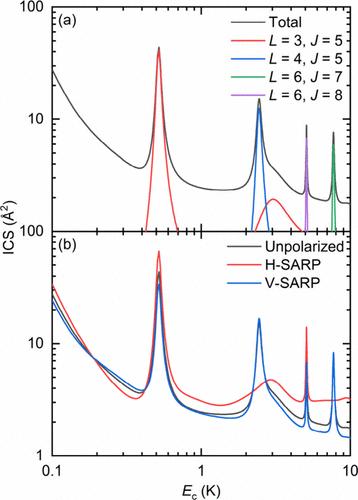
Two mistakes have recently been identified in the original paper, (1) which lead to some changes in the calculation results. First, the initial rotational state of the aligned H2 molecule in eq 2 was defined with the order of subscripts m1 and 0 reversed in the reduced Wigner rotation matrix elements dm1,0j1(β). The correct eq 2 should read The second mistake is concerned with the azimuthal angle dependence (2,3) of the scattering amplitude and differential cross section (DCS) in eqs 1 and 3, which was neglected in the original publication. The azimuthal angle (ϕ) is depicted in Figure S1 of the Supporting Information. The correct eqs 1 and 3 should read respectively Figure 1. Integral cross sections for para-H2 (v1 = 1, j1 = 2) + HF (v2 = 0, j2 = 0) → para-H2 (v′1 = 1, j′1 = 0) + HF (v′2 = 0, j′2 = 3). (a) Partial wave resolved ICSs. (b) ICSs for different initially aligned H2. Figure S3. Integral cross sections for the collisional process para-H2 (v1 = 1, j1 = 2) + HF (v2 = 0, j2 = 0) → para-H2 (v′1 = 1, j′1 = 0) + HF (v′2 = 0, j′2 = 0, 1, 2). Left panels: Partial wave resolved ICSs. Right panels: ICSs for different initially aligned H2. These errors did not change the scientific conclusions in the original paper. This article references 4 other publications. This article has not yet been cited by other publications.
期刊介绍:
The Journal of Physical Chemistry (JPC) Letters is devoted to reporting new and original experimental and theoretical basic research of interest to physical chemists, biophysical chemists, chemical physicists, physicists, material scientists, and engineers. An important criterion for acceptance is that the paper reports a significant scientific advance and/or physical insight such that rapid publication is essential. Two issues of JPC Letters are published each month.



 京公网安备 11010802042870号
京ICP备2023020795号-1
京公网安备 11010802042870号
京ICP备2023020795号-1

 分享
分享
 求助内容:
求助内容: 应助结果提醒方式:
 扫码关注我们
