{"title":"Optimized Nickel Phosphate Cocatalyst on Ge-Doped Hematite Photoanode for Selective Oxidation of 5-Hydroxymethylfurfural to 2,5-Furandicarboxylic Acid","authors":"Jun-Wei Cai, Lu-Min Wu, Wen-Hao Lee, Chih-En Chuang and Tai-Chou Lee*, ","doi":"10.1021/acssuschemeng.4c08378","DOIUrl":null,"url":null,"abstract":"<p >The kinetics of the anode oxygen evolution reaction (OER) in photoelectrochemical (PEC) cells present challenges, motivating the exploration of alternative strategies such as biomass oxidation to yield high-value chemicals. In this study, we investigate the applications of nontoxic, stable, and earth-abundant α-Fe<sub>2</sub>O<sub>3</sub> as a photoanode. In the first part of the research, a Ge-doped α-Fe<sub>2</sub>O<sub>3</sub> thin film was synthesized via a hydrothermal method, with germanium oxide (GeO<sub>2</sub>) introduced into the iron oxide precursor to prepare Ge-doped α-Fe<sub>2</sub>O<sub>3</sub> thin films. We then identified a carbonate-bicarbonate solution as a suitable electrolyte for the α-Fe<sub>2</sub>O<sub>3</sub> photoanode and for the selective oxidation of 5-hydroxymethylfurfural (HMF) into 2,5-furandicarboxylic acid (FDCA), a precursor for polyethylene 2,5-furandicarboxylate (PEF) synthesis. To further enhance photoelectrochemical oxidation performance, nickel phosphate (Ni–P), a cocatalyst, was loaded on top of the Ge-doped α-Fe<sub>2</sub>O<sub>3</sub> by varying electrodeposition time and precursor concentration. Furthermore, we introduced 2,2,6,6-tetramethylpiperidine-1-oxyl (TEMPO) as a mediator to facilitate selective HMF oxidation. Our results indicated that an electrodeposition time of 30 min and a molar ratio of nickel to phosphate in the precursor of Ni<sub>0.075</sub>P (Ni:P = 15:200) yield optimal results for selective oxidation. Relative to the unloaded case, the selectivity of FDCA increases from 35.4% to 67.1% after 12 h of reaction, with a simultaneous increase in yield from 11.8% to 41.0% and HMF conversion reaching 61.1%. α-Fe<sub>2</sub>O<sub>3</sub> shows promise as a photoanode for the selective oxidation of HMF, and the incorporation of Ni–P as a cocatalyst significantly contributes to FDCA formation. This research presents an environmentally sustainable approach to harnessing solar energy for the conversion of biomass into valuable chemical products.</p><p >In this study, we investigate the applications of nontoxic, stable, and earth-abundant α-Fe<sub>2</sub>O<sub>3</sub> as a photoanode. In the first part of the research, a Ge-doped α-Fe<sub>2</sub>O<sub>3</sub> thin film was synthesized via a hydrothermal method, with germanium oxide (GeO<sub>2</sub>) introduced into the iron oxide precursor to prepare Ge-doped α-Fe<sub>2</sub>O<sub>3</sub> thin films. We then identified a carbonate-bicarbonate solution as a suitable electrolyte for the α-Fe<sub>2</sub>O<sub>3</sub> photoanode and for the selective oxidation of 5-hydroxymethylfurfural (HMF) into 2,5-furandicarboxylic acid (FDCA), a precursor for polyethylene 2,5-furandicarboxylate (PEF) synthesis. To further enhance photoelectrochemical oxidation performance, nickel phosphate (Ni−P), a cocatalyst, was loaded on top of the Ge-doped α-Fe<sub>2</sub>O<sub>3</sub> by varying electrodeposition time and precursor concentration.</p>","PeriodicalId":25,"journal":{"name":"ACS Sustainable Chemistry & Engineering","volume":"13 15","pages":"5483–5492 5483–5492"},"PeriodicalIF":7.3000,"publicationDate":"2025-04-10","publicationTypes":"Journal Article","fieldsOfStudy":null,"isOpenAccess":false,"openAccessPdf":"https://pubs.acs.org/doi/epdf/10.1021/acssuschemeng.4c08378","citationCount":"0","resultStr":null,"platform":"Semanticscholar","paperid":null,"PeriodicalName":"ACS Sustainable Chemistry & Engineering","FirstCategoryId":"92","ListUrlMain":"https://pubs.acs.org/doi/10.1021/acssuschemeng.4c08378","RegionNum":1,"RegionCategory":"化学","ArticlePicture":[],"TitleCN":null,"AbstractTextCN":null,"PMCID":null,"EPubDate":"","PubModel":"","JCR":"Q1","JCRName":"CHEMISTRY, MULTIDISCIPLINARY","Score":null,"Total":0}
引用次数: 0
Abstract
The kinetics of the anode oxygen evolution reaction (OER) in photoelectrochemical (PEC) cells present challenges, motivating the exploration of alternative strategies such as biomass oxidation to yield high-value chemicals. In this study, we investigate the applications of nontoxic, stable, and earth-abundant α-Fe2O3 as a photoanode. In the first part of the research, a Ge-doped α-Fe2O3 thin film was synthesized via a hydrothermal method, with germanium oxide (GeO2) introduced into the iron oxide precursor to prepare Ge-doped α-Fe2O3 thin films. We then identified a carbonate-bicarbonate solution as a suitable electrolyte for the α-Fe2O3 photoanode and for the selective oxidation of 5-hydroxymethylfurfural (HMF) into 2,5-furandicarboxylic acid (FDCA), a precursor for polyethylene 2,5-furandicarboxylate (PEF) synthesis. To further enhance photoelectrochemical oxidation performance, nickel phosphate (Ni–P), a cocatalyst, was loaded on top of the Ge-doped α-Fe2O3 by varying electrodeposition time and precursor concentration. Furthermore, we introduced 2,2,6,6-tetramethylpiperidine-1-oxyl (TEMPO) as a mediator to facilitate selective HMF oxidation. Our results indicated that an electrodeposition time of 30 min and a molar ratio of nickel to phosphate in the precursor of Ni0.075P (Ni:P = 15:200) yield optimal results for selective oxidation. Relative to the unloaded case, the selectivity of FDCA increases from 35.4% to 67.1% after 12 h of reaction, with a simultaneous increase in yield from 11.8% to 41.0% and HMF conversion reaching 61.1%. α-Fe2O3 shows promise as a photoanode for the selective oxidation of HMF, and the incorporation of Ni–P as a cocatalyst significantly contributes to FDCA formation. This research presents an environmentally sustainable approach to harnessing solar energy for the conversion of biomass into valuable chemical products.
In this study, we investigate the applications of nontoxic, stable, and earth-abundant α-Fe2O3 as a photoanode. In the first part of the research, a Ge-doped α-Fe2O3 thin film was synthesized via a hydrothermal method, with germanium oxide (GeO2) introduced into the iron oxide precursor to prepare Ge-doped α-Fe2O3 thin films. We then identified a carbonate-bicarbonate solution as a suitable electrolyte for the α-Fe2O3 photoanode and for the selective oxidation of 5-hydroxymethylfurfural (HMF) into 2,5-furandicarboxylic acid (FDCA), a precursor for polyethylene 2,5-furandicarboxylate (PEF) synthesis. To further enhance photoelectrochemical oxidation performance, nickel phosphate (Ni−P), a cocatalyst, was loaded on top of the Ge-doped α-Fe2O3 by varying electrodeposition time and precursor concentration.
期刊介绍:
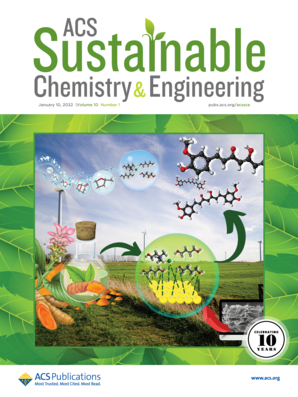
ACS Sustainable Chemistry & Engineering is a prestigious weekly peer-reviewed scientific journal published by the American Chemical Society. Dedicated to advancing the principles of green chemistry and green engineering, it covers a wide array of research topics including green chemistry, green engineering, biomass, alternative energy, and life cycle assessment.
The journal welcomes submissions in various formats, including Letters, Articles, Features, and Perspectives (Reviews), that address the challenges of sustainability in the chemical enterprise and contribute to the advancement of sustainable practices. Join us in shaping the future of sustainable chemistry and engineering.



 京公网安备 11010802042870号
京ICP备2023020795号-1
京公网安备 11010802042870号
京ICP备2023020795号-1

 分享
分享
 求助内容:
求助内容: 应助结果提醒方式:
 扫码关注我们
