Wei Zhang, Wenxiang Zhai, Min Xu*, Tong Ji, Kejiao Ding, Zechun Ren, Jiaqi Su, Song Chen, Liping Cai and Xue Guan,
{"title":"Constructing Reinforced Flexible Wood-Based Hydrogels Leveraging the Ordered Structure of Wood for Potential Wound Treatment","authors":"Wei Zhang, Wenxiang Zhai, Min Xu*, Tong Ji, Kejiao Ding, Zechun Ren, Jiaqi Su, Song Chen, Liping Cai and Xue Guan, ","doi":"10.1021/acssuschemeng.5c00713","DOIUrl":null,"url":null,"abstract":"<p >Bacterial-infected skin wounds can lead to severe, life-threatening complications including multiple organ failure and potentially death. An ideal strategy involves simultaneously inhibiting bacterial infections, eliminating the reactive oxygen species generated by infection, and providing a supportive microenvironment for tissue repair. In this study, a flexible wood-based hydrogel (FW@PA-hydrogel) loaded with phytic acid (PA) was developed, leveraging the unique hierarchical porous structure and anisotropy of wood, along with natural biomass materials known for their biological activity, carboxymethyl chitosan (CMCS), coumarin, and PA. The FW@PA-hydrogel was successfully fabricated by immersing a coumarin-modified CMCS (C-CMCS) and PA mixed solution into flexible wood that had undergone removal of hemicellulose and lignin. This was followed by a high-efficiency photodimerization reaction of coumarin, triggered by 365 nm light irradiation. The resulting hydrogel exhibited reinforced mechanical properties while retaining the remarkable biological activity of fragile biomaterials. In vitro experiments demonstrated that the FW@PA-hydrogel possessed the ability for cell proliferation, antioxidation properties, and antibacterial activity. In murine bacterial-infected wounds, the FW@PA-hydrogel effectively reduced local inflammation and bacterial infection and accelerated wound healing by promoting cell proliferation, stimulating granulation tissue formation. This study presents a promising strategy for utilizing sustainable yet fragile biomaterials derived from biomass for potential wound treatment.</p>","PeriodicalId":25,"journal":{"name":"ACS Sustainable Chemistry & Engineering","volume":"13 15","pages":"5689–5702 5689–5702"},"PeriodicalIF":7.3000,"publicationDate":"2025-04-09","publicationTypes":"Journal Article","fieldsOfStudy":null,"isOpenAccess":false,"openAccessPdf":"","citationCount":"0","resultStr":null,"platform":"Semanticscholar","paperid":null,"PeriodicalName":"ACS Sustainable Chemistry & Engineering","FirstCategoryId":"92","ListUrlMain":"https://pubs.acs.org/doi/10.1021/acssuschemeng.5c00713","RegionNum":1,"RegionCategory":"化学","ArticlePicture":[],"TitleCN":null,"AbstractTextCN":null,"PMCID":null,"EPubDate":"","PubModel":"","JCR":"Q1","JCRName":"CHEMISTRY, MULTIDISCIPLINARY","Score":null,"Total":0}
引用次数: 0
Abstract
Bacterial-infected skin wounds can lead to severe, life-threatening complications including multiple organ failure and potentially death. An ideal strategy involves simultaneously inhibiting bacterial infections, eliminating the reactive oxygen species generated by infection, and providing a supportive microenvironment for tissue repair. In this study, a flexible wood-based hydrogel (FW@PA-hydrogel) loaded with phytic acid (PA) was developed, leveraging the unique hierarchical porous structure and anisotropy of wood, along with natural biomass materials known for their biological activity, carboxymethyl chitosan (CMCS), coumarin, and PA. The FW@PA-hydrogel was successfully fabricated by immersing a coumarin-modified CMCS (C-CMCS) and PA mixed solution into flexible wood that had undergone removal of hemicellulose and lignin. This was followed by a high-efficiency photodimerization reaction of coumarin, triggered by 365 nm light irradiation. The resulting hydrogel exhibited reinforced mechanical properties while retaining the remarkable biological activity of fragile biomaterials. In vitro experiments demonstrated that the FW@PA-hydrogel possessed the ability for cell proliferation, antioxidation properties, and antibacterial activity. In murine bacterial-infected wounds, the FW@PA-hydrogel effectively reduced local inflammation and bacterial infection and accelerated wound healing by promoting cell proliferation, stimulating granulation tissue formation. This study presents a promising strategy for utilizing sustainable yet fragile biomaterials derived from biomass for potential wound treatment.
期刊介绍:
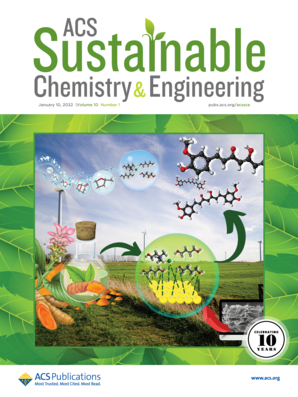
ACS Sustainable Chemistry & Engineering is a prestigious weekly peer-reviewed scientific journal published by the American Chemical Society. Dedicated to advancing the principles of green chemistry and green engineering, it covers a wide array of research topics including green chemistry, green engineering, biomass, alternative energy, and life cycle assessment.
The journal welcomes submissions in various formats, including Letters, Articles, Features, and Perspectives (Reviews), that address the challenges of sustainability in the chemical enterprise and contribute to the advancement of sustainable practices. Join us in shaping the future of sustainable chemistry and engineering.




 京公网安备 11010802042870号
京ICP备2023020795号-1
京公网安备 11010802042870号
京ICP备2023020795号-1

 分享
分享
 求助内容:
求助内容: 应助结果提醒方式:
 扫码关注我们
