Enhanced Aromatic Yield from WEEE via Ex Situ Catalytic Pyrolysis: A Comparative Study of HZSM-5, Fe/HZSM-5, and CaO Catalysts in Single and Dual Modes
{"title":"Enhanced Aromatic Yield from WEEE via Ex Situ Catalytic Pyrolysis: A Comparative Study of HZSM-5, Fe/HZSM-5, and CaO Catalysts in Single and Dual Modes","authors":"Samina Gulshan*, Hoda Shafaghat, Hanmin Yang, Panagiotis Evangelopoulos and Weihong Yang, ","doi":"10.1021/acssuschemeng.4c08759","DOIUrl":null,"url":null,"abstract":"<p >This study investigated an efficient catalyst configuration to enhance the recycling of waste electrical and electronic equipment (WEEE) fractions into aromatic hydrocarbons. Two engineered WEEE fractions, low-grade (LGEW) and medium-grade (MGEW), were used as feedstock in an ex situ catalytic pyrolysis process conducted in a two-stage lab-scale reactor. The first stage involved a batch pyrolyzer, followed by a fixed-bed catalytic reactor. The interaction between catalyst active sites and pyrolysis vapors played a key role in determining the chemical functionality of the surface intermediates. Five catalytic modes were tested: CaO, HZSM-5, Fe/HZSM-5, and a combination of CaO and HZSM-5 in mixed and separate bed configurations, with a catalyst-to-feedstock ratio of 0.15 w/w. The iron-loaded zeolite favored gas production, while CaO effectively converted acids into ketones. The dual-catalyst mixed bed of CaO and HZSM-5 exhibited the best catalytic synergy, enhancing the production of aromatic hydrocarbons and decarbonizing the process. However, metal doping increased catalyst coke formation due to more Lewis acid sites and the production of polycyclic aromatic hydrocarbons. Overall, this study provides a comparative analysis of catalyst activity during the thermochemical conversion of WEEE.</p><p >Ex situ catalytic pyrolysis of WEEE using various catalyst configurations focuses on maximizing aromatic yields, supporting efficient recycling and energy recovery.</p>","PeriodicalId":25,"journal":{"name":"ACS Sustainable Chemistry & Engineering","volume":"13 15","pages":"5493–5505 5493–5505"},"PeriodicalIF":7.3000,"publicationDate":"2025-04-09","publicationTypes":"Journal Article","fieldsOfStudy":null,"isOpenAccess":false,"openAccessPdf":"https://pubs.acs.org/doi/epdf/10.1021/acssuschemeng.4c08759","citationCount":"0","resultStr":null,"platform":"Semanticscholar","paperid":null,"PeriodicalName":"ACS Sustainable Chemistry & Engineering","FirstCategoryId":"92","ListUrlMain":"https://pubs.acs.org/doi/10.1021/acssuschemeng.4c08759","RegionNum":1,"RegionCategory":"化学","ArticlePicture":[],"TitleCN":null,"AbstractTextCN":null,"PMCID":null,"EPubDate":"","PubModel":"","JCR":"Q1","JCRName":"CHEMISTRY, MULTIDISCIPLINARY","Score":null,"Total":0}
引用次数: 0
Abstract
This study investigated an efficient catalyst configuration to enhance the recycling of waste electrical and electronic equipment (WEEE) fractions into aromatic hydrocarbons. Two engineered WEEE fractions, low-grade (LGEW) and medium-grade (MGEW), were used as feedstock in an ex situ catalytic pyrolysis process conducted in a two-stage lab-scale reactor. The first stage involved a batch pyrolyzer, followed by a fixed-bed catalytic reactor. The interaction between catalyst active sites and pyrolysis vapors played a key role in determining the chemical functionality of the surface intermediates. Five catalytic modes were tested: CaO, HZSM-5, Fe/HZSM-5, and a combination of CaO and HZSM-5 in mixed and separate bed configurations, with a catalyst-to-feedstock ratio of 0.15 w/w. The iron-loaded zeolite favored gas production, while CaO effectively converted acids into ketones. The dual-catalyst mixed bed of CaO and HZSM-5 exhibited the best catalytic synergy, enhancing the production of aromatic hydrocarbons and decarbonizing the process. However, metal doping increased catalyst coke formation due to more Lewis acid sites and the production of polycyclic aromatic hydrocarbons. Overall, this study provides a comparative analysis of catalyst activity during the thermochemical conversion of WEEE.
Ex situ catalytic pyrolysis of WEEE using various catalyst configurations focuses on maximizing aromatic yields, supporting efficient recycling and energy recovery.
期刊介绍:
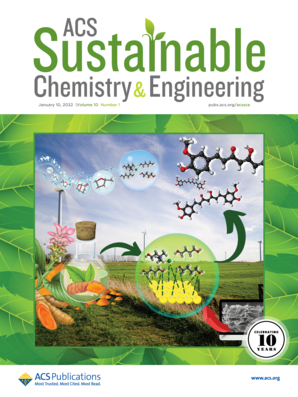
ACS Sustainable Chemistry & Engineering is a prestigious weekly peer-reviewed scientific journal published by the American Chemical Society. Dedicated to advancing the principles of green chemistry and green engineering, it covers a wide array of research topics including green chemistry, green engineering, biomass, alternative energy, and life cycle assessment.
The journal welcomes submissions in various formats, including Letters, Articles, Features, and Perspectives (Reviews), that address the challenges of sustainability in the chemical enterprise and contribute to the advancement of sustainable practices. Join us in shaping the future of sustainable chemistry and engineering.



 京公网安备 11010802042870号
京ICP备2023020795号-1
京公网安备 11010802042870号
京ICP备2023020795号-1

 分享
分享
 求助内容:
求助内容: 应助结果提醒方式:
 扫码关注我们
