{"title":"Sustainability arbitrage pricing of ESG derivatives","authors":"Takashi Kanamura","doi":"10.1016/j.irfa.2025.104177","DOIUrl":null,"url":null,"abstract":"<div><div>This study aims to propose a new model of ESG derivative pricing by introducing a new concept of sustainability arbitrage arising from ES components vertical to market risk and examine the model’s usefulness in practice by focusing on the mean-reverting properties of ESG asset prices. The ESG derivative pricing model, an extension of good-deal bounds (GDB) in an incomplete market, can overcome the arbitrariness of setting the exogenous Sharpe ratio necessary for the GDBs. The empirical studies using ESG indices of S&P, MSCI, and STOXX demonstrate that the price boundaries from sustainability arbitrage pricing of ESG futures and call options are much tighter than those from the original good-deal bounds with twice the Sharpe ratio, which is the maximum of any portfolio performance as assumed in Ross (1976) and which Shanken (1992) calls “approximate arbitrage.” Sustainability arbitrage pricing generates relatively tight price boundaries consistent with sustainable concepts. Then, empirical studies find the long-term mean of ESG indices strongly affects ES risk premiums in sustainability arbitrage pricing. The results confirm the importance of mean-reversion of ESG indices in ESG derivative pricing. Sustainability arbitrage pricing produces a positive relationship between economic and ESG value, symmetric information holding of ES risk between buyers and sellers, and reasonable upper limits in ES risk premiums. These three features of the ES risk premium may prove that sustainability arbitrage pricing is valid for ESG derivative pricing in practice. Finally, we discuss the validities of the proposed models and empirical studies using an econometric analysis, model parameter estimation using more recent extended data, and a sensitivity analysis of strike prices to call option prices.</div></div>","PeriodicalId":48226,"journal":{"name":"International Review of Financial Analysis","volume":"104 ","pages":"Article 104177"},"PeriodicalIF":9.8000,"publicationDate":"2025-08-01","publicationTypes":"Journal Article","fieldsOfStudy":null,"isOpenAccess":false,"openAccessPdf":"","citationCount":"0","resultStr":null,"platform":"Semanticscholar","paperid":null,"PeriodicalName":"International Review of Financial Analysis","FirstCategoryId":"96","ListUrlMain":"https://www.sciencedirect.com/science/article/pii/S1057521925002649","RegionNum":1,"RegionCategory":"经济学","ArticlePicture":[],"TitleCN":null,"AbstractTextCN":null,"PMCID":null,"EPubDate":"2025/4/8 0:00:00","PubModel":"Epub","JCR":"Q1","JCRName":"BUSINESS, FINANCE","Score":null,"Total":0}
引用次数: 0
Abstract
This study aims to propose a new model of ESG derivative pricing by introducing a new concept of sustainability arbitrage arising from ES components vertical to market risk and examine the model’s usefulness in practice by focusing on the mean-reverting properties of ESG asset prices. The ESG derivative pricing model, an extension of good-deal bounds (GDB) in an incomplete market, can overcome the arbitrariness of setting the exogenous Sharpe ratio necessary for the GDBs. The empirical studies using ESG indices of S&P, MSCI, and STOXX demonstrate that the price boundaries from sustainability arbitrage pricing of ESG futures and call options are much tighter than those from the original good-deal bounds with twice the Sharpe ratio, which is the maximum of any portfolio performance as assumed in Ross (1976) and which Shanken (1992) calls “approximate arbitrage.” Sustainability arbitrage pricing generates relatively tight price boundaries consistent with sustainable concepts. Then, empirical studies find the long-term mean of ESG indices strongly affects ES risk premiums in sustainability arbitrage pricing. The results confirm the importance of mean-reversion of ESG indices in ESG derivative pricing. Sustainability arbitrage pricing produces a positive relationship between economic and ESG value, symmetric information holding of ES risk between buyers and sellers, and reasonable upper limits in ES risk premiums. These three features of the ES risk premium may prove that sustainability arbitrage pricing is valid for ESG derivative pricing in practice. Finally, we discuss the validities of the proposed models and empirical studies using an econometric analysis, model parameter estimation using more recent extended data, and a sensitivity analysis of strike prices to call option prices.
期刊介绍:
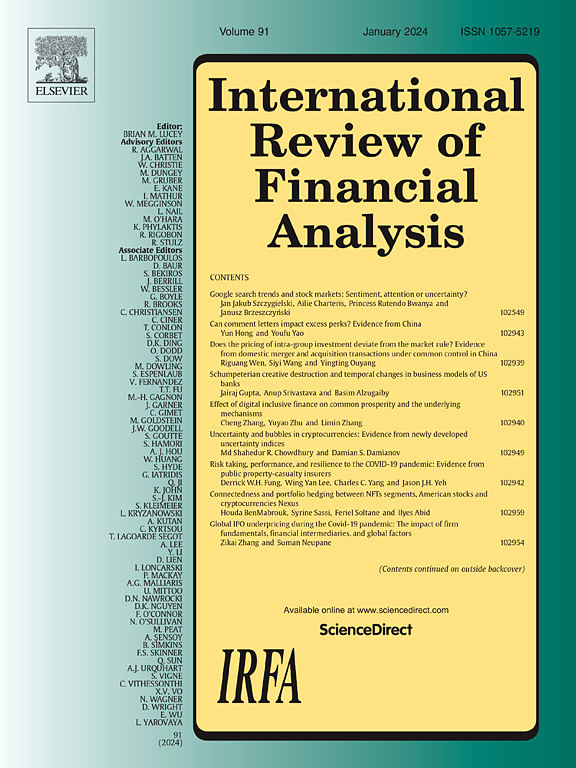
The International Review of Financial Analysis (IRFA) is an impartial refereed journal designed to serve as a platform for high-quality financial research. It welcomes a diverse range of financial research topics and maintains an unbiased selection process. While not limited to U.S.-centric subjects, IRFA, as its title suggests, is open to valuable research contributions from around the world.



 京公网安备 11010802042870号
京ICP备2023020795号-1
京公网安备 11010802042870号
京ICP备2023020795号-1

 分享
分享
 求助内容:
求助内容: 应助结果提醒方式:
 扫码关注我们
