Lei Qiao , Ge Yang , Tianjing Deng , Jiajing Chang , Xina Dou , Xiaofan Song , Xiaonan Zeng , Li Ren , Chunlan Xu
{"title":"Prophylactic supplementation with biogenic selenium nanoparticles mitigated intestinal barrier oxidative damage through suppressing epithelial-immune crosstalk with gut-on-a-chip","authors":"Lei Qiao , Ge Yang , Tianjing Deng , Jiajing Chang , Xina Dou , Xiaofan Song , Xiaonan Zeng , Li Ren , Chunlan Xu","doi":"10.1016/j.jare.2025.04.023","DOIUrl":null,"url":null,"abstract":"<div><h3>Introduction</h3><div>Biogenic selenium nanoparticles (SeNPs) have emerged as novel promising modulators of biological reactions such as redox and immune responses due to their multiple bioactivities and unique physicochemical properties.</div></div><div><h3>Objectives</h3><div>The research objective of this investigation is to explore the mechanism of uptake and metabolism of SeNPs by intestinal epithelial cells and its protective effect on intestinal barrier function with gut-on-a-chip.</div></div><div><h3>Methods</h3><div>We designed a gut-on-a-chip to replicate key structural and environmental features of the intestinal tract to investigate the effects of oxidative stress on the intestinal barrier function and immune homeostasis of the intestinal epithelial cells as well as the regulatory role of SeNPs, and verified it through mice and piglet models.</div></div><div><h3>Results</h3><div>Biogenic SeNPs can be effectively taken up by IPEC-J2 cells via clathrin- and caveolae-mediated endocytosis and further metabolized into selenocystine and trace amounts of selenite within cells, which are then incorporated into the synthesis of antioxidant selenoenzymes. A gut-on-a-chip model confirmed that Diquat-induced oxidative stress significantly impaired intestinal epithelial barrier integrity and damaged villi-like structures. In addition, the oxidative stress in IPEC-J2 cells induced activation of intestinal mucosal mast cells (MCs) to release IL-1β and TNF-α, further exacerbating oxidative stress in IPEC-J2 cells and leading to excessive ROS generation. However, SeNPs treatment increased cellular selenium content and antioxidant selenoenzyme activities, modulated AMPK/NLRP3/Nrf2 pathways, effectively alleviated oxidative stress, maintained mitochondrial homeostasis, inhibited pro-inflammatory factors expression. The mice and early-weaned piglet models further confirmed that SeNPs can increase the selenoproteins expression in the jejunum, reduce MCs activation, inhibited cell pyroptosis, and eventually exhibit an effective protective effect against intestinal barrier oxidative damage.</div></div><div><h3>Conclusions</h3><div>These results indicated that biogenic SeNPs reinforced antioxidant enzyme defenses, maintained mitochondrial homeostasis, inhibited crosstalk between inflammatory cells and intestinal epithelial cells, thereby protecting the intestinal epithelial barrier against oxidative stress damage.</div></div>","PeriodicalId":14952,"journal":{"name":"Journal of Advanced Research","volume":"80 ","pages":"Pages 197-218"},"PeriodicalIF":13.0000,"publicationDate":"2026-02-01","publicationTypes":"Journal Article","fieldsOfStudy":null,"isOpenAccess":false,"openAccessPdf":"","citationCount":"0","resultStr":null,"platform":"Semanticscholar","paperid":null,"PeriodicalName":"Journal of Advanced Research","FirstCategoryId":"103","ListUrlMain":"https://www.sciencedirect.com/science/article/pii/S209012322500267X","RegionNum":1,"RegionCategory":"综合性期刊","ArticlePicture":[],"TitleCN":null,"AbstractTextCN":null,"PMCID":null,"EPubDate":"2025/4/20 0:00:00","PubModel":"Epub","JCR":"Q1","JCRName":"MULTIDISCIPLINARY SCIENCES","Score":null,"Total":0}
引用次数: 0
Abstract
Introduction
Biogenic selenium nanoparticles (SeNPs) have emerged as novel promising modulators of biological reactions such as redox and immune responses due to their multiple bioactivities and unique physicochemical properties.
Objectives
The research objective of this investigation is to explore the mechanism of uptake and metabolism of SeNPs by intestinal epithelial cells and its protective effect on intestinal barrier function with gut-on-a-chip.
Methods
We designed a gut-on-a-chip to replicate key structural and environmental features of the intestinal tract to investigate the effects of oxidative stress on the intestinal barrier function and immune homeostasis of the intestinal epithelial cells as well as the regulatory role of SeNPs, and verified it through mice and piglet models.
Results
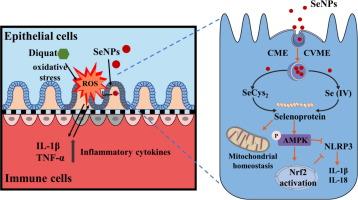
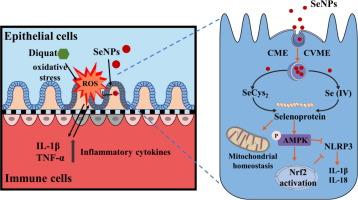
Biogenic SeNPs can be effectively taken up by IPEC-J2 cells via clathrin- and caveolae-mediated endocytosis and further metabolized into selenocystine and trace amounts of selenite within cells, which are then incorporated into the synthesis of antioxidant selenoenzymes. A gut-on-a-chip model confirmed that Diquat-induced oxidative stress significantly impaired intestinal epithelial barrier integrity and damaged villi-like structures. In addition, the oxidative stress in IPEC-J2 cells induced activation of intestinal mucosal mast cells (MCs) to release IL-1β and TNF-α, further exacerbating oxidative stress in IPEC-J2 cells and leading to excessive ROS generation. However, SeNPs treatment increased cellular selenium content and antioxidant selenoenzyme activities, modulated AMPK/NLRP3/Nrf2 pathways, effectively alleviated oxidative stress, maintained mitochondrial homeostasis, inhibited pro-inflammatory factors expression. The mice and early-weaned piglet models further confirmed that SeNPs can increase the selenoproteins expression in the jejunum, reduce MCs activation, inhibited cell pyroptosis, and eventually exhibit an effective protective effect against intestinal barrier oxidative damage.
Conclusions
These results indicated that biogenic SeNPs reinforced antioxidant enzyme defenses, maintained mitochondrial homeostasis, inhibited crosstalk between inflammatory cells and intestinal epithelial cells, thereby protecting the intestinal epithelial barrier against oxidative stress damage.
期刊介绍:
Journal of Advanced Research (J. Adv. Res.) is an applied/natural sciences, peer-reviewed journal that focuses on interdisciplinary research. The journal aims to contribute to applied research and knowledge worldwide through the publication of original and high-quality research articles in the fields of Medicine, Pharmaceutical Sciences, Dentistry, Physical Therapy, Veterinary Medicine, and Basic and Biological Sciences.
The following abstracting and indexing services cover the Journal of Advanced Research: PubMed/Medline, Essential Science Indicators, Web of Science, Scopus, PubMed Central, PubMed, Science Citation Index Expanded, Directory of Open Access Journals (DOAJ), and INSPEC.




 京公网安备 11010802042870号
京ICP备2023020795号-1
京公网安备 11010802042870号
京ICP备2023020795号-1

 分享
分享
 求助内容:
求助内容: 应助结果提醒方式:
 扫码关注我们
