Pavel M. Talianov, Daria D. Mikushina, Sergey Rzhevskiy, Konstantin V. Arabuli, Lev E. Zelenkov, Soslan Khubezhov, Lev S. Logunov, Dmitry S. Gets, Oleksii O. Peltek, Mikhail V. Zyuzin, Sergey V. Makarov
{"title":"Template-Assisted Synthesis of CsPbBr3 Nanocrystals with a Humidity-Induced Fluorescent Response: Mechanism and Sensing Applications","authors":"Pavel M. Talianov, Daria D. Mikushina, Sergey Rzhevskiy, Konstantin V. Arabuli, Lev E. Zelenkov, Soslan Khubezhov, Lev S. Logunov, Dmitry S. Gets, Oleksii O. Peltek, Mikhail V. Zyuzin, Sergey V. Makarov","doi":"10.1021/acs.jpclett.5c00151","DOIUrl":null,"url":null,"abstract":"Metal halide perovskites present a vast potential for the development of cutting-edge optoelectronic devices. However, their vulnerability to environmental factors, especially humidity, leads to widely acknowledged stability challenges. On the other hand, such a high sensitivity to water in the atmosphere is an opportunity for humidity sensing applications. In this study, we synthesize lead halide perovskite CsPbBr<sub>3</sub> nanocrystals within CaCO<sub>3</sub> templates with a porous structure (CsPbBr<sub>3</sub>@CaCO<sub>3</sub>) and investigate the mechanisms underlying the fluorescence response to changes in relative humidity. The reversible transformation of CsPbBr<sub>3</sub> to CsPb<sub>2</sub>Br<sub>5</sub> leads to the removal of surface defects, which results in an increase in photoluminescence intensity, thereby enabling the determination of ambient relative humidity levels. Moreover, we investigated a mechanism of CsPbBr<sub>3</sub> degradation driven by CO<sub>2</sub> in humid environments underlying the perovskite transformations. As a proof of concept, we developed a fluorescence-based humidity sensor based on CsPbBr<sub>3</sub>@CaCO<sub>3</sub> with rapid response and recovery times, maintaining performance across multiple cycles.","PeriodicalId":62,"journal":{"name":"The Journal of Physical Chemistry Letters","volume":"6 1","pages":""},"PeriodicalIF":4.6000,"publicationDate":"2025-04-21","publicationTypes":"Journal Article","fieldsOfStudy":null,"isOpenAccess":false,"openAccessPdf":"","citationCount":"0","resultStr":null,"platform":"Semanticscholar","paperid":null,"PeriodicalName":"The Journal of Physical Chemistry Letters","FirstCategoryId":"1","ListUrlMain":"https://doi.org/10.1021/acs.jpclett.5c00151","RegionNum":2,"RegionCategory":"化学","ArticlePicture":[],"TitleCN":null,"AbstractTextCN":null,"PMCID":null,"EPubDate":"","PubModel":"","JCR":"Q2","JCRName":"CHEMISTRY, PHYSICAL","Score":null,"Total":0}
引用次数: 0
Abstract
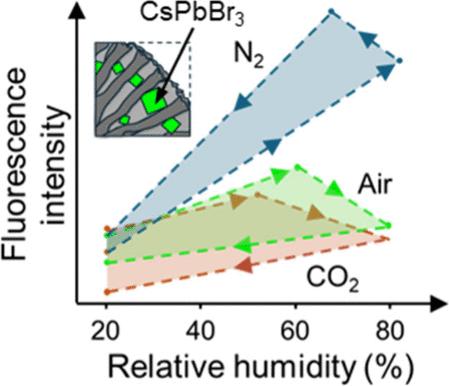
Metal halide perovskites present a vast potential for the development of cutting-edge optoelectronic devices. However, their vulnerability to environmental factors, especially humidity, leads to widely acknowledged stability challenges. On the other hand, such a high sensitivity to water in the atmosphere is an opportunity for humidity sensing applications. In this study, we synthesize lead halide perovskite CsPbBr3 nanocrystals within CaCO3 templates with a porous structure (CsPbBr3@CaCO3) and investigate the mechanisms underlying the fluorescence response to changes in relative humidity. The reversible transformation of CsPbBr3 to CsPb2Br5 leads to the removal of surface defects, which results in an increase in photoluminescence intensity, thereby enabling the determination of ambient relative humidity levels. Moreover, we investigated a mechanism of CsPbBr3 degradation driven by CO2 in humid environments underlying the perovskite transformations. As a proof of concept, we developed a fluorescence-based humidity sensor based on CsPbBr3@CaCO3 with rapid response and recovery times, maintaining performance across multiple cycles.
期刊介绍:
The Journal of Physical Chemistry (JPC) Letters is devoted to reporting new and original experimental and theoretical basic research of interest to physical chemists, biophysical chemists, chemical physicists, physicists, material scientists, and engineers. An important criterion for acceptance is that the paper reports a significant scientific advance and/or physical insight such that rapid publication is essential. Two issues of JPC Letters are published each month.



 京公网安备 11010802042870号
京ICP备2023020795号-1
京公网安备 11010802042870号
京ICP备2023020795号-1

 分享
分享
 求助内容:
求助内容: 应助结果提醒方式:
 扫码关注我们
