{"title":"Insight into the High Hole Concentration of p-Type Ga2O3 via In Situ Nitrogen Doping","authors":"Yaoping Lu, Lemin Jia, Duanyang Chen, Titao Li, Hongji Qi, Xiaorui Xu, Xiaohang Li, Minmin Zhu, Haizhong Zhang, Xiaoqiang Lu","doi":"10.1021/acs.jpclett.5c00318","DOIUrl":null,"url":null,"abstract":"The unclear p-type conduction mechanism and lack of reliable p-type Ga<sub>2</sub>O<sub>3</sub> severely hinder Ga<sub>2</sub>O<sub>3</sub>-based high-voltage electronics. Here, we demonstrate in situ nitrogen (N) doping via metal–organic chemical vapor deposition homoepitaxy using N<sub>2</sub>O as oxygen source and acceptor dopant. Structural and compositional analyses confirm efficient N incorporation (favored by N–Ga bonding) compensating residual Si/H donors without compromising crystallinity. The Ga<sub>2</sub>O<sub>3</sub>:N epilayers achieve excellent p-type performance: 1.04 × 10<sup>18</sup> cm<sup>–3</sup> hole concentration, 0.47 cm<sup>2</sup> V<sup>–1</sup> s<sup>–1</sup> mobility at room temperature, and 0.168 eV activation energy. A completely new insight into the p-type conduction mechanism in Ga<sub>2</sub>O<sub>3</sub> is introduced, focusing on the crystallographic visualization of acceptors (N<sup>2–</sup>) and holes (O<sup>–</sup>), as well as the hole excitation process. It is suggested that careful suppression of the donor compensation effect and precise control of the N chemical potential, which leads to the fabrication of trace O<sup>–</sup> species solid-dissolved within Ga<sub>2</sub>O<sub>3</sub>, are essential for achieving high-hole-concentration p-type conduction in oxides.","PeriodicalId":62,"journal":{"name":"The Journal of Physical Chemistry Letters","volume":"39 1","pages":""},"PeriodicalIF":4.6000,"publicationDate":"2025-04-21","publicationTypes":"Journal Article","fieldsOfStudy":null,"isOpenAccess":false,"openAccessPdf":"","citationCount":"0","resultStr":null,"platform":"Semanticscholar","paperid":null,"PeriodicalName":"The Journal of Physical Chemistry Letters","FirstCategoryId":"1","ListUrlMain":"https://doi.org/10.1021/acs.jpclett.5c00318","RegionNum":2,"RegionCategory":"化学","ArticlePicture":[],"TitleCN":null,"AbstractTextCN":null,"PMCID":null,"EPubDate":"","PubModel":"","JCR":"Q2","JCRName":"CHEMISTRY, PHYSICAL","Score":null,"Total":0}
引用次数: 0
Abstract
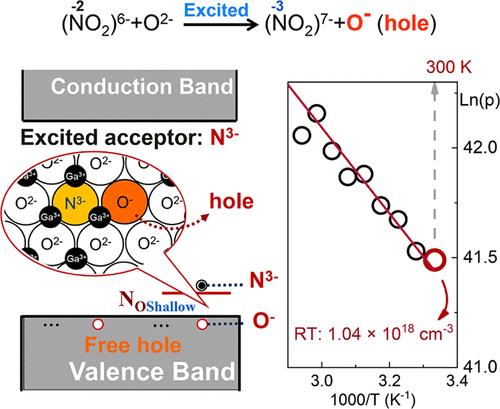
The unclear p-type conduction mechanism and lack of reliable p-type Ga2O3 severely hinder Ga2O3-based high-voltage electronics. Here, we demonstrate in situ nitrogen (N) doping via metal–organic chemical vapor deposition homoepitaxy using N2O as oxygen source and acceptor dopant. Structural and compositional analyses confirm efficient N incorporation (favored by N–Ga bonding) compensating residual Si/H donors without compromising crystallinity. The Ga2O3:N epilayers achieve excellent p-type performance: 1.04 × 1018 cm–3 hole concentration, 0.47 cm2 V–1 s–1 mobility at room temperature, and 0.168 eV activation energy. A completely new insight into the p-type conduction mechanism in Ga2O3 is introduced, focusing on the crystallographic visualization of acceptors (N2–) and holes (O–), as well as the hole excitation process. It is suggested that careful suppression of the donor compensation effect and precise control of the N chemical potential, which leads to the fabrication of trace O– species solid-dissolved within Ga2O3, are essential for achieving high-hole-concentration p-type conduction in oxides.
期刊介绍:
The Journal of Physical Chemistry (JPC) Letters is devoted to reporting new and original experimental and theoretical basic research of interest to physical chemists, biophysical chemists, chemical physicists, physicists, material scientists, and engineers. An important criterion for acceptance is that the paper reports a significant scientific advance and/or physical insight such that rapid publication is essential. Two issues of JPC Letters are published each month.



 京公网安备 11010802042870号
京ICP备2023020795号-1
京公网安备 11010802042870号
京ICP备2023020795号-1

 分享
分享
 求助内容:
求助内容: 应助结果提醒方式:
 扫码关注我们
