Teng Ji, Falong Yan, Yang Zhang, Qun Lu, Kaige Gao
{"title":"One-Dimensional Organic Lead Bromide Elastic Crystals with Strong Electron–Phonon Coupling","authors":"Teng Ji, Falong Yan, Yang Zhang, Qun Lu, Kaige Gao","doi":"10.1021/acs.jpclett.5c00753","DOIUrl":null,"url":null,"abstract":"Two novel one-dimensional (1D) lead halide elastic crystals, [Pb<sub>2</sub>Br<sub>4</sub>(DMA)<sub>2</sub>]<sub><i>n</i></sub> (<b>1</b>) (DMA = <i>N</i>,<i>N</i>-dimethylacetamide) and [Pb<sub>2</sub>Br<sub>4</sub>(DMF)<sub>2</sub>]<sub><i>n</i></sub> (<b>2</b>) (DMF = <i>N</i>,<i>N</i>-dimethylformamide), were reported. Both compounds <b>1</b> and <b>2</b> feature a neutral 1D bimetallic axis chain structure. The bending strain of compound <b>1</b> is 1.36%, higher than those of all reported 1D single-metal axis chain coordinate polymers, indicating the superior elastic properties of the 1D bimetallic axis chain polymers. Compound <b>1</b> exhibits strong red-to-near-infrared (NIR) fluorescence emission below 200 K, with an emission peak at 700 nm and a full width at half maximum (fwhm) of 200 nm, indicating strong electron–phonon coupling in compound <b>1</b>. The large Stokes shift and broad fwhm of compound <b>1</b> may be attributed to its excellent elasticity, as this elasticity allows the molecule’s self-trapped exciton state to undergo greater structural distortion. It is suggested that 1D organic lead halide elastic crystals could be promising candidates for emerging applications in efficient NIR light-emitting diodes, supercontinuum sources, and flexible NIR optical waveguides.","PeriodicalId":62,"journal":{"name":"The Journal of Physical Chemistry Letters","volume":"28 1","pages":""},"PeriodicalIF":4.6000,"publicationDate":"2025-04-21","publicationTypes":"Journal Article","fieldsOfStudy":null,"isOpenAccess":false,"openAccessPdf":"","citationCount":"0","resultStr":null,"platform":"Semanticscholar","paperid":null,"PeriodicalName":"The Journal of Physical Chemistry Letters","FirstCategoryId":"1","ListUrlMain":"https://doi.org/10.1021/acs.jpclett.5c00753","RegionNum":2,"RegionCategory":"化学","ArticlePicture":[],"TitleCN":null,"AbstractTextCN":null,"PMCID":null,"EPubDate":"","PubModel":"","JCR":"Q2","JCRName":"CHEMISTRY, PHYSICAL","Score":null,"Total":0}
引用次数: 0
Abstract
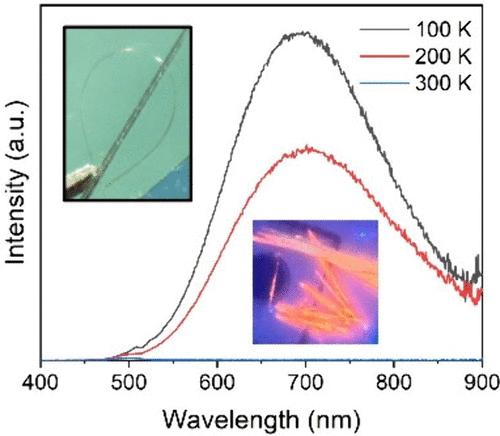
Two novel one-dimensional (1D) lead halide elastic crystals, [Pb2Br4(DMA)2]n (1) (DMA = N,N-dimethylacetamide) and [Pb2Br4(DMF)2]n (2) (DMF = N,N-dimethylformamide), were reported. Both compounds 1 and 2 feature a neutral 1D bimetallic axis chain structure. The bending strain of compound 1 is 1.36%, higher than those of all reported 1D single-metal axis chain coordinate polymers, indicating the superior elastic properties of the 1D bimetallic axis chain polymers. Compound 1 exhibits strong red-to-near-infrared (NIR) fluorescence emission below 200 K, with an emission peak at 700 nm and a full width at half maximum (fwhm) of 200 nm, indicating strong electron–phonon coupling in compound 1. The large Stokes shift and broad fwhm of compound 1 may be attributed to its excellent elasticity, as this elasticity allows the molecule’s self-trapped exciton state to undergo greater structural distortion. It is suggested that 1D organic lead halide elastic crystals could be promising candidates for emerging applications in efficient NIR light-emitting diodes, supercontinuum sources, and flexible NIR optical waveguides.
期刊介绍:
The Journal of Physical Chemistry (JPC) Letters is devoted to reporting new and original experimental and theoretical basic research of interest to physical chemists, biophysical chemists, chemical physicists, physicists, material scientists, and engineers. An important criterion for acceptance is that the paper reports a significant scientific advance and/or physical insight such that rapid publication is essential. Two issues of JPC Letters are published each month.



 京公网安备 11010802042870号
京ICP备2023020795号-1
京公网安备 11010802042870号
京ICP备2023020795号-1

 分享
分享
 求助内容:
求助内容: 应助结果提醒方式:
 扫码关注我们
