Ahmad Ostovari Moghaddam, Seyedsaeed Mehrabi-Kalajahi, Mohammad Moaddeli, Amin Abdollahzadeh, Seyed Amir Hossein Vasigh, Segun Ahemba Akaahimbe, Mahya Nangir, Rahele Fereidonnejad, Behrouz Shaabani, Mariappan Anandkumar, Sergey A. Aksenov, Andrey S. Vasenko, Andreu Cabot
{"title":"Electrocatalytic Reduction of CO2 to Long-Chain Hydrocarbons on (FeCoNiCu)3O4 Medium Entropy Oxide Nanoparticles","authors":"Ahmad Ostovari Moghaddam, Seyedsaeed Mehrabi-Kalajahi, Mohammad Moaddeli, Amin Abdollahzadeh, Seyed Amir Hossein Vasigh, Segun Ahemba Akaahimbe, Mahya Nangir, Rahele Fereidonnejad, Behrouz Shaabani, Mariappan Anandkumar, Sergey A. Aksenov, Andrey S. Vasenko, Andreu Cabot","doi":"10.1021/acs.jpclett.5c00259","DOIUrl":null,"url":null,"abstract":"Electrocatalytic CO<sub>2</sub> reduction reaction (CO<sub>2</sub>RR) to valuable multicarbon (C<sub>2+</sub>) fuels and chemicals presents a promising strategy to mitigate atmospheric CO<sub>2</sub> accumulation and promote the closure of the carbon cycle. However, significant challenges persist in achieving both high product selectivity and sustained stability in the CO<sub>2</sub>RR. In this study, the catalytic performance of (Fe,Co,Ni,Cu)<sub>3</sub>O<sub>4</sub> medium entropy oxide (MEO) nanoparticles anchored on reduced graphene oxide (rGO) was evaluated for the CO<sub>2</sub>RR. The MEO–rGO catalyst exhibited remarkable activity, achieving a cathodic current density of −0.5 A cm<sup>–2</sup> at −1.7 V, significantly outperforming bare nickel foam (−0.15 A cm<sup>–2</sup>). Additionally, the catalyst demonstrated a high total Faradaic efficiency (FE) of 60.3% for C<sub>2+</sub> products, comprising 30.6% C<sub>5</sub>H<sub>12</sub>O and 29.7% C<sub>5</sub>H<sub>10</sub>O. This exceptional selectivity toward long-chain hydrocarbons is attributed to the enhanced C–C coupling on the MEO–rGO surface, facilitated by reduced energy barriers. Density functional theory (DFT) calculations further revealed that the adsorption and reduction of CO<sub>2</sub> on the (Fe,Co,Ni,Cu)<sub>3</sub>O<sub>4</sub> MEO surface are energetically favorable processes.","PeriodicalId":62,"journal":{"name":"The Journal of Physical Chemistry Letters","volume":"33 1","pages":""},"PeriodicalIF":4.6000,"publicationDate":"2025-04-20","publicationTypes":"Journal Article","fieldsOfStudy":null,"isOpenAccess":false,"openAccessPdf":"","citationCount":"0","resultStr":null,"platform":"Semanticscholar","paperid":null,"PeriodicalName":"The Journal of Physical Chemistry Letters","FirstCategoryId":"1","ListUrlMain":"https://doi.org/10.1021/acs.jpclett.5c00259","RegionNum":2,"RegionCategory":"化学","ArticlePicture":[],"TitleCN":null,"AbstractTextCN":null,"PMCID":null,"EPubDate":"","PubModel":"","JCR":"Q2","JCRName":"CHEMISTRY, PHYSICAL","Score":null,"Total":0}
引用次数: 0
Abstract
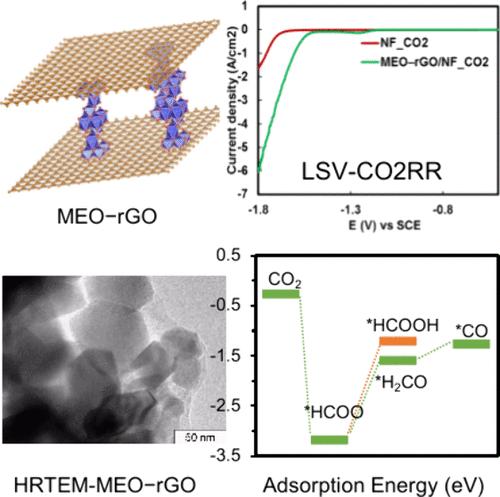
Electrocatalytic CO2 reduction reaction (CO2RR) to valuable multicarbon (C2+) fuels and chemicals presents a promising strategy to mitigate atmospheric CO2 accumulation and promote the closure of the carbon cycle. However, significant challenges persist in achieving both high product selectivity and sustained stability in the CO2RR. In this study, the catalytic performance of (Fe,Co,Ni,Cu)3O4 medium entropy oxide (MEO) nanoparticles anchored on reduced graphene oxide (rGO) was evaluated for the CO2RR. The MEO–rGO catalyst exhibited remarkable activity, achieving a cathodic current density of −0.5 A cm–2 at −1.7 V, significantly outperforming bare nickel foam (−0.15 A cm–2). Additionally, the catalyst demonstrated a high total Faradaic efficiency (FE) of 60.3% for C2+ products, comprising 30.6% C5H12O and 29.7% C5H10O. This exceptional selectivity toward long-chain hydrocarbons is attributed to the enhanced C–C coupling on the MEO–rGO surface, facilitated by reduced energy barriers. Density functional theory (DFT) calculations further revealed that the adsorption and reduction of CO2 on the (Fe,Co,Ni,Cu)3O4 MEO surface are energetically favorable processes.
电催化二氧化碳还原反应(CO2RR)对有价多碳(C2+)燃料和化学品的反应是一种很有前途的策略,可以减少大气中二氧化碳的积累,促进碳循环的闭合。然而,在CO2RR中实现高产品选择性和持续稳定性仍然存在重大挑战。在这项研究中,(Fe,Co,Ni,Cu)3O4介质熵氧化物(MEO)纳米颗粒锚定在还原氧化石墨烯(rGO)上,对CO2RR的催化性能进行了评估。MEO-rGO催化剂表现出显著的活性,在- 1.7 V时阴极电流密度为- 0.5 a cm-2,明显优于裸泡沫镍(- 0.15 a cm-2)。此外,该催化剂对C2+产物的总法拉第效率(FE)高达60.3%,其中c5h120为30.6%,c5h100为29.7%。这种对长链碳氢化合物的特殊选择性是由于MEO-rGO表面的C-C偶联增强,减少了能量势垒。密度泛函理论(DFT)计算进一步揭示了CO2在(Fe,Co,Ni,Cu)3O4 MEO表面的吸附和还原是能量有利的过程。
期刊介绍:
The Journal of Physical Chemistry (JPC) Letters is devoted to reporting new and original experimental and theoretical basic research of interest to physical chemists, biophysical chemists, chemical physicists, physicists, material scientists, and engineers. An important criterion for acceptance is that the paper reports a significant scientific advance and/or physical insight such that rapid publication is essential. Two issues of JPC Letters are published each month.



 京公网安备 11010802042870号
京ICP备2023020795号-1
京公网安备 11010802042870号
京ICP备2023020795号-1

 分享
分享
 求助内容:
求助内容: 应助结果提醒方式:
 扫码关注我们
