Ashwin Srinivasan, Nadine van Westrenen, Zachary Benmamoun, Matthew Feldman, Dongjin Seo, William A. Ducker
{"title":"Capillary Rise for Inclined Walls","authors":"Ashwin Srinivasan, Nadine van Westrenen, Zachary Benmamoun, Matthew Feldman, Dongjin Seo, William A. Ducker","doi":"10.1021/acs.jpcc.5c00130","DOIUrl":null,"url":null,"abstract":"The equilibrium height of a meniscus in a truncated trapezoidal capillary was examined by theory and experiment. Experiments focused on the limit of larger separation between the parallel sides than the sloped sides, where the capillary rise was dominated by the gap between the sloped sides. The capillary was constructed from hydrophilic borosilicate glass slides, and the liquid was pure water or ethanol–water solutions. Theoretical results were obtained by numerical solution of the Young–Laplace equation to obtain the shape of the vapor–liquid interface as a function of the height above the surrounding liquid. We found good agreement between experiment and theory for wall angles, α, in the range 0–30°, a variety of submerged depths of the capillary, and ethanol solutions in the range 0–30% v/v. Experiment and theory showed that the meniscus rose less for greater angles of the trapezoid, and the rise is much more sensitive to α than to the contact angle, θ, for the small angles explored in this work. The rise is particularly sensitive to variation of α in the range 0–4°. In general, the criterion for the meniscus to rise in a capillary with inclined sides is (θ + α)< 90°, which is in contrast to θ < 90° for a capillary with parallel walls. The inclination of the wall provides an additional control variable, and a useful variable because of the high sensitivity to α at small angles. Capillaries with angled walls occur in natural and engineered systems, such as in porous media, where many wall inclinations can be found. In addition to capillary rise, these results have potentially useful applications to wetting of patterned surfaces, and to filtration.","PeriodicalId":61,"journal":{"name":"The Journal of Physical Chemistry C","volume":"108 1","pages":""},"PeriodicalIF":3.2000,"publicationDate":"2025-04-21","publicationTypes":"Journal Article","fieldsOfStudy":null,"isOpenAccess":false,"openAccessPdf":"","citationCount":"0","resultStr":null,"platform":"Semanticscholar","paperid":null,"PeriodicalName":"The Journal of Physical Chemistry C","FirstCategoryId":"1","ListUrlMain":"https://doi.org/10.1021/acs.jpcc.5c00130","RegionNum":3,"RegionCategory":"化学","ArticlePicture":[],"TitleCN":null,"AbstractTextCN":null,"PMCID":null,"EPubDate":"","PubModel":"","JCR":"Q2","JCRName":"CHEMISTRY, PHYSICAL","Score":null,"Total":0}
引用次数: 0
Abstract
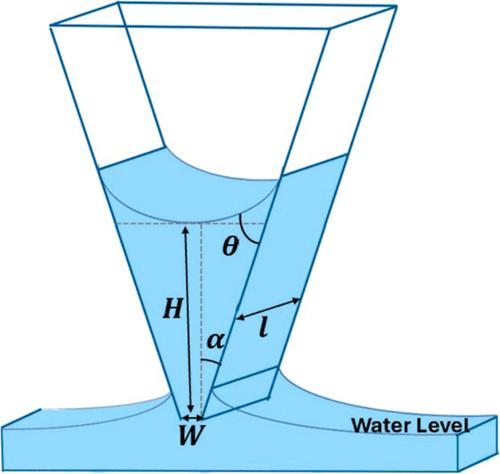
The equilibrium height of a meniscus in a truncated trapezoidal capillary was examined by theory and experiment. Experiments focused on the limit of larger separation between the parallel sides than the sloped sides, where the capillary rise was dominated by the gap between the sloped sides. The capillary was constructed from hydrophilic borosilicate glass slides, and the liquid was pure water or ethanol–water solutions. Theoretical results were obtained by numerical solution of the Young–Laplace equation to obtain the shape of the vapor–liquid interface as a function of the height above the surrounding liquid. We found good agreement between experiment and theory for wall angles, α, in the range 0–30°, a variety of submerged depths of the capillary, and ethanol solutions in the range 0–30% v/v. Experiment and theory showed that the meniscus rose less for greater angles of the trapezoid, and the rise is much more sensitive to α than to the contact angle, θ, for the small angles explored in this work. The rise is particularly sensitive to variation of α in the range 0–4°. In general, the criterion for the meniscus to rise in a capillary with inclined sides is (θ + α)< 90°, which is in contrast to θ < 90° for a capillary with parallel walls. The inclination of the wall provides an additional control variable, and a useful variable because of the high sensitivity to α at small angles. Capillaries with angled walls occur in natural and engineered systems, such as in porous media, where many wall inclinations can be found. In addition to capillary rise, these results have potentially useful applications to wetting of patterned surfaces, and to filtration.
期刊介绍:
The Journal of Physical Chemistry A/B/C is devoted to reporting new and original experimental and theoretical basic research of interest to physical chemists, biophysical chemists, and chemical physicists.



 京公网安备 11010802042870号
京ICP备2023020795号-1
京公网安备 11010802042870号
京ICP备2023020795号-1

 分享
分享
 求助内容:
求助内容: 应助结果提醒方式:
 扫码关注我们
