Edirisuriya M. Dilanga Siriwardane, Rongzhi Dong, Jianjun Hu, Deniz Çakır
{"title":"Exploiting Transformer-Based Networks and Boosting Algorithms for Ultralow Compressible Boride Design","authors":"Edirisuriya M. Dilanga Siriwardane, Rongzhi Dong, Jianjun Hu, Deniz Çakır","doi":"10.1021/acs.jpcc.5c00183","DOIUrl":null,"url":null,"abstract":"Ultralow compressible materials, which have a high bulk modulus (<i>K</i>), are invaluable in extreme conditions due to their ability to undergo significant compression without structural failure. As a large number of borides can be found with high <i>K</i>, this study develops a computational framework to scan the vast chemical space to identify the ultralow compressible borides. Transformer-based networks are helpful to generate new chemical compositions due to their self-attention mechanism, scalability, and ability to capture long-range dependencies. First, we developed a transformer-based network to generate new binary and ternary boride compositions based on the known boride compositions. Next, we trained a hybrid model based on AdaBoost and Gradient Boosting algorithms with a mean absolute error (MAE) of 14.1 GPa to scan the high <i>K</i> borides. The CALYPSO code was used to find the possible structures for those materials. After predicting <i>K</i> for a broad chemical domain, we found that Re–B and W–B systems are promising ultralow compressible materials. We then performed density functional theory (DFT) calculations to investigate the stability of the high <i>K</i> materials. Our computations suggest that W<sub>3</sub>B<sub>2</sub>, W<sub>2</sub>B<sub>3</sub>, W<sub>5</sub>VB<sub>4</sub>, and Re<sub>5</sub>CrB<sub>4</sub> materials exhibit <i>K</i> > 300 GPa with a negative formation energy and energy-above-hull less than 40 meV. These materials are mechanically and dynamically stable based on the elastic constant calculations and the phonon dispersion.","PeriodicalId":61,"journal":{"name":"The Journal of Physical Chemistry C","volume":"1 1","pages":""},"PeriodicalIF":3.2000,"publicationDate":"2025-04-21","publicationTypes":"Journal Article","fieldsOfStudy":null,"isOpenAccess":false,"openAccessPdf":"","citationCount":"0","resultStr":null,"platform":"Semanticscholar","paperid":null,"PeriodicalName":"The Journal of Physical Chemistry C","FirstCategoryId":"1","ListUrlMain":"https://doi.org/10.1021/acs.jpcc.5c00183","RegionNum":3,"RegionCategory":"化学","ArticlePicture":[],"TitleCN":null,"AbstractTextCN":null,"PMCID":null,"EPubDate":"","PubModel":"","JCR":"Q2","JCRName":"CHEMISTRY, PHYSICAL","Score":null,"Total":0}
引用次数: 0
Abstract
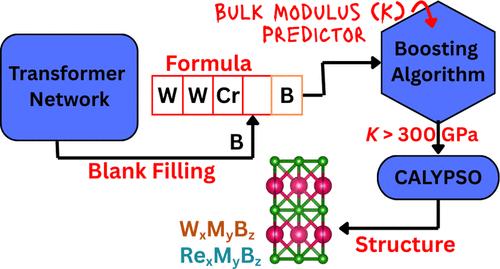
Ultralow compressible materials, which have a high bulk modulus (K), are invaluable in extreme conditions due to their ability to undergo significant compression without structural failure. As a large number of borides can be found with high K, this study develops a computational framework to scan the vast chemical space to identify the ultralow compressible borides. Transformer-based networks are helpful to generate new chemical compositions due to their self-attention mechanism, scalability, and ability to capture long-range dependencies. First, we developed a transformer-based network to generate new binary and ternary boride compositions based on the known boride compositions. Next, we trained a hybrid model based on AdaBoost and Gradient Boosting algorithms with a mean absolute error (MAE) of 14.1 GPa to scan the high K borides. The CALYPSO code was used to find the possible structures for those materials. After predicting K for a broad chemical domain, we found that Re–B and W–B systems are promising ultralow compressible materials. We then performed density functional theory (DFT) calculations to investigate the stability of the high K materials. Our computations suggest that W3B2, W2B3, W5VB4, and Re5CrB4 materials exhibit K > 300 GPa with a negative formation energy and energy-above-hull less than 40 meV. These materials are mechanically and dynamically stable based on the elastic constant calculations and the phonon dispersion.
期刊介绍:
The Journal of Physical Chemistry A/B/C is devoted to reporting new and original experimental and theoretical basic research of interest to physical chemists, biophysical chemists, and chemical physicists.



 京公网安备 11010802042870号
京ICP备2023020795号-1
京公网安备 11010802042870号
京ICP备2023020795号-1

 分享
分享
 求助内容:
求助内容: 应助结果提醒方式:
 扫码关注我们
