Gregor M. Linden , Sandra Schüttner , Nora Fribiczer , Sebastian Seiffert , Holger Frey
{"title":"Biobased oleyl glycidyl ether: copolymerization with ethylene oxide, postmodification, thermal properties, and micellization behavior†","authors":"Gregor M. Linden , Sandra Schüttner , Nora Fribiczer , Sebastian Seiffert , Holger Frey","doi":"10.1039/d5py00159e","DOIUrl":null,"url":null,"abstract":"<div><div>Oleyl glycidyl ether (OlGE) is a highly hydrophobic monomer synthesized from a biobased fatty alcohol and epichlorohydrin. When combined with hydrophilic monomethoxy poly(ethylene glycol) (mPEG) macroinitiators, well-defined, highly amphiphilic AB block copolymers are obtained <em>via</em> anionic ring-opening polymerization (<em>Đ</em> ≤ 1.08). Surprisingly, an investigation of the copolymerization kinetics of OlGE and ethylene oxide revealed an almost ideally random copolymerization (<em>r</em><sub>EO</sub> = 1.27, <em>r</em><sub>OlGE</sub> = 0.78) despite the significant structural differences. Both statistical and block copolymers were investigated regarding their behavior in aqueous solution. The block copolymers of the type mPEG-<em>b</em>-POlGE featured two distinct melting temperatures (<em>T</em><sub>m</sub>s). Besides a melting transition of mPEG, a second <em>T</em><sub>m</sub> is attributed to the crystallization of the <em>cis</em>-alkenyl side chains of the OlGE units. Varying degrees of side chain hydrogenation of the POlGE homopolymer using potassium azodicarboxylate (PADA) allowed for tailoring of the <em>T</em><sub>m</sub>. The thiol–ene click reaction permitted subsequent functionalization. This work does not merely highlight the prospect of novel polyether surfactants, it also suggests the potential of biobased long-chain polyethers for the development of drug delivery systems featuring temperature-controlled release.</div></div>","PeriodicalId":100,"journal":{"name":"Polymer Chemistry","volume":"16 21","pages":"Pages 2494-2505"},"PeriodicalIF":3.9000,"publicationDate":"2025-05-06","publicationTypes":"Journal Article","fieldsOfStudy":null,"isOpenAccess":false,"openAccessPdf":"","citationCount":"0","resultStr":null,"platform":"Semanticscholar","paperid":null,"PeriodicalName":"Polymer Chemistry","FirstCategoryId":"92","ListUrlMain":"https://www.sciencedirect.com/org/science/article/pii/S1759995425001561","RegionNum":2,"RegionCategory":"化学","ArticlePicture":[],"TitleCN":null,"AbstractTextCN":null,"PMCID":null,"EPubDate":"2025/4/21 0:00:00","PubModel":"Epub","JCR":"Q2","JCRName":"POLYMER SCIENCE","Score":null,"Total":0}
引用次数: 0
Abstract
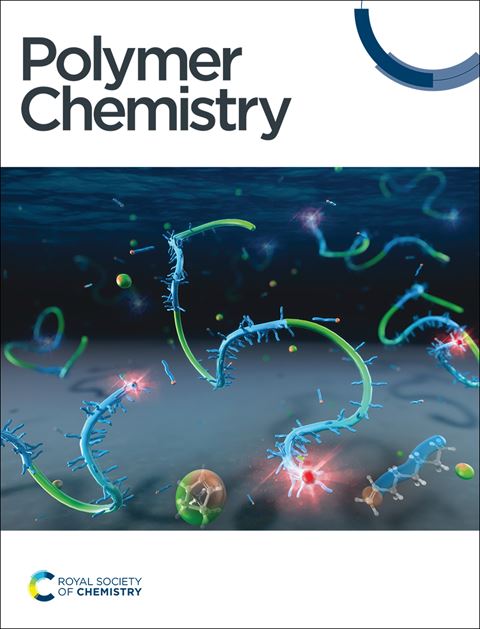
Oleyl glycidyl ether (OlGE) is a highly hydrophobic monomer synthesized from a biobased fatty alcohol and epichlorohydrin. When combined with hydrophilic monomethoxy poly(ethylene glycol) (mPEG) macroinitiators, well-defined, highly amphiphilic AB block copolymers are obtained via anionic ring-opening polymerization (Đ ≤ 1.08). Surprisingly, an investigation of the copolymerization kinetics of OlGE and ethylene oxide revealed an almost ideally random copolymerization (rEO = 1.27, rOlGE = 0.78) despite the significant structural differences. Both statistical and block copolymers were investigated regarding their behavior in aqueous solution. The block copolymers of the type mPEG-b-POlGE featured two distinct melting temperatures (Tms). Besides a melting transition of mPEG, a second Tm is attributed to the crystallization of the cis-alkenyl side chains of the OlGE units. Varying degrees of side chain hydrogenation of the POlGE homopolymer using potassium azodicarboxylate (PADA) allowed for tailoring of the Tm. The thiol–ene click reaction permitted subsequent functionalization. This work does not merely highlight the prospect of novel polyether surfactants, it also suggests the potential of biobased long-chain polyethers for the development of drug delivery systems featuring temperature-controlled release.
期刊介绍:
Polymer Chemistry welcomes submissions in all areas of polymer science that have a strong focus on macromolecular chemistry. Manuscripts may cover a broad range of fields, yet no direct application focus is required.



 京公网安备 11010802042870号
京ICP备2023020795号-1
京公网安备 11010802042870号
京ICP备2023020795号-1

 分享
分享
 求助内容:
求助内容: 应助结果提醒方式:
 扫码关注我们
