The integrity of the lipid bilayer structure is retained in natural occurring deep eutectic solvent water mixtures – a small angle X-ray scattering study
Marité Cárdenas, Victoria Ariel Bjørnestad, Kari Kristine Almåsvold Borgos and Reidar Lund
{"title":"The integrity of the lipid bilayer structure is retained in natural occurring deep eutectic solvent water mixtures – a small angle X-ray scattering study","authors":"Marité Cárdenas, Victoria Ariel Bjørnestad, Kari Kristine Almåsvold Borgos and Reidar Lund","doi":"10.1039/D5CP00331H","DOIUrl":null,"url":null,"abstract":"<p >Natural occurring deep eutectic solvents (NADES) are solvents made of metabolites occurring in living organisms, and are thought to play a special role in plants especially given that some of these metabolites exist in concentrations as high as 1 M. NADES have properties similar to ionic liquids, and have been shown to protect enzymes against loss of activity as well as proteins against thermal denaturation. Here, we explore the structure of lipid vesicles in NADES rich aqueous solutions and compare to concentrated saline aqueous solutions matching the various NADES osmolarity. The vesicle structure was analysed by small angle X-ray scattering (SAXS) and dynamic light scattering (DLS). Two types of NADES were prepared using choline chloride and glucose or maleic acid at a molar ratio of 1 : 1 giving the solvents a neutral or an acidic nature, respectively. The stability of the vesicles in the various solvents was measured against time and temperature. The results of this work demonstrate that lipid bilayers retain their structure in NADES rich aqueous solutions as compared to pure water, in contrast to high saline aqueous solutions. Moreover, the vesicles are more stable against sedimentation and aggregation in NADES than in water.</p>","PeriodicalId":99,"journal":{"name":"Physical Chemistry Chemical Physics","volume":" 19","pages":" 10248-10258"},"PeriodicalIF":2.9000,"publicationDate":"2025-04-21","publicationTypes":"Journal Article","fieldsOfStudy":null,"isOpenAccess":false,"openAccessPdf":"https://pubs.rsc.org/en/content/articlepdf/2025/cp/d5cp00331h?page=search","citationCount":"0","resultStr":null,"platform":"Semanticscholar","paperid":null,"PeriodicalName":"Physical Chemistry Chemical Physics","FirstCategoryId":"92","ListUrlMain":"https://pubs.rsc.org/en/content/articlelanding/2025/cp/d5cp00331h","RegionNum":3,"RegionCategory":"化学","ArticlePicture":[],"TitleCN":null,"AbstractTextCN":null,"PMCID":null,"EPubDate":"","PubModel":"","JCR":"Q3","JCRName":"CHEMISTRY, PHYSICAL","Score":null,"Total":0}
引用次数: 0
Abstract
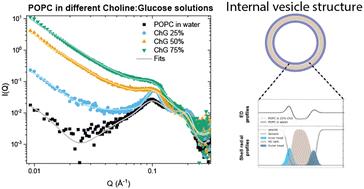
Natural occurring deep eutectic solvents (NADES) are solvents made of metabolites occurring in living organisms, and are thought to play a special role in plants especially given that some of these metabolites exist in concentrations as high as 1 M. NADES have properties similar to ionic liquids, and have been shown to protect enzymes against loss of activity as well as proteins against thermal denaturation. Here, we explore the structure of lipid vesicles in NADES rich aqueous solutions and compare to concentrated saline aqueous solutions matching the various NADES osmolarity. The vesicle structure was analysed by small angle X-ray scattering (SAXS) and dynamic light scattering (DLS). Two types of NADES were prepared using choline chloride and glucose or maleic acid at a molar ratio of 1 : 1 giving the solvents a neutral or an acidic nature, respectively. The stability of the vesicles in the various solvents was measured against time and temperature. The results of this work demonstrate that lipid bilayers retain their structure in NADES rich aqueous solutions as compared to pure water, in contrast to high saline aqueous solutions. Moreover, the vesicles are more stable against sedimentation and aggregation in NADES than in water.
期刊介绍:
Physical Chemistry Chemical Physics (PCCP) is an international journal co-owned by 19 physical chemistry and physics societies from around the world. This journal publishes original, cutting-edge research in physical chemistry, chemical physics and biophysical chemistry. To be suitable for publication in PCCP, articles must include significant innovation and/or insight into physical chemistry; this is the most important criterion that reviewers and Editors will judge against when evaluating submissions.
The journal has a broad scope and welcomes contributions spanning experiment, theory, computation and data science. Topical coverage includes spectroscopy, dynamics, kinetics, statistical mechanics, thermodynamics, electrochemistry, catalysis, surface science, quantum mechanics, quantum computing and machine learning. Interdisciplinary research areas such as polymers and soft matter, materials, nanoscience, energy, surfaces/interfaces, and biophysical chemistry are welcomed if they demonstrate significant innovation and/or insight into physical chemistry. Joined experimental/theoretical studies are particularly appreciated when complementary and based on up-to-date approaches.




 京公网安备 11010802042870号
京ICP备2023020795号-1
京公网安备 11010802042870号
京ICP备2023020795号-1

 分享
分享
 求助内容:
求助内容: 应助结果提醒方式:
 扫码关注我们
