Song Yu, Huajian Pan, Xinzhuo Zhou, Dongxiao Yang and Gang Bi
{"title":"High-efficiency CO2 electroreduction on molybdenene: a comparative study using fixed-charge and fixed-potential methods†","authors":"Song Yu, Huajian Pan, Xinzhuo Zhou, Dongxiao Yang and Gang Bi","doi":"10.1039/D4NR05394J","DOIUrl":null,"url":null,"abstract":"<p >The electrochemical conversion of renewable energy into fuels and chemicals addresses the energy crisis and environmental pollution. Current CO<small><sub>2</sub></small> reduction reaction (CO<small><sub>2</sub></small>RR) catalysts face challenges like high overpotentials and poor selectivity. Metallenes, with structural advantages and abundant active sites, offer high performance. Notably, molybdenene has excelled in nitrogen reduction reaction electrocatalysis. Herein, we employed three methods, the fixed-charge method (FCM) without and with a solvent effect and the fixed-potential method (FPM), to evaluate molybdenene for the CO<small><sub>2</sub></small>RR. This material inherently captures and activates CO<small><sub>2</sub></small> due to its surplus surface electrons, demonstrating high activity and selectivity, favoring CH<small><sub>4</sub></small> production. The optimal pathway, *CO<small><sub>2</sub></small> → *OCHO → *OCH<small><sub>2</sub></small>O → *OCH<small><sub>2</sub></small>OH → *OCH<small><sub>2</sub></small> → *OCH<small><sub>3</sub></small> → *O → *OH → *H<small><sub>2</sub></small>O, exhibits low overpotentials (0.68 V), lower than that of Cu(211). Despite identical overpotentials from the FCM with the solvent effect and the FPM, varying the potential-determining step emphasizes constant potential conditions. These findings underscore the potential of this emerging material as a high-efficiency CO<small><sub>2</sub></small>RR electrocatalyst, broadening its application prospects and encouraging further theoretical and practical exploration.</p>","PeriodicalId":92,"journal":{"name":"Nanoscale","volume":" 19","pages":" 12432-12440"},"PeriodicalIF":5.1000,"publicationDate":"2025-04-21","publicationTypes":"Journal Article","fieldsOfStudy":null,"isOpenAccess":false,"openAccessPdf":"","citationCount":"0","resultStr":null,"platform":"Semanticscholar","paperid":null,"PeriodicalName":"Nanoscale","FirstCategoryId":"88","ListUrlMain":"https://pubs.rsc.org/en/content/articlelanding/2025/nr/d4nr05394j","RegionNum":3,"RegionCategory":"材料科学","ArticlePicture":[],"TitleCN":null,"AbstractTextCN":null,"PMCID":null,"EPubDate":"","PubModel":"","JCR":"Q1","JCRName":"CHEMISTRY, MULTIDISCIPLINARY","Score":null,"Total":0}
引用次数: 0
Abstract
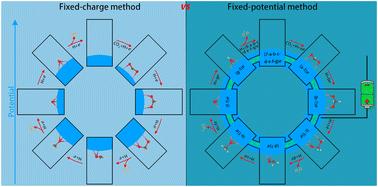
The electrochemical conversion of renewable energy into fuels and chemicals addresses the energy crisis and environmental pollution. Current CO2 reduction reaction (CO2RR) catalysts face challenges like high overpotentials and poor selectivity. Metallenes, with structural advantages and abundant active sites, offer high performance. Notably, molybdenene has excelled in nitrogen reduction reaction electrocatalysis. Herein, we employed three methods, the fixed-charge method (FCM) without and with a solvent effect and the fixed-potential method (FPM), to evaluate molybdenene for the CO2RR. This material inherently captures and activates CO2 due to its surplus surface electrons, demonstrating high activity and selectivity, favoring CH4 production. The optimal pathway, *CO2 → *OCHO → *OCH2O → *OCH2OH → *OCH2 → *OCH3 → *O → *OH → *H2O, exhibits low overpotentials (0.68 V), lower than that of Cu(211). Despite identical overpotentials from the FCM with the solvent effect and the FPM, varying the potential-determining step emphasizes constant potential conditions. These findings underscore the potential of this emerging material as a high-efficiency CO2RR electrocatalyst, broadening its application prospects and encouraging further theoretical and practical exploration.
期刊介绍:
Nanoscale is a high-impact international journal, publishing high-quality research across nanoscience and nanotechnology. Nanoscale publishes a full mix of research articles on experimental and theoretical work, including reviews, communications, and full papers.Highly interdisciplinary, this journal appeals to scientists, researchers and professionals interested in nanoscience and nanotechnology, quantum materials and quantum technology, including the areas of physics, chemistry, biology, medicine, materials, energy/environment, information technology, detection science, healthcare and drug discovery, and electronics.



 京公网安备 11010802042870号
京ICP备2023020795号-1
京公网安备 11010802042870号
京ICP备2023020795号-1

 分享
分享
 求助内容:
求助内容: 应助结果提醒方式:
 扫码关注我们
