Huaxin Liu, Fangjun Zhu, Yinghao Zhang, Yuming Liu, Yi Zhang, Wentao Deng, Guoqiang Zou, Hongshuai Hou, Xiaobo Ji
{"title":"Synergistic Regulation of Multi-Interface Chemistry by Functional Carbon Dots for High-Performance Composite Solid Electrolytes","authors":"Huaxin Liu, Fangjun Zhu, Yinghao Zhang, Yuming Liu, Yi Zhang, Wentao Deng, Guoqiang Zou, Hongshuai Hou, Xiaobo Ji","doi":"10.1002/anie.202505230","DOIUrl":null,"url":null,"abstract":"<p>Low ionic conductivity, poor mechanical strength, and unstable interface structure are still the main factors hindering the practical application of polymer solid-state lithium metal batteries (SSLMBs). In this work, we have developed a unique composite filler (LLZTOCDs) for solid polymer electrolytes to address these challenges through synergistic regulation of multi-interface chemistry. The LLZTOCDs is prepared via thermal treatment of N,S,F-codoped carbon dots (NSFCDs) and Li<sub>6.5</sub>La<sub>3</sub>Zr<sub>1.5</sub>Ta<sub>0.5</sub>O<sub>12</sub> (LLZTO) inorganic electrolyte. Here, the detrimental Li<sub>2</sub>CO<sub>3</sub> on the LLZTO surface is converted into a fast ion-conducting and an electron-insulating interlayer of LiF and Li<b><sub>3</sub></b>N, and the carbon dots self-assemble into a functional organophilic coating on the outermost layer, which acts as a bridge between the LLZTO and the polymer. This unique structure enhances the compatibility and ion-exchange kinetics between the LLZTOCDs and the polymer, significantly improving the mechanical strength and Li<b><sup>+</sup></b> transport. Additionally, the oxygen vacancies formed in situ at the LLZTOCDs interface provide an anion confinement effect, increasing lithium salt dissociation, and enhancing the Li<sup>+</sup> transference number to 0.85. Therefore, the solid battery constructed with LLZTOCDs exhibits excellent electrochemical stability, long-cycle life, and high ionic conductivity (1.96 × 10<b><sup>−</sup></b><sup>4</sup> S cm<sup>−1</sup> at 25 °C), providing a feasible strategy for practical applications.</p>","PeriodicalId":125,"journal":{"name":"Angewandte Chemie International Edition","volume":"64 26","pages":""},"PeriodicalIF":16.9000,"publicationDate":"2025-04-21","publicationTypes":"Journal Article","fieldsOfStudy":null,"isOpenAccess":false,"openAccessPdf":"","citationCount":"0","resultStr":null,"platform":"Semanticscholar","paperid":null,"PeriodicalName":"Angewandte Chemie International Edition","FirstCategoryId":"92","ListUrlMain":"https://onlinelibrary.wiley.com/doi/10.1002/anie.202505230","RegionNum":1,"RegionCategory":"化学","ArticlePicture":[],"TitleCN":null,"AbstractTextCN":null,"PMCID":null,"EPubDate":"","PubModel":"","JCR":"Q1","JCRName":"CHEMISTRY, MULTIDISCIPLINARY","Score":null,"Total":0}
引用次数: 0
Abstract
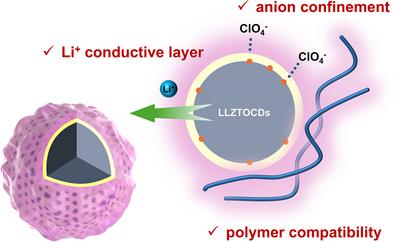
Low ionic conductivity, poor mechanical strength, and unstable interface structure are still the main factors hindering the practical application of polymer solid-state lithium metal batteries (SSLMBs). In this work, we have developed a unique composite filler (LLZTOCDs) for solid polymer electrolytes to address these challenges through synergistic regulation of multi-interface chemistry. The LLZTOCDs is prepared via thermal treatment of N,S,F-codoped carbon dots (NSFCDs) and Li6.5La3Zr1.5Ta0.5O12 (LLZTO) inorganic electrolyte. Here, the detrimental Li2CO3 on the LLZTO surface is converted into a fast ion-conducting and an electron-insulating interlayer of LiF and Li3N, and the carbon dots self-assemble into a functional organophilic coating on the outermost layer, which acts as a bridge between the LLZTO and the polymer. This unique structure enhances the compatibility and ion-exchange kinetics between the LLZTOCDs and the polymer, significantly improving the mechanical strength and Li+ transport. Additionally, the oxygen vacancies formed in situ at the LLZTOCDs interface provide an anion confinement effect, increasing lithium salt dissociation, and enhancing the Li+ transference number to 0.85. Therefore, the solid battery constructed with LLZTOCDs exhibits excellent electrochemical stability, long-cycle life, and high ionic conductivity (1.96 × 10⁻⁴ S cm−1 at 25 °C), providing a feasible strategy for practical applications.
期刊介绍:
Angewandte Chemie, a journal of the German Chemical Society (GDCh), maintains a leading position among scholarly journals in general chemistry with an impressive Impact Factor of 16.6 (2022 Journal Citation Reports, Clarivate, 2023). Published weekly in a reader-friendly format, it features new articles almost every day. Established in 1887, Angewandte Chemie is a prominent chemistry journal, offering a dynamic blend of Review-type articles, Highlights, Communications, and Research Articles on a weekly basis, making it unique in the field.



 京公网安备 11010802042870号
京ICP备2023020795号-1
京公网安备 11010802042870号
京ICP备2023020795号-1

 分享
分享
 求助内容:
求助内容: 应助结果提醒方式:
 扫码关注我们
