Modulation of Se vacancies on NiSe2@CoSe2 heterostructures to optimize ethanol electrooxidation activity for efficient hybrid water splitting and zinc–ethanol–air batteries†
{"title":"Modulation of Se vacancies on NiSe2@CoSe2 heterostructures to optimize ethanol electrooxidation activity for efficient hybrid water splitting and zinc–ethanol–air batteries†","authors":"Jiahui Li, Feilong Fang, Yongqi Jian, Zilong Li, Junmin Zhu, Fangyan Xie, Jian Chen, Yanshuo Jin, Nan Wang, Xiyun Zhang and Hui Meng","doi":"10.1039/D5QI00621J","DOIUrl":null,"url":null,"abstract":"<p >We developed a V<small><sub>Se</sub></small>-NiSe<small><sub>2</sub></small>@CoSe<small><sub>2</sub></small> catalyst to increase active sites, fine-tune the electronic structure and optimize Co 3d orbital spin states, enabling superior ethanol oxidation (1.33 V@<em>j</em><small><sub>10</sub></small>). Replacing the OER with the EOR reduced the water-splitting voltage by 200 mV, decreased reaction energy consumption by 60%, lowered the battery charging voltage by 300 mV, and increased the round-trip efficiency by 10.8%.</p>","PeriodicalId":79,"journal":{"name":"Inorganic Chemistry Frontiers","volume":" 17","pages":" 5029-5036"},"PeriodicalIF":6.4000,"publicationDate":"2025-04-21","publicationTypes":"Journal Article","fieldsOfStudy":null,"isOpenAccess":false,"openAccessPdf":"","citationCount":"0","resultStr":null,"platform":"Semanticscholar","paperid":null,"PeriodicalName":"Inorganic Chemistry Frontiers","FirstCategoryId":"92","ListUrlMain":"https://pubs.rsc.org/en/content/articlelanding/2025/qi/d5qi00621j","RegionNum":1,"RegionCategory":"化学","ArticlePicture":[],"TitleCN":null,"AbstractTextCN":null,"PMCID":null,"EPubDate":"","PubModel":"","JCR":"Q1","JCRName":"CHEMISTRY, INORGANIC & NUCLEAR","Score":null,"Total":0}
引用次数: 0
Abstract
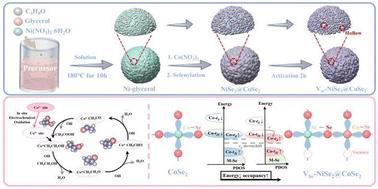
We developed a VSe-NiSe2@CoSe2 catalyst to increase active sites, fine-tune the electronic structure and optimize Co 3d orbital spin states, enabling superior ethanol oxidation (1.33 V@j10). Replacing the OER with the EOR reduced the water-splitting voltage by 200 mV, decreased reaction energy consumption by 60%, lowered the battery charging voltage by 300 mV, and increased the round-trip efficiency by 10.8%.



 京公网安备 11010802042870号
京ICP备2023020795号-1
京公网安备 11010802042870号
京ICP备2023020795号-1

 分享
分享
 求助内容:
求助内容: 应助结果提醒方式:
 扫码关注我们
