Models and Measurements Quantify Photon Recycling, Charge-Carrier Diffusion and Photon Scattering Contributions to Photoluminescence in InP Nanowire Arrays
Danielle R. Lustig, Fangqi Chen, Wentao Zhang, Olivia F. Bird, Javier Fajardo, Jr., Shane Ardo, Shu Hu, Gordana Dukovic, A. Alec Talin, Rohini Bala Chandran, Justin B. Sambur
{"title":"Models and Measurements Quantify Photon Recycling, Charge-Carrier Diffusion and Photon Scattering Contributions to Photoluminescence in InP Nanowire Arrays","authors":"Danielle R. Lustig, Fangqi Chen, Wentao Zhang, Olivia F. Bird, Javier Fajardo, Jr., Shane Ardo, Shu Hu, Gordana Dukovic, A. Alec Talin, Rohini Bala Chandran, Justin B. Sambur","doi":"10.1021/acs.jpcc.5c01618","DOIUrl":null,"url":null,"abstract":"Nanowire arrays present many unique advantages for solar-to-chemical energy conversion. One possible advantage is that photon recycling between neighboring nanowires has the potential to increase solar energy conversion efficiencies. Here, we explore three underlying mechanisms of optical and electronic coupling between neighboring nanowires─incident photon scattering, photon recycling, and charge-carrier transport from the photoexcited nanowire to the neighboring nanowire via the underlying substrate─using single nanowire-level microscopy and spectroscopy measurements. We present a comprehensive analysis of light absorption and emission of a single nanowire at open circuit, and subsequent re-absorption and re-emission by a neighboring nanowire. We developed a novel correlated single nanowire microspectroscopy and widefield imaging methodology to spatially resolve photon communication pathways between neighboring nanowires and selectively image re-emitted and reflected photons. We developed unique multiphysics models to couple wave optics and semiconductor photophysics to especially isolate contributions from photon recycling and electronic transport to photon emission from neighboring nanowires. By systematically varying the morphologies of the nanowires modeled, we identified pathways to maximize photon recycling between neighboring nanowires. We concluded that the measured photoluminescence is more strongly influenced by the diffusion of charge carriers as compared to photon recycling in materials with moderate-to-large charge-carrier mobilities (>10 cm<sup>2</sup> V<sup>–1</sup> s<sup>–1</sup>), and that photon recycling dictates photoluminescence intensity only when the charge-carrier mobility is low (<1 cm<sup>2</sup> V<sup>–1</sup> s<sup>–1</sup>). The experimental and simulation platforms developed herein for photon management strategies can be leveraged by the semiconductor photocatalysis community to enhance solar-to-chemical conversion efficiencies in semiconductor nanowire arrays.","PeriodicalId":61,"journal":{"name":"The Journal of Physical Chemistry C","volume":"34 1","pages":""},"PeriodicalIF":3.2000,"publicationDate":"2025-04-19","publicationTypes":"Journal Article","fieldsOfStudy":null,"isOpenAccess":false,"openAccessPdf":"","citationCount":"0","resultStr":null,"platform":"Semanticscholar","paperid":null,"PeriodicalName":"The Journal of Physical Chemistry C","FirstCategoryId":"1","ListUrlMain":"https://doi.org/10.1021/acs.jpcc.5c01618","RegionNum":3,"RegionCategory":"化学","ArticlePicture":[],"TitleCN":null,"AbstractTextCN":null,"PMCID":null,"EPubDate":"","PubModel":"","JCR":"Q2","JCRName":"CHEMISTRY, PHYSICAL","Score":null,"Total":0}
引用次数: 0
Abstract
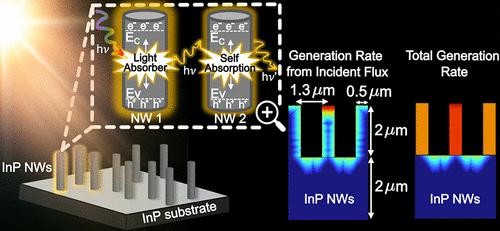
Nanowire arrays present many unique advantages for solar-to-chemical energy conversion. One possible advantage is that photon recycling between neighboring nanowires has the potential to increase solar energy conversion efficiencies. Here, we explore three underlying mechanisms of optical and electronic coupling between neighboring nanowires─incident photon scattering, photon recycling, and charge-carrier transport from the photoexcited nanowire to the neighboring nanowire via the underlying substrate─using single nanowire-level microscopy and spectroscopy measurements. We present a comprehensive analysis of light absorption and emission of a single nanowire at open circuit, and subsequent re-absorption and re-emission by a neighboring nanowire. We developed a novel correlated single nanowire microspectroscopy and widefield imaging methodology to spatially resolve photon communication pathways between neighboring nanowires and selectively image re-emitted and reflected photons. We developed unique multiphysics models to couple wave optics and semiconductor photophysics to especially isolate contributions from photon recycling and electronic transport to photon emission from neighboring nanowires. By systematically varying the morphologies of the nanowires modeled, we identified pathways to maximize photon recycling between neighboring nanowires. We concluded that the measured photoluminescence is more strongly influenced by the diffusion of charge carriers as compared to photon recycling in materials with moderate-to-large charge-carrier mobilities (>10 cm2 V–1 s–1), and that photon recycling dictates photoluminescence intensity only when the charge-carrier mobility is low (<1 cm2 V–1 s–1). The experimental and simulation platforms developed herein for photon management strategies can be leveraged by the semiconductor photocatalysis community to enhance solar-to-chemical conversion efficiencies in semiconductor nanowire arrays.
期刊介绍:
The Journal of Physical Chemistry A/B/C is devoted to reporting new and original experimental and theoretical basic research of interest to physical chemists, biophysical chemists, and chemical physicists.




 京公网安备 11010802042870号
京ICP备2023020795号-1
京公网安备 11010802042870号
京ICP备2023020795号-1

 分享
分享
 求助内容:
求助内容: 应助结果提醒方式:
 扫码关注我们
